
Large Everglades wildfire sends smoke toward Pembroke Pines as Florida tracks 61 active fires
A large wildfire burning in western Broward County, Florida, has scorched nearly 2 023 ha (5 000 acres) as of May 11, 2026, sending smoke toward the Pembroke Pines area while fire crews worked to contain the blaze. It was 20% contained after burning approximately 1 942 ha (4 800 acres), according to the Florida Forest Service (FFS).
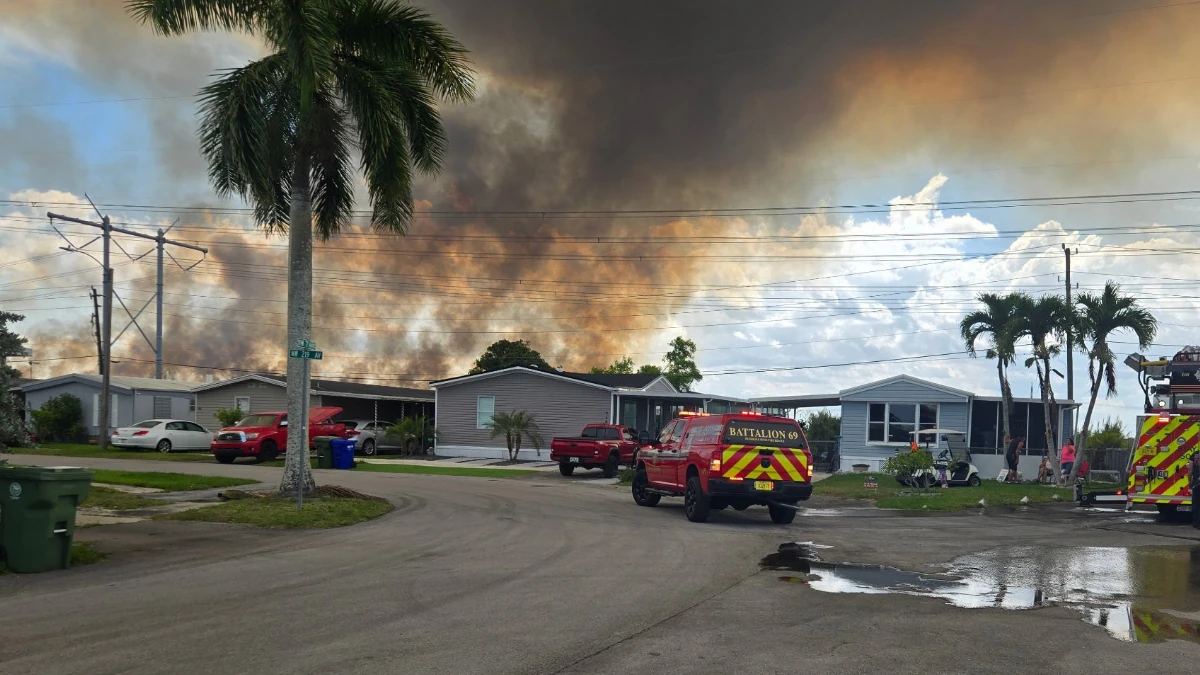
Wildfire in Broward County sending smoke to Pembroke Pines on May 10, 2026. Credit: PPPD
A large wildfire burning in western Broward County has scorched nearly 2 023 ha (5 000 acres) of land as of May 11 and is sending smoke toward the Pembroke Pines neighborhood.
The blaze, dubbed the Max Road Fire, has burned approximately 1 942 ha (4 800 acres) of land and stands at 20% containment, according to the Florida Forest Service (FFS).
“Attention residents: There is a large Everglades fire that is sending smoke toward the Holly Lake area (US-27 and Pines Boulevard). Fire-Rescue has set up along the perimeter of the Holly Lake community to monitor the fire in the event that it approaches Pembroke Pines,” said the Pembroke Pines Police Department (PPPD).
PPPD reported that drivers in the area were stopping to look at the Everglades fire, causing traffic jams along US-27 and Pines Boulevard.
“PPPD is requesting that drivers please stay out of the area; cars attempting to stop along the roadway will be directed to move,” they said.

Multiple fires continue to burn across Florida, with FFS reporting 61 active fires across the state on May 11. A wildfire in nearby Miami-Dade, dubbed the 172 Ave Fire, has burned around 85 ha (210 acres) and is 30% contained.
Multiple large wildfires continue to burn in northern parts of the state. The largest of these fires include the Railroad Fire in Putnam County at 1 941 ha (4 796 acres) and 95% containment; the Sargent Fire in Baker County at 1 025 ha (2 532 acres) and 81% containment; and the South Cana Fire in Lafayette County, which has burned 890 ha (2 200 acres) and stands at 37% containment.

Rishav Kothari is Editor-in-Chief of The Watchers, where he runs the newsroom and covers earthquakes, volcanoes, severe weather and space weather.
Published in the last 24 hours
- In September 1859, a solar storm lit up the night sky so brightly that gold miners in the Rocky Mountains woke up after midnight and started cooking breakfast, convinced the aurora glowing over their camp was the sunrise Epicenter
- A patch of warm Pacific water that could become the strongest El Niño in more than 70 years sits thousands of miles from any American town, yet it is already the main reason NOAA expects a wetter winter across the South and a milder one across the North
