
Record rainfall brings ancient Lake Manly back to life in Death Valley
Record-breaking rainfall in Death Valley, California, has brought the ancient lake to life, according to satellite images issued by NASA on December 12, 2025.
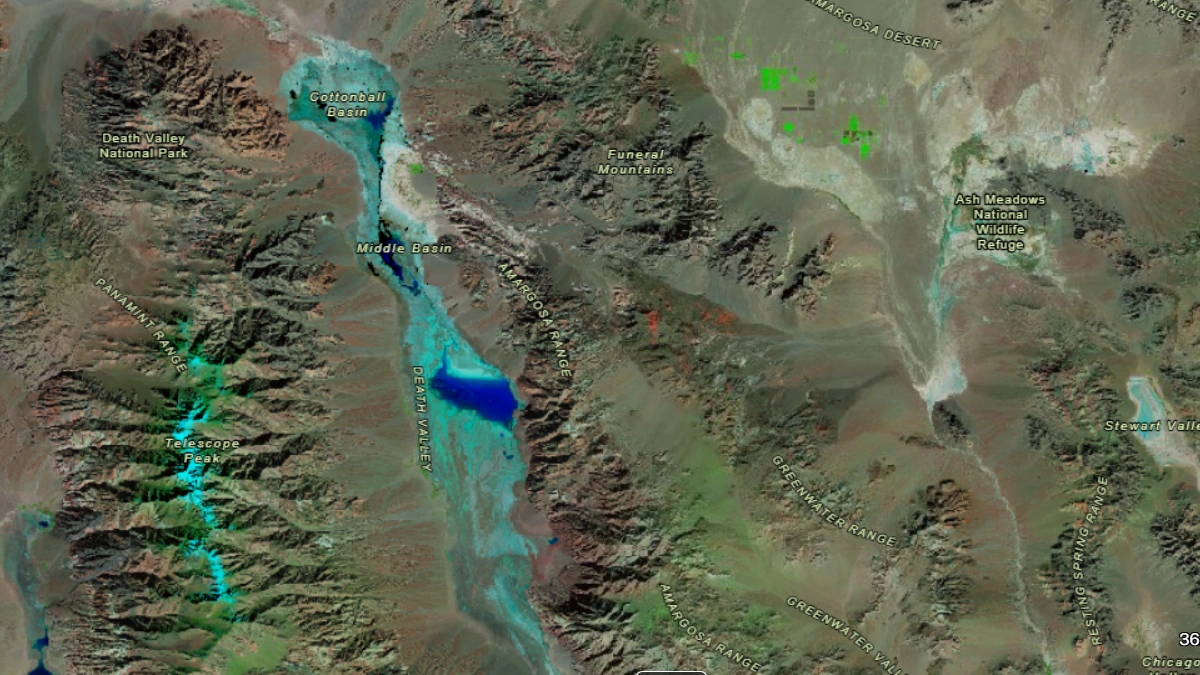
Satellite image of Badwater Basin on November 7, 2025. Credit: NASA Worldview
Death Valley National Park recorded 44.7 mm (1.76 inches) of rainfall in November, breaking the previous record of 4.32 mm (1.7 inches) for the month set in 1923. Around 6.1 mm (2.4 inches) of rainfall fell between September and November, which also made this the wettest fall for the park on record.
While this may not seem like a large total, keep in mind that Death Valley is one of the driest and hottest places on the planet, receiving an average of around 60.9 mm (2.2 inches) of rain annually. These relatively small totals prompted multiple road closures and flooding incidents in the Death Valley National Park.
Between 128 000 and 186 000 years ago, when ice covered the Sierra Nevada, a lake 161 km (100 miles) long and 183 m (600 feet) deep sat in eastern California in what is now the Mojave Desert. As the climate warmed and the ice retreated, the lake dried up, leaving a white salt pan in its place.
This is what becomes Lake Manly, when water fills up parts of Badwater Basin during rare heavy rain events like the one in November. It is also the lowest point in North America, sitting 86 m (282 feet) below sea level.
The lake is pretty small and will most likely disappear soon as the water evaporates in the extreme Death Valley heat.
It last made an appearance in 2023 after Hurricane Hilary, which weakened to a post-tropical low before reaching Southern California, dumping 55.9 mm (2.2 inches) of rain on the park and filling the basin.
The satellite image of the lake was declared the Image of the Week by NASA Worldview on December 12.

Rishav Kothari is Editor-in-Chief of The Watchers, where he runs the newsroom and covers earthquakes, volcanoes, severe weather and space weather.
Published in the last 24 hours
- A South Dakota man put the widest and heaviest hailstone on US record in his freezer, and a power cut melted part of it before NOAA measured it at 8 inches across and nearly 2 pounds in 2010 Epicenter
- Black kites and brown falcons in northern Australia have been seen snatching smoldering sticks from wildfires, flying them into unburned grass and dropping them, starting new fires that send lizards, rodents and insects running straight toward the waiting birds Epicenter
- A levee protecting a highway north of San Francisco is pocked with animal burrows and only 3 feet wide in places, and a report warns this winter's El Niño could push water over the top Epicenter
- In January 2000, chunks of ice weighing up to 6 pounds fell out of clear blue skies over Spain for 10 days. One smashed through a car windshield, and scientists still can’t fully explain where they came from Epicenter
