
Smoke from Canadian wildfires triggers air quality alerts in 10 U.S. states, 2025 nears second-worst year
Air quality alerts were issued across the U.S. Midwest and Northeast on Monday, August 4, 2025, and remain in effect on August 5, as over 740 wildfires burning across Canada send smoke to the U.S. Currently, 2025 is the third most destructive year for wildfires in Canada and is likely to become the second most destructive year surpassing 1989 when wildfires burned over 17 million acres of land across the country.
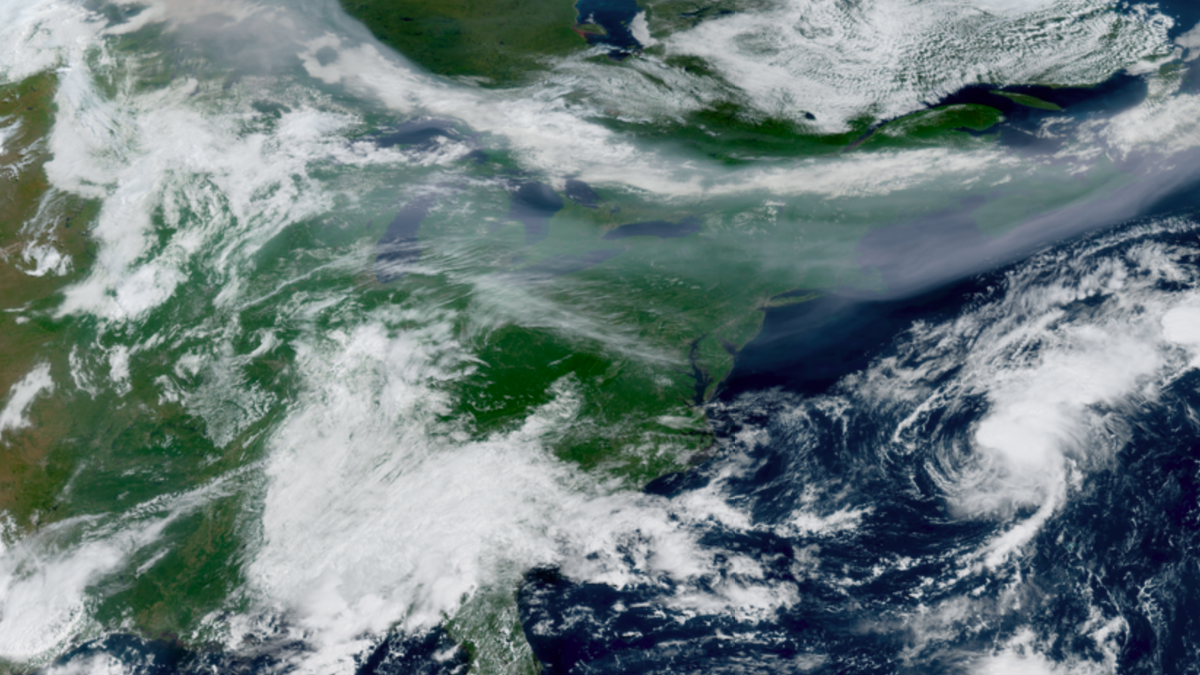
Smoke from wildfires in Canada seen over central Canada, the Great Lakes and the northeastern United States. Credit: NOAA/GOES-East
Wildfires burning across northern Manitoba and Saskatchewan are sending smoke across the Great Lakes region and the northeastern United States. Air quality alerts were issued on Monday, August 4, across 10 states from Minnesota to Connecticut.
Red flag warnings remain in effect for parts of Nevada, Utah, Colorado, and Wyoming due to very dry conditions, low humidity, and gusty winds. Existing fires may undergo rapid development, and new fires could ignite quickly under these conditions.
Air quality index (AQI) readings exceeding 150 were recorded in several cities — levels considered unhealthy even for individuals not classified as sensitive groups.
.@NOAA's #GOESEast tracked the thick gray #smoke from Canadian #wildfires that brought hazy skies and #AirQuality alerts across the Upper Midwest and Northeast yesterday. More alerts are in effect today as smoke continues to bring the threat for unhealthy air quality across… pic.twitter.com/0okwz8Qld9
— NOAA Satellites (@NOAASatellites) August 5, 2025
At sunset smoke becomes very visible on the GOESS satellite. Amazing how red the sun was tonight before it became obscured at times. #mewx #nhwx pic.twitter.com/BmgNysaIyi
— NWS Gray (@NWSGray) August 3, 2025
Hazy skies were also observed in East Coast cities, including New York City, on Monday. As of early afternoon, AQI sensors in the area registered values below 100, indicating air pollution levels that are not considered harmful to the general population.
The most hazardous smoke concentrations were reported in small Canadian towns located near the wildfires. These areas are experiencing air quality levels classified as hazardous, posing a serious risk to human health.
Further from the source of the fires, a dense haze reached surface levels early Monday, resulting in unhealthy air quality from Milwaukee to Buffalo, including major cities such as Detroit and Toronto.
There are numerous #wildfires burning across the Southwest this week, and @NOAA's #GOESWest has been tracking the heat and smoke from the blazes. In this imagery from this morning, the satellite is monitoring the #MonroeCanyonFire, #WhiteSageFire and the #DragonBravoFire, among… pic.twitter.com/RA6CHtDlEV
— NOAA Satellites (@NOAASatellites) July 30, 2025
In May 2025, numerous #wildfires burned across Canada and the #smoke travelled thousands of miles from the fire source impacting U.S. air quality. Learn how NOAA help track and #forecast smoke that can impact your #airquality: https://t.co/fogPUiWKkv pic.twitter.com/YccdzgcsVA
— NOAA Satellites (@NOAASatellites) July 28, 2025
As of Tuesday, 741 wildfires were actively burning across Canada, with 304 classified as out of control. The fires have scorched more than 6.4 million ha (16 million acres) of land, making 2025 the third most destructive wildfire year in Canadian history since records began in 1983.
With only 400 000 ha (1 million acres) remaining to surpass the second-most destructive year, 2025 is likely to overtake that position.
Currently, the second place is held by 1989 with over 6.8 million ha (17 million acres) of land being burned, while the most destructive year remains 2023, during which wildfires burned more than 16.9 million ha (42 million acres) across Canada.

I am an Assistant Editor and Severe Weather & Science Journalist at The Watchers, specializing in real-time severe weather coverage, geophysical event reporting, and research-driven scientific analysis. You can reach me at rishav(at)watchers(.)news.

Commenting rules and guidelines
We value the thoughts and opinions of our readers and welcome healthy discussions on our website. In order to maintain a respectful and positive community, we ask that all commenters follow these rules.