
Hayli Gubbi’s first eruption in at least 12 000 years grounds flights across India and the Middle East
Ash and sulfur dioxide released by Ethiopia’s Hayli Gubbi volcano, erupting for the first time in at least 12 000 years, disrupted regional air travel between November 24 and 25, 2025. The eruption produced a high-altitude plume reaching about 14 km (46 000 feet) above sea level, spreading eastward across the Arabian Peninsula and India, where aviation authorities issued advisories, rerouted long-haul flights, and temporarily suspended operations on affected routes.
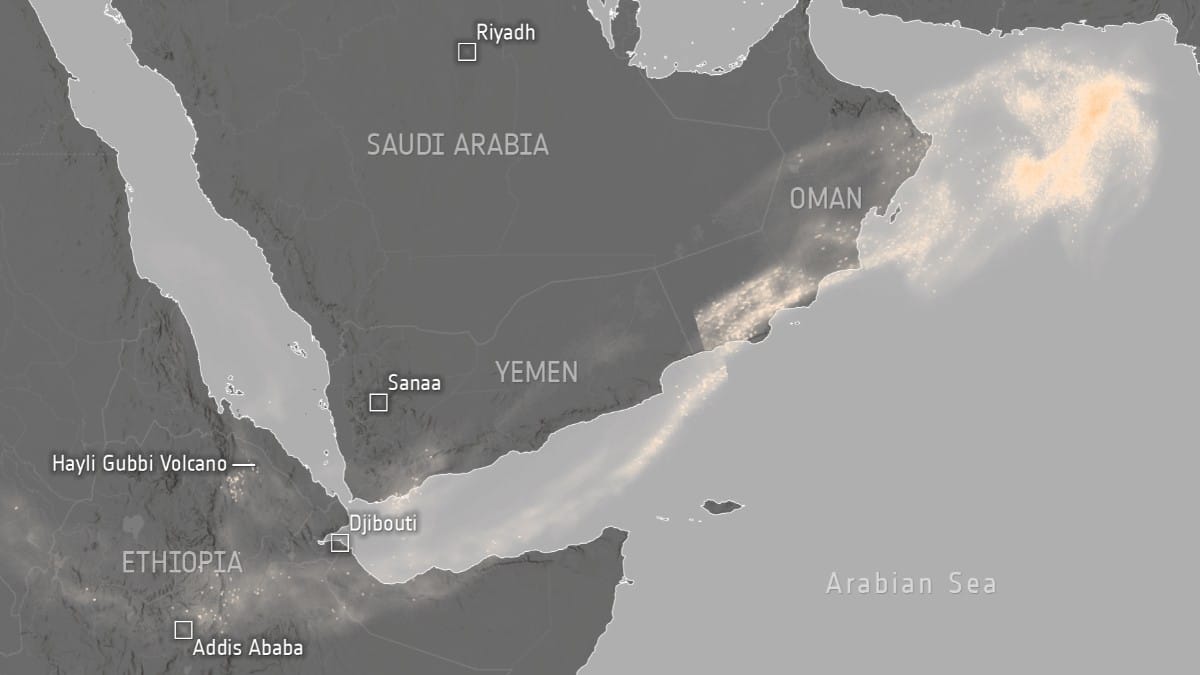
Sulfur dioxide plume produced by eruption at Hayli Gubbi volcano, Ethiopia on November 24, 2025. Credit: ESA
Volcanic ash from Hayli Gubbi’s eruption on November 23 continued to drift eastward over the following two days, disrupting air corridors linking Africa, the Middle East, and South Asia.
According to the Toulouse Volcanic Ash Advisory Centre (VAAC), the eruption began at 08:30 UTC on November 23 and produced a column up to about 13.7 km (45 000 feet). The eruption ceased later the same day, but residual ash remained detectable across multiple atmospheric layers.
Toulouse VAAC’s final advisory, issued at 21:30 UTC on November 24, placed the ash cloud between 6.7 km and 13.7 km (22 000–45 000 feet) moving east at approximately 167 km/h. Responsibility for tracking the event was then transferred to the Tokyo VAAC.
VAAC Tokyo’s subsequent bulletins between 03:00 UTC and 09:00 UTC on November 25 confirmed continuing transport of volcanic ash between 9 and 10.5 km (29 500–34 400 feet), with the plume extending from the Arabian Sea to the Bay of Bengal. Himawari-8 imagery showed the eastern edge of the plume advancing toward western China and Southeast Asia before gradual dissipation.
The movement of ash through upper-tropospheric flight corridors caused widespread disruption to commercial aviation. India’s Directorate General of Civil Aviation (DGCA) issued a safety advisory, warning of potential engine abrasion and advising operators to modify flight plans to avoid the affected airspace.
Air India cancelled 11 flights for the technical inspection of aircraft that may have encountered the ash cloud. Akasa Air suspended services to Jeddah, Kuwait, and Abu Dhabi. Vistara and IndiGo reported rerouting and delays for multiple domestic and international services connecting Mumbai, Delhi, and Bengaluru.
Meteorological analysis from the India Meteorological Department (IMD) indicated the highest ash concentration between 9 km and 11 km (29 500–36 000 feet), corresponding to the standard cruise levels of transcontinental flights linking Europe, the Middle East, and Southeast Asia. Indian media reported that at least 28 flights were rerouted on November 25.
Airlines based in the Gulf region, including carriers operating from Muscat, Jeddah, and Dubai, adjusted altitude levels to avoid contaminated airways. The Oman Meteorology Department confirmed a thin layer of SO2 haze aloft but no surface deposition.
No domestic flight restrictions were reported within Ethiopia.

The ash trajectory, from Afar Region toward the Arabian Sea, marks the first recorded aviation-scale hazard originating from this segment of the East African Rift.
By midday on November 25, VAAC Tokyo reported that ash above 10.6 km (35 000 feet) was no longer visible in satellite imagery. Remaining lower-level material, below 9 km (29 500 feet), was dispersing east at about 150 km/h, with full dispersion expected within 24 hours.
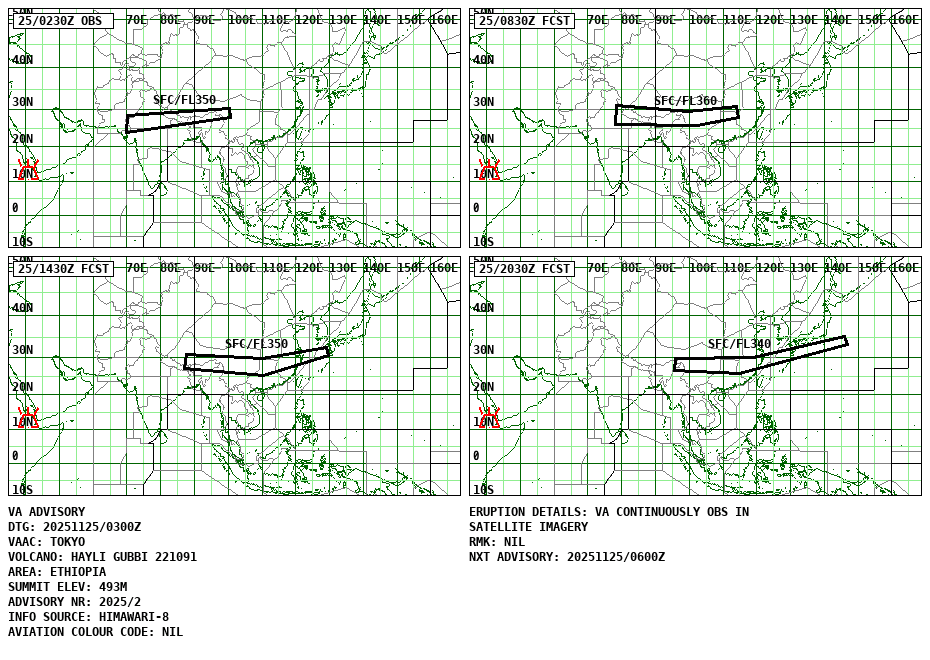
International air traffic along the affected corridors gradually returned to normal routing later that day. Authorities in India and the Gulf maintained limited advisories for haze and potential visibility reduction until residual SO2 was no longer detectable at flight levels.

Hayli Gubbi volcano lies in Ethiopia’s Afar Rift Volcanic Province, forming the southernmost edifice of the Erta Ale Range. It is a shield-type structure built primarily of basaltic lava flows, overlain by younger fissure-fed flows extending northward.

Before the 2025 eruption, Hayli Gubbi had no confirmed Holocene activity. Sedimentary and lava sequences indicate its last eruptive phase occurred more than 8 000 years ago.
The summit hosts a small symmetrical scoria cone with a crater about 200 m (650 feet) wide, displaying weak fumarolic emissions observed intermittently over recent decades. Open fissures extend for more than 10 km (6.2 miles), linking to the axial rift system that also feeds Erta Ale, one of Africa’s most continuously active volcanoes.

I'm a dedicated researcher, journalist, and editor at The Watchers. With over 20 years of experience in the media industry, I specialize in hard science news, focusing on extreme weather, seismic and volcanic activity, space weather, and astronomy, including near-Earth objects and planetary defense strategies. You can reach me at teo /at/ watchers.news.

Commenting rules and guidelines
We value the thoughts and opinions of our readers and welcome healthy discussions on our website. In order to maintain a respectful and positive community, we ask that all commenters follow these rules.