
M7.8 earthquake off southern Mindanao leaves at least 94 dead, Philippines
A major earthquake registered by the USGS as M7.8 struck Mindanao, Philippines, at 23:37 UTC on June 7, 2026 (07:37 LT on June 8). The agency is reporting a depth of 55.2 km (34.3 miles). EMSC is reporting M7.8 at a depth of 45 km (28 miles). Tsunami waves up to 1 m (3.3 feet) were observed in Sultan Kudarat and Sarangani.
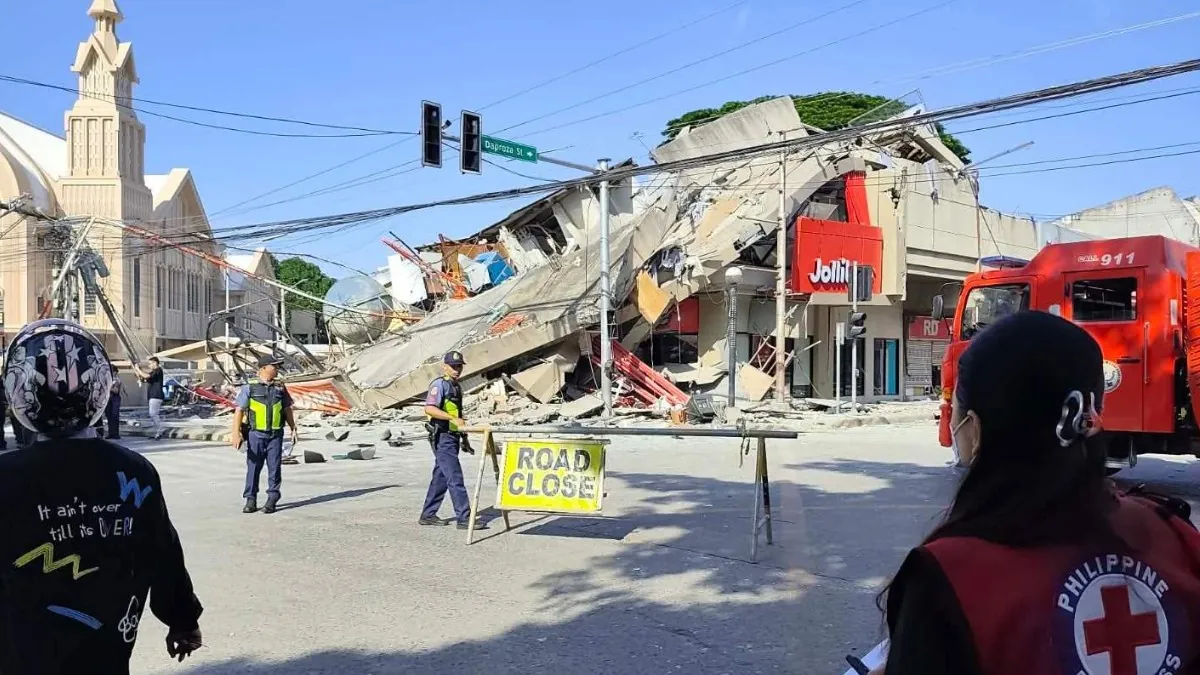
Damage caused by M7.8 earthquake in Philippines on June 7, 2026. Credit: IFRC Asia Pacific
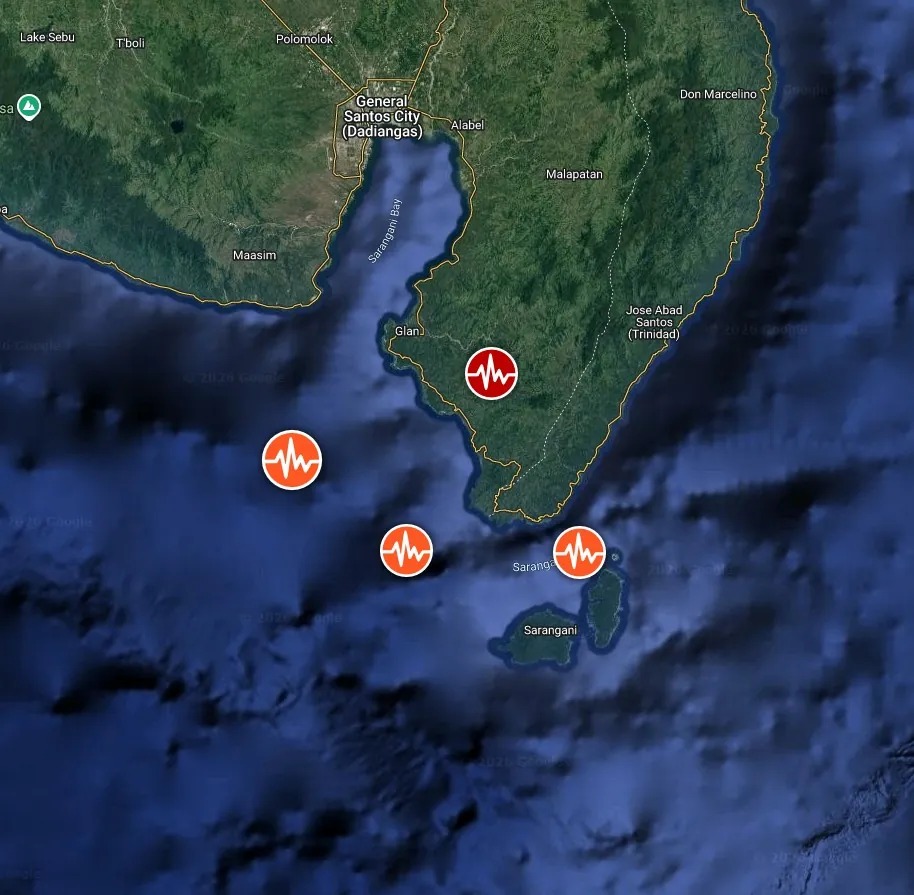
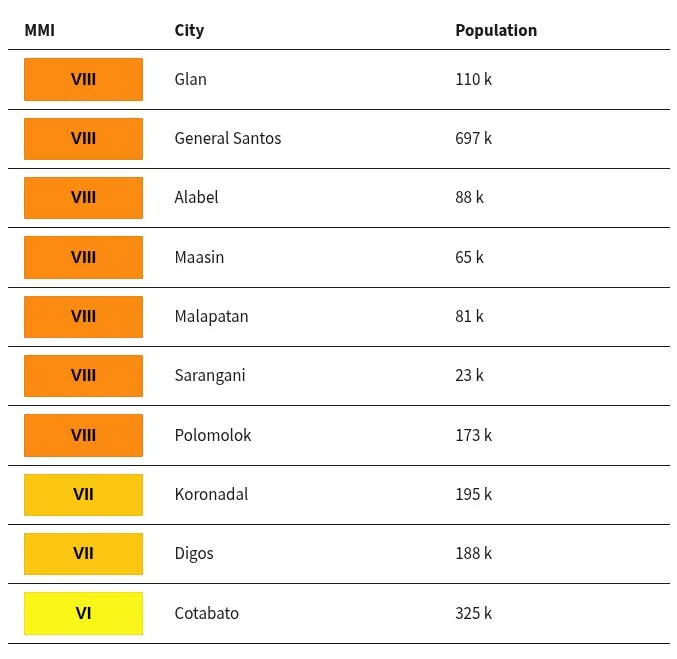
The epicenter was located 27 km (17 miles) SW of Kablalan (population 2 698), 31 km (19 miles) SW of Glan (population 24 256), 50 km (31 miles) SSW of Malapatan (population 19 439), 56 km (35 miles) SSW of Lun Pequeño (population 11 541), and 104 km (65 miles) SSE of Koronadal (population 195 398), Philippines.
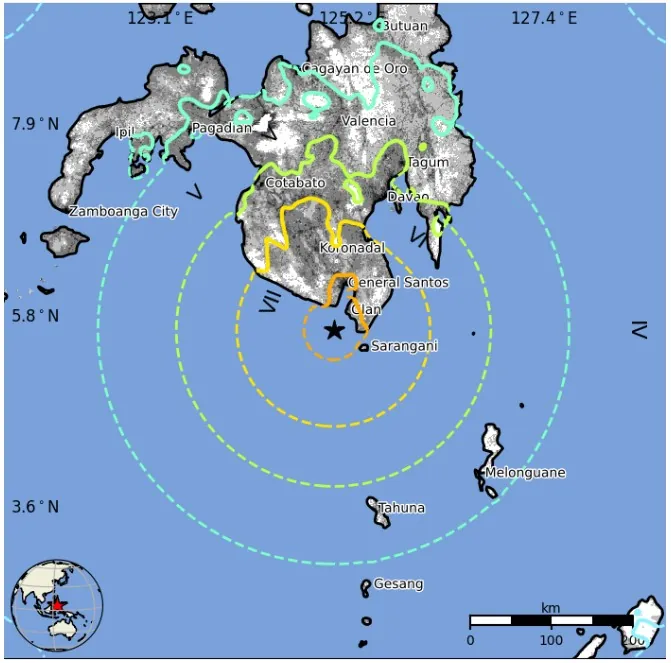
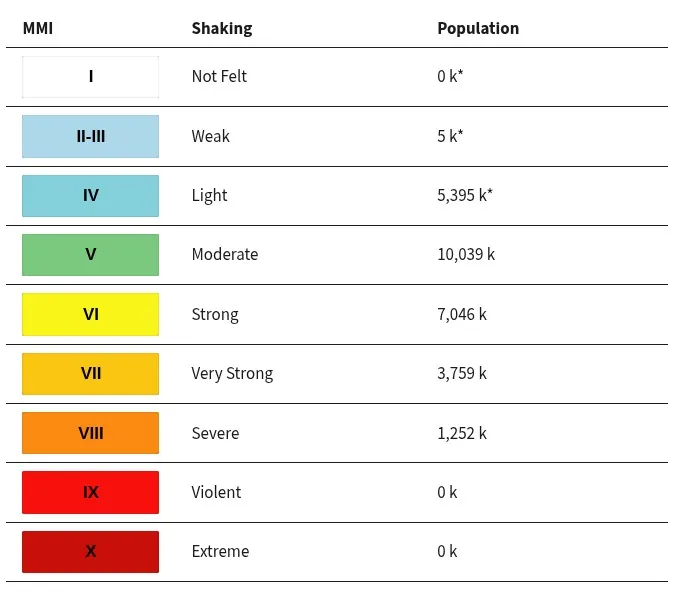
1.2 million people are estimated to have felt severe shaking, 3.76 million very strong, 7 million strong, and 10 million moderate.
NWS PTWC reported that tsunami waves reaching 1 to 3 m (3.3 to 9.8 feet) above tide level are possible along some coasts of the Philippines. Tsunami waves reaching 0.3 to 1 m (1 to 3 feet) above tide level are possible for some coasts of Indonesia and Malaysia.
Philippine President Ferdinand Marcos Jr. asked people in areas vulnerable to tsunamis to immediately go to higher ground. Indonesian and Malaysian authorities also issued warnings to their nearby coastal areas, AP reported.
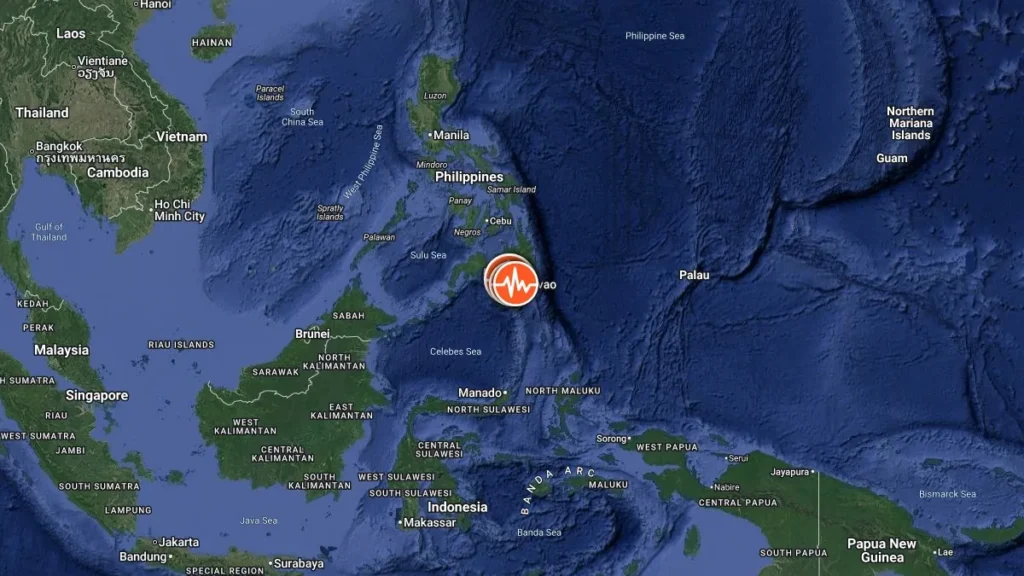
The USGS issued a Yellow alert for shaking-related fatalities and an Orange alert for economic losses. Some casualties are possible. Significant damage is likely and the disaster is potentially widespread. Estimated economic losses are less than 1% of GDP of the Philippines. Past events with this alert level have required a regional or national level response.
Overall, the population in this region resides in structures that are a mix of vulnerable and earthquake-resistant construction. The predominant vulnerable building types are reinforced concrete and heavy wood frame construction.
Recent earthquakes in this area have caused secondary hazards such as tsunamis and landslides that might have contributed to losses.
Liquefaction triggered by this earthquake is estimated to be extensive in severity and/or spatial extent. The number of people living near areas that could have produced liquefaction in this earthquake is extensive.
Landslides are expected to be significant in number and/or spatial extent. The number of people living near areas that could have produced landslides in this earthquake is significant.
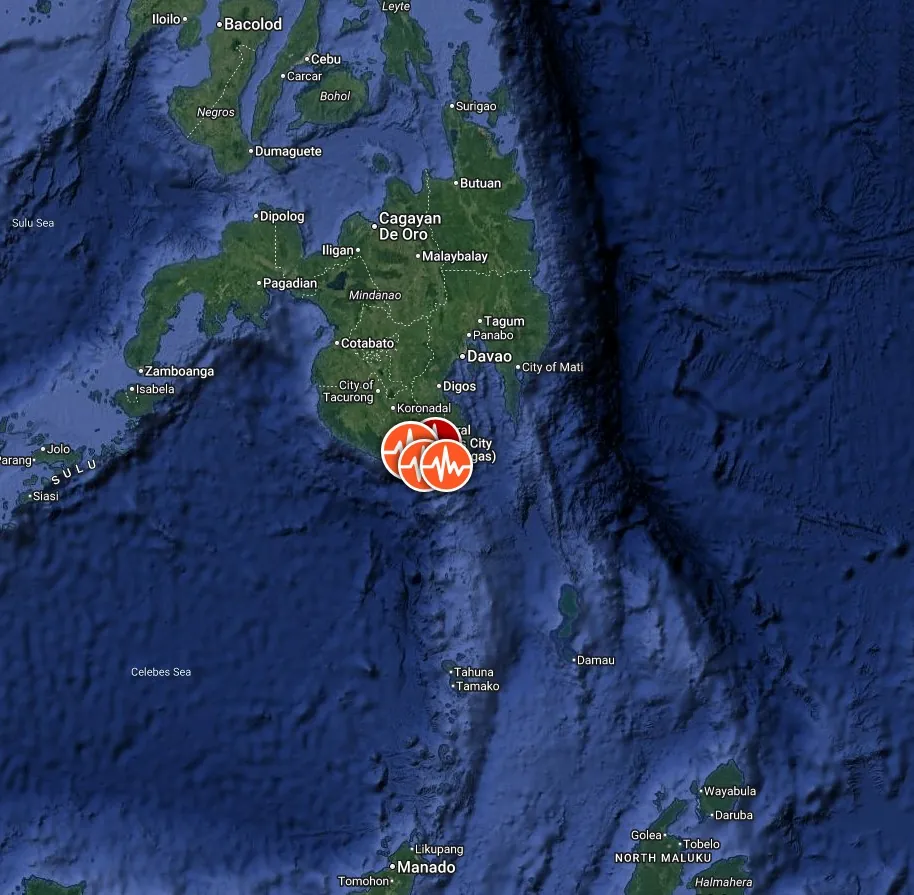
The Philippine Institute of Volcanology and Seismology (PHIVOLCS) Director Teresito Bacolcol said land-based tsunami watch stations observed 1 m (3 feet) waves in Sultan Kudarat and Sarangani, with smaller waves observed in at least one other province.
President Marcos said a tsunami warning was in effect across several coastal provinces in Mindanao and directed government agencies to act immediately. The Office of Civil Defense and the National Disaster Risk Reduction and Management Council began coordinating disaster response and monitoring, while the Department of Social Welfare and Development was directed to pre-position relief goods and prepare evacuation centers.
In Sarangani province, local disaster chief Rene Punzalan said power and telecommunications were down, school classes were suspended, and a damage assessment was underway.
Damage reports were concentrated in the General Santos-Sarangani area during the first hours after the quake. Reuters reported falling furniture, damaged televisions and appliances, aftershocks, and residents leaving homes in General Santos, while the city disaster office said authorities were assessing reports of damage and some injuries.
AP reported that at least one small commercial building in General Santos partly collapsed, with staff from a DZRH provincial branch reaching the ground floor without injuries. Debris also fell from other buildings and damaged tricycle taxis parked below, while it remained unclear whether other people were trapped in the rubble.
In Maasim, Sarangani, disaster chief Arlene Hollero said that evacuations were underway in coastal villages. No casualties had been reported there at the time of his interview with Reuters. Hollero said water had receded shortly after the quake, a bridge had suffered cracks, and a shrine with a large cross had collapsed. In Alabel town, police chief Benjie Ancheta said the police building had cracks after the quake struck during a flag-raising ceremony, where some people fainted.
Authorities are verifying reports of at least five deaths in General Santos, Reuters reported at 02:52 UTC on June 8, citing Agripino Dacera, the city’s disaster management chief.
The Philippine government ordered the suspension of classes at all levels across affected areas of Mindanao until further notice. The Department of Public Works and Highways was placed on standby to assess roads, bridges, and critical infrastructure and to clear routes needed for rescue and relief operations.
Strong aftershocks followed the mainshock, including M6.1 at 23:48 UTC, M6.0 at 23:49 UTC, and M6.5 at 00:55 UTC on June 8.
The USGS said the quake resulted from thrust faulting. Its depth and moment‑tensor estimate indicate the event occurred within the complex zone of active deformation associated with westward subduction of the Philippine plate beneath the Sunda plate.
Northeastern Indonesia and southern Philippines are characterized by complex tectonics in which motions of numerous small plates accommodate the large-scale convergence between the Philippine Sea and Sunda plates. At the location of this earthquake, the Philippine plate is moving towards the Sunda at 7.3 cm (2.8 inches) per year.
While commonly plotted as points on maps, earthquakes of this size are more appropriately described as slip distributed over a broad fault area. Thrust faulting events of the size of the June 7 earthquake are typically about 120 x 50 km in size (65 x 31 miles).
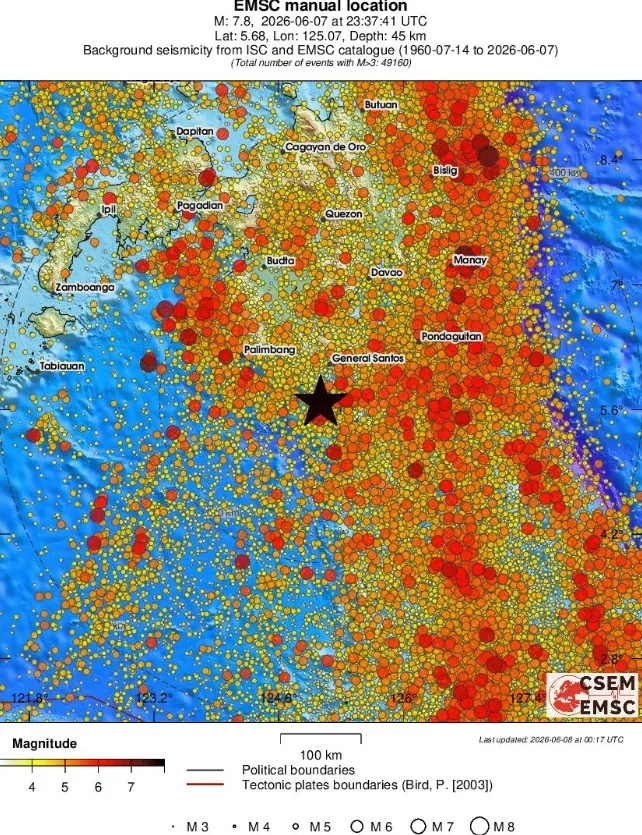
The region around this earthquake is tectonically active, and large earthquakes are common. Since 1900, 35 earthquakes with a magnitude of M 7+ have occurred within 300 km (180 miles) of this event. The largest was a magnitude 8.3 earthquake on August 15, 1918, that occurred 118 km (73 miles) to the west. More recently, a magnitude 7.4 event occurred on October 10, 2025, 260 km (161 miles) to the northeast, resulting in more than ten fatalities.
Updates
12:40 UTC, June 8
At least 32 people were reported dead and 134 injured by 12:00 UTC, while Philippine authorities continued verifying preliminary casualty figures.
Damage was concentrated in General Santos, where shops and buildings were damaged, some structures were reduced to rubble, a hospital was evacuated due to cracks, and one Notre Dame of Dadiangas University building collapsed while empty. AP reported a deadly landslide in Glan, Sarangani, tsunami damage in at least one coastal village, and at least 12 people missing in General Santos.
13:00 UTC, June 9
At least 37 people were killed, nearly 500 injured, and more than 32 000 displaced, with only 4 people still officially missing as rescue teams continued searching collapsed and heavily damaged buildings in General Santos.
Damage includes about 2 500 houses and 117 government buildings and facilities across several provinces, collapsed buildings and debris in General Santos, toppled power lines and utility posts, damaged schools and hospitals, and continued disruption at General Santos International Airport, where 63 domestic flights were canceled except humanitarian missions.
Tsunami waves up to 1.4 m (4.6 feet) were measured in the Philippines.
08:40 UTC, June 10
The death toll has risen to at least 45 people by June 10. The number of injured stands at 487, while 17 people are still missing. NDRRMC figures place 33 deaths in Soccsksargen and 12 in Davao Region.
Damage has expanded to more than 3 100 houses, key roads and bridges, over 100 government buildings, General Santos International Airport, and thousands of public school buildings, while more than 25 000 people were displaced.
PHIVOLCS recorded more than 2 000 aftershocks by the morning of June 10, complicating rescue work in General Santos, where responders had to withdraw from a damaged grocery during a strong aftershock.
12:10 UTC, June 11
At least 47 people were reported dead on June 11, 688 were injured, and 31–33 were missing. Most deaths were caused by falling debris, collapsed buildings, landslides, and sea incidents.
NDRRMC figures show 346 449 people were affected and more than 45 000 displaced across several southern Philippine regions.
Damage now includes more than 12 600 houses, 45 road sections, and 8 bridges. An airport in Soccsksargen is non-operational, while landslides have isolated villages in Glan, Sarangani, where local officials requested helicopter delivery of food and water.
10:10 UTC, June 14
The death toll has risen to at least 61 on June 13, the number of injured to 1 403 injured, and there are still 40 people missing.
OCD figures show about 724 000 people / 173 000 families affected, and around 10 000 people displaced. Damage has expanded to PHP 1 billion in infrastructure losses, 725 damaged infrastructure assets, about 9 900 houses destroyed, and 44 100 houses partially damaged, while 13 municipalities and cities are under a state of calamity.
PHIVOLCS reported 5 200 aftershocks, including 76 felt.
Relief and shelter operations continue across General Santos, Sarangani, Davao Occidental, and nearby affected areas.
16:45 UTC, July 14
The latest consolidated government figures show that the June 8 earthquake left 94 people dead, 1 316 injured and 18 missing as of July 8, according to NDRRMC Situation Report No. 28.
A separate DSWD assessment dated July 13 reported 391 891 families, or 1 655 313 people, affected across 650 barangays in the Zamboanga Peninsula, Davao Region, Soccsksargen and BARMM. Of these, 95 629 people remained displaced, including 31 463 in 80 evacuation centers and 64 166 staying with relatives or friends.
The DSWD recorded 121 426 damaged houses, including 19 305 destroyed and 102 121 partially damaged.
Damage to public infrastructure had reached approximately PHP 1.4 billion in the latest NDRRMC accounting. This figure does not include an estimated PHP 70 billion in losses to marine resources caused by coastal uplift in Sarangani Bay.
Government agencies and local authorities had provided PHP 1.157 billion in humanitarian assistance by July 13. Relief, temporary shelter, food distribution, and protection operations remained active across the worst-affected parts of Sarangani, General Santos City, South Cotabato, and Davao Occidental.
Estimated population exposure to earthquake shaking
Selected cities exposed
Regional seismicity
References:
1 M7.8 earthquake Mindanao, Philippines – USGS – June 7, 2026
2 M7.8 earthquake Mindanao, Philippines – EMSC – June 7, 2026

I'm a dedicated researcher, journalist, and editor at The Watchers. With over 20 years of experience in the media industry, I specialize in hard science news, focusing on extreme weather, seismic and volcanic activity, space weather, and astronomy, including near-Earth objects and planetary defense strategies. You can reach me at teo /at/ watchers.news.

Commenting rules and guidelines
We value the thoughts and opinions of our readers and welcome healthy discussions on our website. In order to maintain a respectful and positive community, we ask that all commenters follow these rules.