
Rare octuplet waterspouts form over the Baltic Sea between Poland and Denmark
A rare waterspout outbreak occurred over the Baltic Sea on August 21, 2025, producing at least 12 waterspouts off the coast of Poland and 8 off Denmark, including one sighting of eight simultaneous funnels.
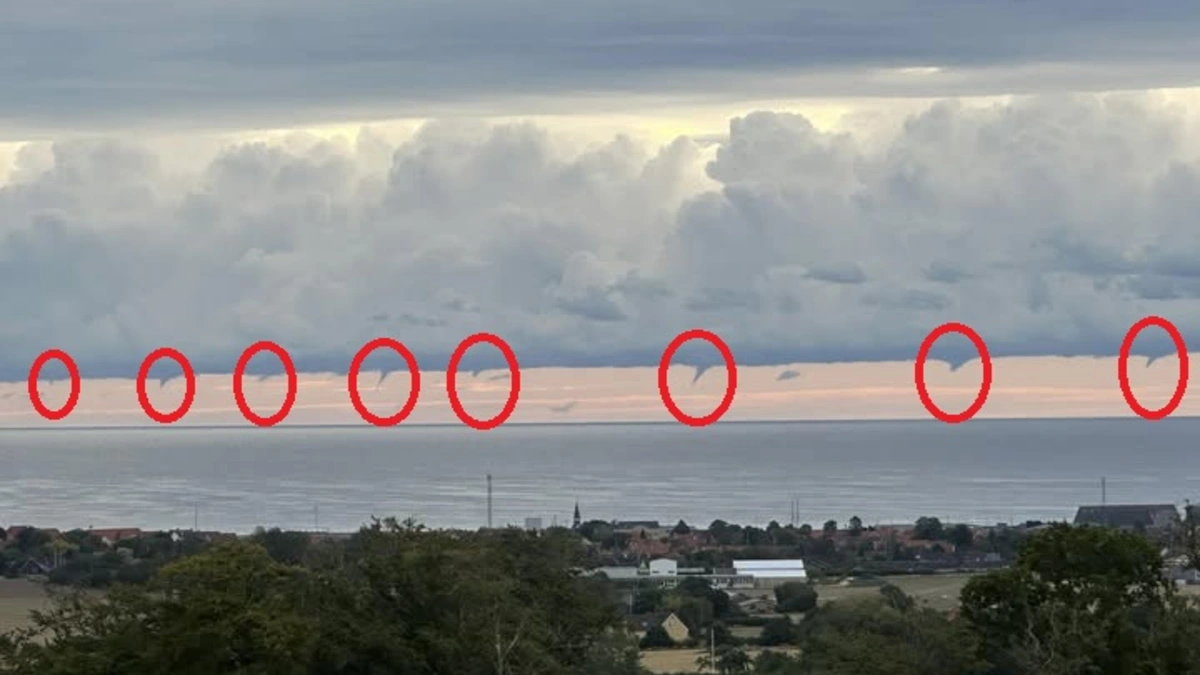
Rare octuplet waterspouts spotted over the Baltic Sea on August 21, 2025. Credit: ICWR
A rare outbreak of waterspouts was reported over the Baltic Sea on August 21, with multiple independent observers documenting at least 20 funnels. Reports confirmed 12 waterspouts off Poland and 8 off Denmark, including a Danish observer who recorded eight aligned simultaneously.
The event was documented by the International Centre for Waterspout Research (ICWR), which tracks and archives global waterspout activity. Such outbreaks are defined as days with multiple waterspouts in close temporal and spatial proximity.
Climatological classifications distinguish between small outbreaks (5–9 waterspouts per day), moderate outbreaks (10–19), and large outbreaks (20 or more). Based on available data, the August 21 event qualifies as a large outbreak.
Waterspouts are rotating columns of air and spray that develop over bodies of water, often under cumulus cloud bases. Most are non-tornadic, short-lived, and typically last several minutes, though simultaneous clusters such as this outbreak are considerably less common.
They form when warm surface waters interact with cooler air masses aloft, creating strong vertical instability, low-level wind shear, and convergence zones conducive to vortex formation.
The Baltic Sea is a known location for summer waterspout activity, with a seasonal maximum in July and August. Previous research has shown that favorable conditions arise when sea surface temperatures remain elevated while upper-air troughs transport cooler air masses into the region.
While individual waterspouts are relatively common, simultaneous alignments of six or more are rarely documented in Europe.

I’m a science journalist and researcher at The Watchers, contributing to the Epicenter edition, where I cover peer-reviewed scientific research and emerging discoveries across Earth and space sciences. With a background in astronomy and a passion for environmental science, I’ve worked in shark and coral conservation in Fiji, conducting reef and shark-behavior research, contributing to mangrove restoration, and earning PADI Open Water and Coral Reef Certifications. I bring a blend of scientific rigor and storytelling to illuminate the discoveries shaping our planet and beyond.

Commenting rules and guidelines
We value the thoughts and opinions of our readers and welcome healthy discussions on our website. In order to maintain a respectful and positive community, we ask that all commenters follow these rules.