
Shallowing of Caspian Sea disrupts ports and threatens biodiversity, Azerbaijan
Rapid declines in the Caspian Sea water level are disrupting port operations, reducing oil shipments, and threatening seal and sturgeon populations, Azerbaijani officials reported on August 21, 2025.
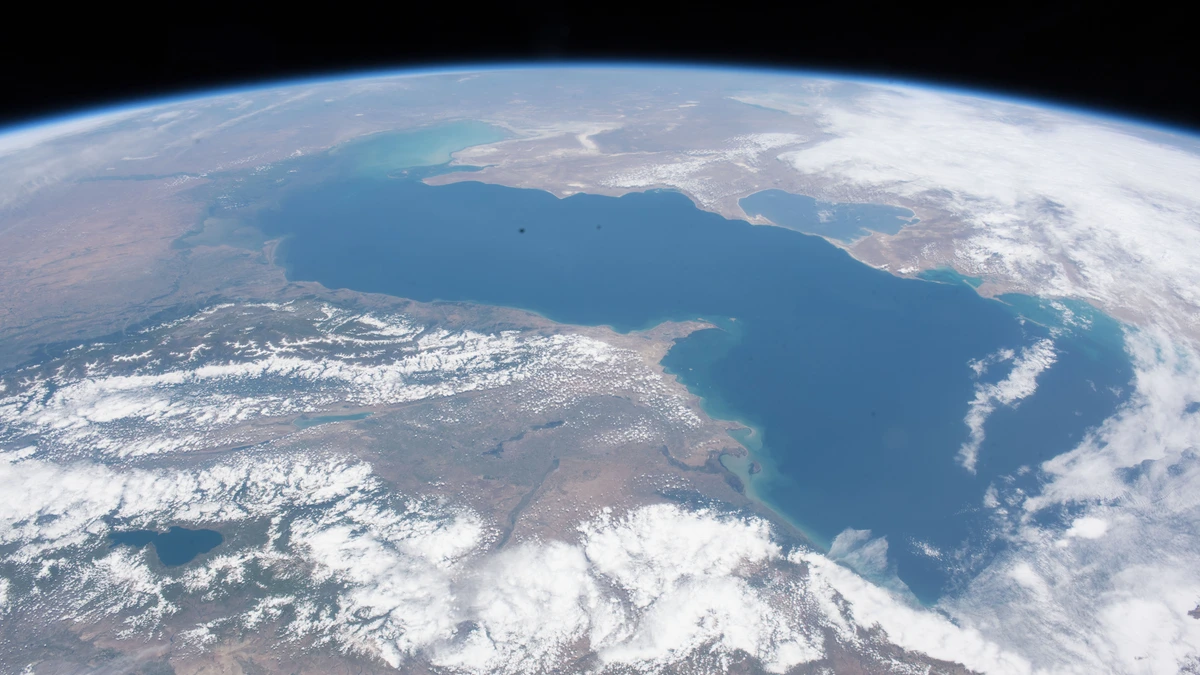
The Caspian Sea taken from the International Space Station, seen from the southwest. Credit: Earth Science and Remote Sensing Unit, NASA Johnson Space Center
The Caspian Sea, the world’s largest enclosed saltwater lake, has been losing water at an accelerating rate.
Azerbaijan’s Deputy Ecology Minister Rauf Hajiyev said the sea level fell 0.93 m (3 feet) in the past five years, 1.5 m (5 feet) in the past decade, and 2.5 m (8 feet) over the past 30 years. Current decline rates are estimated at 20–30 cm (8–12 inches) per year.
Hajiyev said the retreat of the coastline is disrupting economic activity and affecting the lives of millions in the region. About 4 million people live along Azerbaijan’s Caspian shoreline and around 15 million across the Caspian basin.
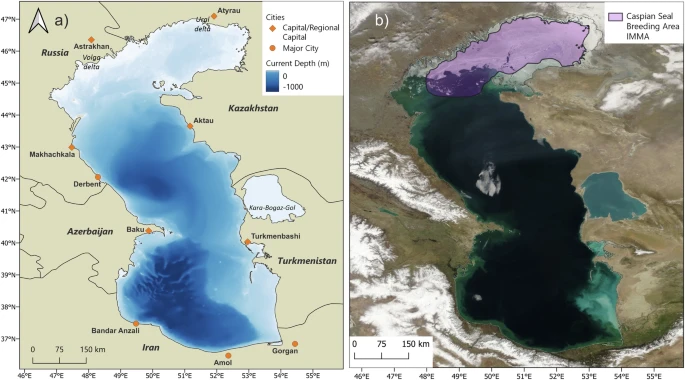
The decline is affecting port operations in Baku. Eldar Salakhov, director of the Baku International Sea Port, reported that oil shipments through the Dubendi terminal dropped to 810 000 tons in the first half of 2025, compared with 880 000 tons a year earlier.
He said dredging works are needed to maintain access for large tankers. More than 250 000 m³ (8.8 million ft³) of dredging was completed in 2024, and a new vessel, Engineer Soltan Kazimov, capable of deepening channels to 18 m (59 feet), will soon begin operations.
Hajiyev warned that shrinking waters are destroying wetlands and reed beds, threatening species such as sturgeon and Caspian seals. Sturgeon are losing up to 45% of their seasonal habitats, while seals risk losing most of their breeding grounds if water levels continue to fall.
Azerbaijan blames both climate change and Russian dam construction on the Volga River, which provides about 80% of the Caspian inflow, for the decline.
Despite strained relations, Azerbaijan and Russia established a joint working group in April 2025 and plan to approve a monitoring and response program in September.

I’m a science journalist and researcher at The Watchers, contributing to the Epicenter edition, where I cover peer-reviewed scientific research and emerging discoveries across Earth and space sciences. With a background in astronomy and a passion for environmental science, I’ve worked in shark and coral conservation in Fiji, conducting reef and shark-behavior research, contributing to mangrove restoration, and earning PADI Open Water and Coral Reef Certifications. I bring a blend of scientific rigor and storytelling to illuminate the discoveries shaping our planet and beyond.

A slow motion disaster that flies under radar, lake balkhash is more vitally urgent to Kazakhstan, totally dry Aral sea has international attention, Russia is disinterested in Caspian. Even Azerbaijan is relatively unaffected being in deep water, but persisting declining trend already affects shallow areas and if this continues big engineering required, expensive with ecology side effects that has large potential to pollute Caspian with invasive species.