
Glacial lake outburst flood destroys over 300 homes in Gilgit-Baltistan, Pakistan
A glacial lake outburst flood (GLOF) destroyed over 300 homes in Pakistan’s Gilgit-Baltistan region on August 22, 2025, forcing hundreds to evacuate in at least six villages.
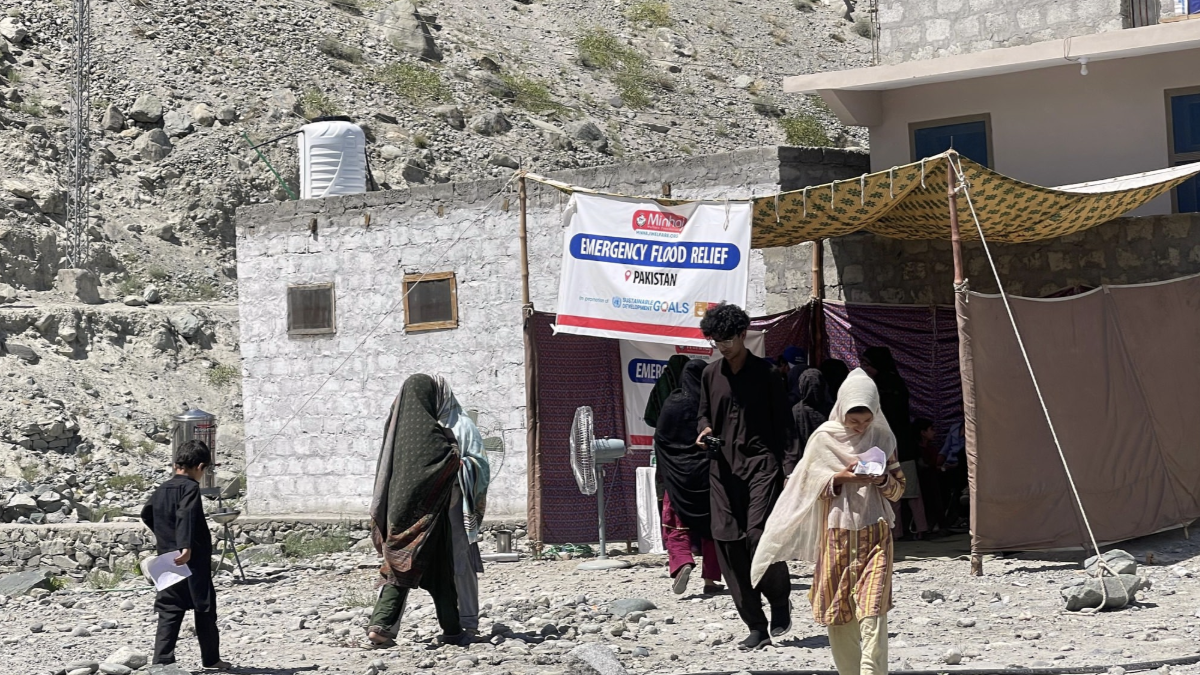
Flood relief camp set up in Gilgit-Baltistan following glacial lake outburst flood on August 22, 2025. Credit: Minhaj Welfare
A glacial lake outburst flood (GLOF) destroyed over 330 houses and impacted at least six villages in the Gupis Valley of Ghizer District in Gilgit-Baltistan on August 22.
The glacier burst triggered heavy debris flow and a major river blockage at around 04:00 local time (LT), leading to the rapid formation of an artificial lake extending over 7 km (4.35 miles) in length.
Emergency teams and the Pakistan Army, aided by local volunteers, evacuated over 200 residents from affected areas. Around 40 individuals stranded in isolated pockets were rescued by helicopter later that day.
The villages of Tildas, Roshan, Miduri, Hawks Thangi, Goth, and adjacent settlements were inundated. Initial assessments indicate that at least 330 houses, along with dozens of shops and community structures, were either damaged or swept away. Approximately 80 % of Raushan village was reported destroyed.
By August 23, water levels in the artificial lake had begun to recede, alleviating immediate downstream risk. However, local authorities have warned that the natural dam formed by the landslide remains unstable and that additional rainfall could reactivate the flooding threat.
In Roshan village, located approximately 200 km (120 miles) from Gilgit, a local shepherd’s timely warning prevented loss of life. While tending livestock in the mountains during the early hours of August 22, the shepherd observed signs of an impending flood and used his mobile phone to alert residents. The rapid evacuation that followed allowed all villagers to escape moments before floodwaters engulfed the area.
Although no casualties occurred, officials confirmed that Roshan was fully inundated, with all household belongings and livestock lost. The event has prompted renewed discussion about the importance of indigenous observation in Gilgit-Baltistan’s high-risk terrain, where formal flood alert systems reportedly failed to provide actionable warnings.
While some reports on social media mention a total of 10 fatalities, official statements report no confirmed deaths. Infrastructure damage includes roads, irrigation channels, and bridges, although full assessments are still ongoing.
The Pakistan Meteorological Department has forecast additional rainfall for the region over the coming days, increasing the risk of further landslides or erosion of the natural dam.

I am an Assistant Editor and Severe Weather & Science Journalist at The Watchers, specializing in real-time severe weather coverage, geophysical event reporting, and research-driven scientific analysis. You can reach me at rishav(at)watchers(.)news.

Commenting rules and guidelines
We value the thoughts and opinions of our readers and welcome healthy discussions on our website. In order to maintain a respectful and positive community, we ask that all commenters follow these rules.