
Extreme heat spreads across Europe as WMO warns of expanding impacts on millions
Extreme heat continued to spread across Europe on June 24, 2026, prompting widespread red alerts and health warnings across Europe. The prolonged heatwave driven by a strong upper-level ridge is affecting much of Western, Central, and Southern Europe, with temperatures forecast to remain 3 to 10°C (5.4 to 18°F) above seasonal averages and locally exceed 40°C (104°F) through the end of June.

Image credit: Tsuyoshi Kozu
Extreme heat continued to spread across Europe on June 24, prompting widespread red alerts and health warnings as the World Meteorological Organization (WMO) reported impacts on millions of people and forecast further expansion of dangerous heat conditions across large parts of the continent.
At least 40 people have drowned in France since June 18 while seeking relief from the heatwave. The country recorded its hottest day on record on June 23, according to Météo-France, with a national average temperature of 29.3°C (84.7°F).
Authorities issued a top-level red alert covering 58 departments, the largest such alert area reported by the national weather service, and warned of heightened wildfire danger amid worsening drought conditions.
The heat has triggered severe warnings across multiple countries. The UK Met Office issued a red extreme heat warning for June 24–25 and forecast temperatures reaching at least 39°C (102.2°F), with the possibility of exceeding existing June records.
In Switzerland, MeteoSwiss issued top-level red alerts for large parts of the country, including Zurich and Geneva. Spain’s national weather agency forecast temperatures reaching 44°C (111.2°F) in parts of Córdoba province.
According to WMO’s Regional Climate Center Network, coordinated through Germany’s national weather service, the Deutsche Wetterdienst (DWD), the heatwave is expected to extend across large parts of Western, Central, and Southern Europe over the next two weeks as the primary focus shifts toward southeastern Europe and the Balkans.
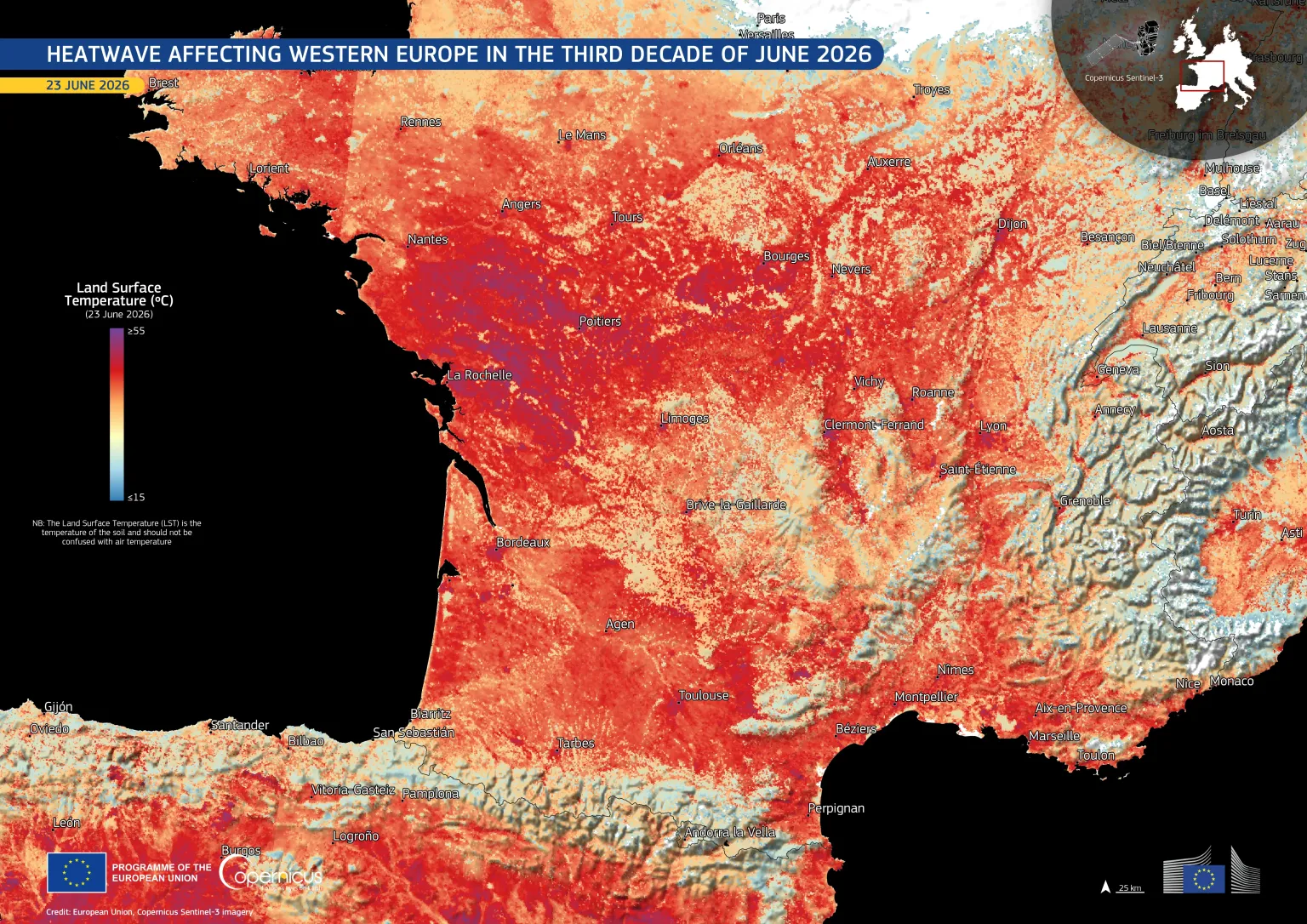
Countries within the affected area include Portugal, Spain, France, Belgium, Luxembourg, the Netherlands, the southern parts of the United Kingdom, Germany, Switzerland, Austria, Italy, and numerous countries across southeastern Europe.
Regional climate guidance indicates temperatures between 3°C and 10°C (5.4°F and 18°F) above seasonal averages across much of the affected region.
Maximum temperatures above 35°C (95°F) are forecast in many locations, with local temperatures of over 40°C (104°F) through the end of June.
The heat is forecast to spread farther north and east during the weekend. Large temperature anomalies are expected across Denmark, southern Scandinavia, Poland, the Baltic states, the Czech Republic, and the Alpine region.
Temperatures are forecast to reach the upper 30s°C (90s°F). Some locations may approach 40 to 41 °C (104 to 106 °F) by June 25.
Southern England is forecast to experience some of the most unusual conditions. Several weather models continue to project temperatures of 40 to 41 °C (104 to 106 °F) across parts of the region.
Temperatures are also expected to reach the low 30s °C (mid-80s °F) across Ireland, Northern Ireland, and northern England. Some valleys in Scotland could also reach 30 °C (86 °F).
Across the Iberian Peninsula, temperatures may locally reach 44 °C (111 °F) in southern Spain. Portugal is expected to remain somewhat cooler, although temperatures there are also forecast to remain well above normal for the time of year.
A notable feature of the event is the persistence of unusually warm nights. WMO has also mentioned that the occurrence of “tropical nights” overnight has increased.
A “tropical night” is a term widely adopted in some regions, such as Europe and parts of Asia. It can be defined as a night where the temperature does not drop below 20°C (68°F). During heatwaves, these become increasingly common, particularly in cities.
Such conditions limit the body’s ability to recover from daytime heat exposure and can significantly increase health risks during prolonged heat events.
The heat is forecast to expand into Italy and the central Balkan Peninsula during the weekend and early next week. Temperatures across northern Italy may reach the upper 30s to low 40s °C (upper 90s to low 100s °F). Parts of the Balkans may also see temperatures in the upper 30s °C beneath increasingly dry air.
The event is being driven by a strong upper-level ridge, commonly referred to as a heat dome. Air slowly sinks beneath the ridge, compressing and warming as it descends. The process promotes clear skies, weak atmospheric mixing, and continued warming at the surface.
The heatwave is expected to persist into early July. Dry soils in many areas are expected to limit natural cooling through evaporation, allowing temperatures to remain elevated. Prolonged heat, very low humidity, and increasingly dry vegetation may further increase wildfire risk while worsening drought conditions across parts of Europe.
References:
1 WMO and partners act as extreme heat grips Europe – WMO– June 24, 2026
2Europe’s Excessive Heat Warning: Record June Heat Dome Spikes France to 45°C, UK Eyes 40 °C – SWE – June 22, 2026

I am an Assistant Editor and Severe Weather & Science Journalist at The Watchers, specializing in real-time severe weather coverage, geophysical event reporting, and research-driven scientific analysis. You can reach me at rishav(at)watchers(.)news.

Commenting rules and guidelines
We value the thoughts and opinions of our readers and welcome healthy discussions on our website. In order to maintain a respectful and positive community, we ask that all commenters follow these rules.