
Volcanic Alert Level for White Island raised to 3, New Zealand
Volcanic ash has been increasingly detected in the steam and gas plume at White Island volcano, New Zealand, over the past few months, prompting authorities to raise the Volcanic Alert Level to 3 on April 17, 2025. Intermittent explosive activity observed during aerial monitoring supports the assessment of elevated volcanic unrest.
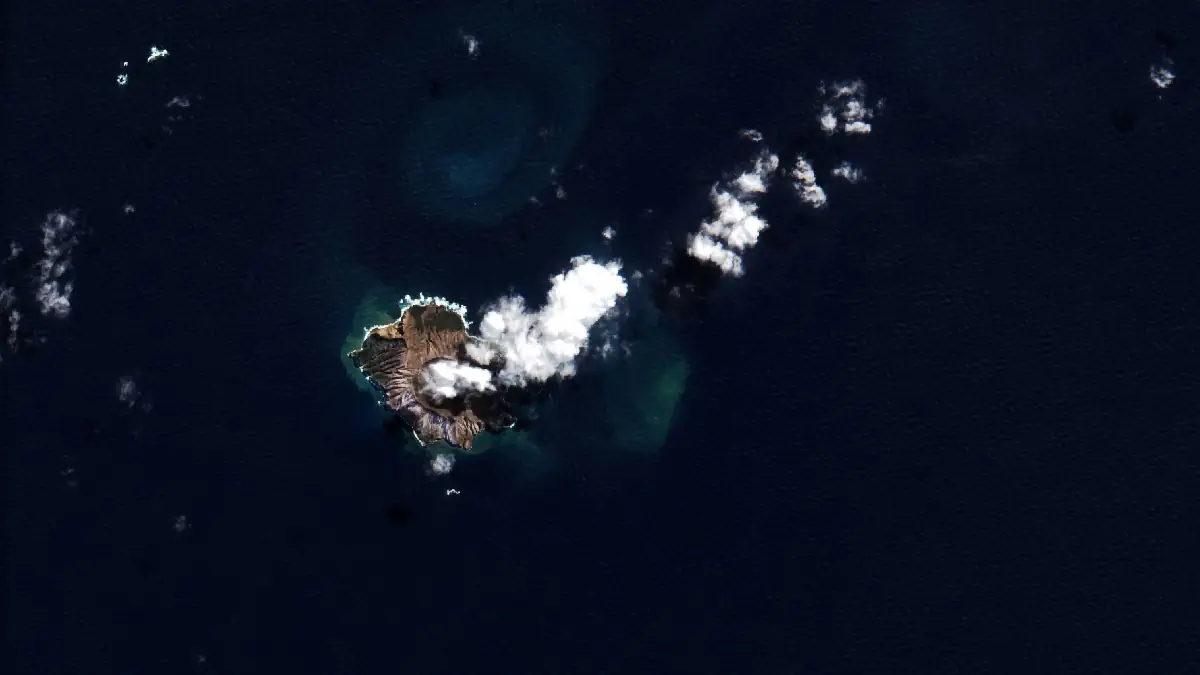
Satellite image of White Island volcano on April 4, 2025. Image credit: Copernicus EU/Sentinel-2, The Watchers
The increase in volcanic activity has been gradual, with webcams at Whakatāne and Te Kaha capturing more ash in the gas and steam plume, and satellite imagery from MetService confirming minor volcanic ash emissions.
The emissions have created a visible hazy plume drifting downwind from the volcano, occasionally producing sulfur odors noticeable along the Bay of Plenty coastline during northerly winds.
Observation flights identified impact craters on the main crater floor, indicating explosive events that expelled rocks several hundred meters from active vents.
Such activity is characteristic of White Island, where vents may periodically clog or increase gas flux, resulting in short, low-level eruptions.
Gas and thermal measurements, along with sulfur dioxide (SO2) emissions detected by satellite, show slight increases, which are consistent with an overall increase in volcanic activity and more frequent ash emissions.
“Steam, gas, and volcanic ash emissions remain variable as they have been for the past few months, and due to our lack of on-island monitoring, it is possible that short-duration eruptions are occurring without being directly recorded,” GeoNet Duty Volcanologist Geoff Kilgour said.
“Recent activity is consistent with a low level of eruptive activity and therefore, the Volcanic Alert Level is raised to Level 3. The continued presence of volcanic ash emissions means that the Aviation Color Code remains Orange.”
Due to the absence of on-island sensors, authorities rely on satellite data, webcams, and periodic aerial observations to monitor activity.
References:
1 Volcanic Activity Bulletin WI-2025/06 – GeoNet – April 17, 2025

Teo Blašković founded The Watchers in 2011 and edited it until 2026, covering seismic and volcanic activity, extreme weather, space weather and near-Earth objects. Articles on this page are his archive.
Published in the last 24 hours
- High Risk of excessive rainfall covers Florida’s Space Coast as St. Johns River near Cocoa reaches 5.67 m
- Four small asteroids will pass close to Earth from November 21 to 23
- Cyclone Akvan weakens after landfall near Gopalpur; more than 300 000 evacuated in Odisha, India
- A broad low over southeastern Florida and the northwestern Bahamas has a 30 percent chance of subtropical or tropical development within 48 hours and a 50 percent chance within 7 days, the National Hurricane Center says
