
Increased activity, Aviation Color Code raised to Orange at White Island volcano, New Zealand
Small ash emissions along with large white steam plumes have been observed over the past week at White Island volcano in New Zealand, according to a bulletin released by the GNS at 14:30 LT (01:30 UTC) on Monday, February 24, 2025. The Alert Level remains at 2 while the Aviation Color Code has been raised to Orange.
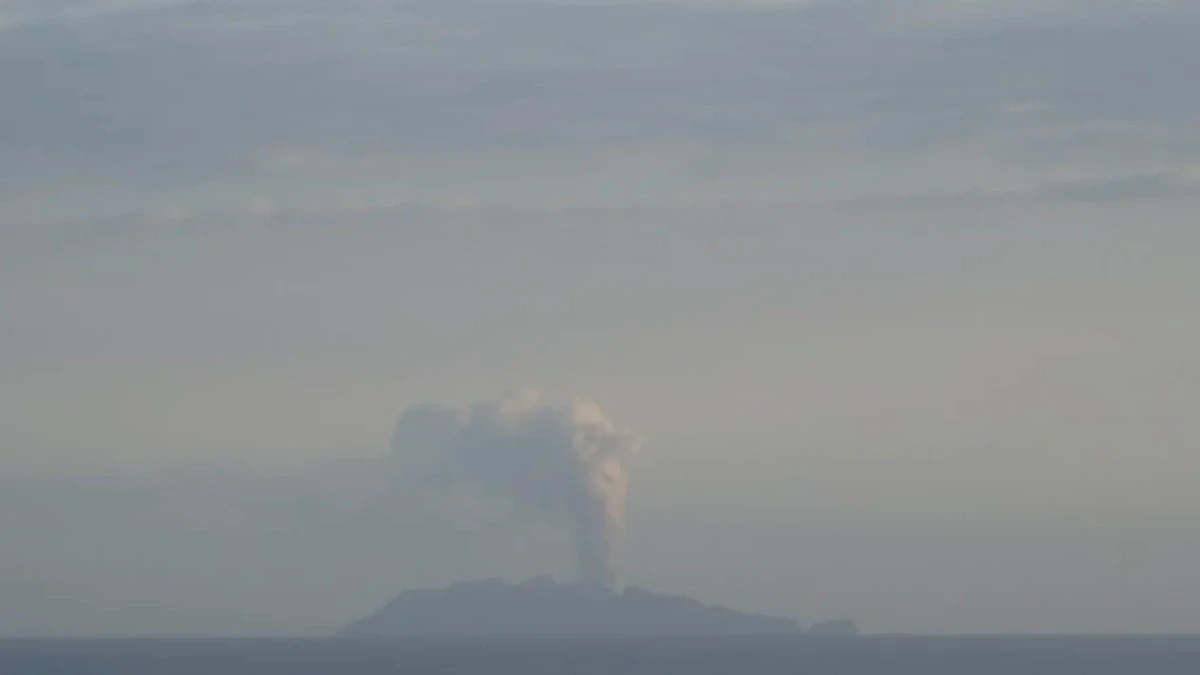
White Island volcano at 07:50 LT on February 24, 2025. Image credit: GNS
Variable steam, gas, and ash emissions were observed at White Island volcano, located in the Bay of Plenty, New Zealand, over the past week, according to a bulletin released by the Institute of Geological and Nuclear Sciences Limited (GNS) on Monday. GNS confirms the Volcanic Alert Level remains at 2 while the Aviation Color Code has increased to Orange.
Over the past week, large white, steam-rich plumes were visible from webcams at Whakatane and Te Kaha. Satellite imagery over the weekend detected minor ash emissions in the plume which appeared as a faint haze along the coast.
Satellite sensors recorded sulfur dioxide (SO2) emissions that may have produced noticeable sulfur odors under northerly wind conditions.
GNS cautions that the current lack of consistent real-time monitoring data leaves uncertainty about the present level of volcanic activity, which could escalate with little or no warning.
White Island is the emergent summit of a submarine volcano measuring roughly 2 km by 2.4 km (1.2 by 1.5 miles). The full submarine structure spans about 16 km by 18 km (10 by 11 miles) in the Bay of Plenty, approximately 50 km (31 miles) offshore from New Zealand’s North Island.
The island comprises two overlapping andesitic-to-dacitic stratovolcanoes, with the southeastern edge open at sea level. Recent activity has been concentrated roughly 1 km (0.6 miles) from the shoreline at the island’s rear. Volckner Rocks, remnants of a lava dome, are situated 5 km (3.1 miles) to the northwest.
The volcano lies within a subduction zone under a continental crust exceeding 25 km (15.5 miles) in thickness.
The most recent eruption began on May 24, 2024, and is still ongoing as of February 24, 2025, with both explosive and effusive characteristics. Prior to this, the volcano last erupted on December 9, 2019, with a Volcanic Explosivity Index (VEI) of 2. Earlier eruptions include the period from February 1, 1986, to July 28, 1994, which lasted several years and was classified as a VEI 3 event.
References:
1 Small ash emissions and large steam plumes observed at Whakaari. Volcanic Alert Level remains at 2 and Aviation Colour Code changes to Orange. – GNS – February 24, 2025
2 Whakaari/White Island – GVP – Accessed on February 24, 2025

Rishika holds a Master’s in International Studies from Stella Maris College, Chennai, India, where she earned a gold medal, and an MCA from the University of Mysore, Karnataka, India. Previously, she served as a Research Assistant at the National Institute of Advanced Studies, Indian Institute of Science, Bengaluru, India. During her tenure, she contributed as a Junior Writer for Europe Monitor on the Global Politics website and as an Assistant Editor for The World This Week. Her work has also been published in The Hindu newspaper, showing her expertise in global affairs. Rishika is also a recipient of the Women Empowerment Award at the district level in Haryana, India, in 2022.

Commenting rules and guidelines
We value the thoughts and opinions of our readers and welcome healthy discussions on our website. In order to maintain a respectful and positive community, we ask that all commenters follow these rules.