
Supermassive black hole Ansky awakens with record-breaking X-ray flares
Previously dormant supermassive black hole Ansky in galaxy SDSS1335+0728, approximately 300 million light-years away in Virgo, started emitting exceptional X-ray flares in late 2019. These quasiperiodic eruptions last 10 times longer, shine 10 times brighter, and release 100 times more energy than typical black hole bursts. ESA’s XMM-Newton and NASA telescopes have recorded 165 such events since February 2024.

This artist’s impression illustrates the mechanism that could be at the origin of the powerful bursts of X-ray light seen from a newly awakened black hole named Ansky. Credit: ESA
Astronomers initially detected enhanced optical emissions from galaxy SDSS1335+0728 in December 2019, indicating renewed activity from its previously dormant central black hole, named Ansky.
Regular X-ray flares, identified as quasiperiodic eruptions (QPEs), were first documented in February 2024. The bursts recur approximately every 4.5 days, marking the longest known interval between such events observed in astronomical research.
The QPEs from Ansky are exceptional, lasting 10 times longer and shining 10 times brighter than typical eruptions. Each burst releases 100 times more energy than those observed in other black holes, with 165 bursts documented by April 2025.
Current astrophysical models struggle to explain the flares’ extreme properties, and researchers note that the number of theoretical models exceeds the available data.
Scientists propose that the flares are linked to an accretion disc, where gas spirals into the black hole. A hypothesis suggests a small object, possibly a star, crosses the disc twice per orbit at a specific angle, causing shocks that produce the X-ray bursts. No observations confirm the destruction of a star by Ansky.
Astronomers also speculate that such powerful and regular outbursts might generate gravitational waves detectable by ESA’s upcoming Laser Interferometer Space Antenna (LISA), scheduled for launch in the 2030s.
Ultraviolet emissions from the galaxy have increased fourfold since 2021, with X-ray activity first intensifying notably in February 2024, as recorded by NASA’s Neutron Star Interior Composition Explorer (NICER).
The regularity and strength of these bursts continue to defy conventional explanations of black hole behavior, prompting further study.
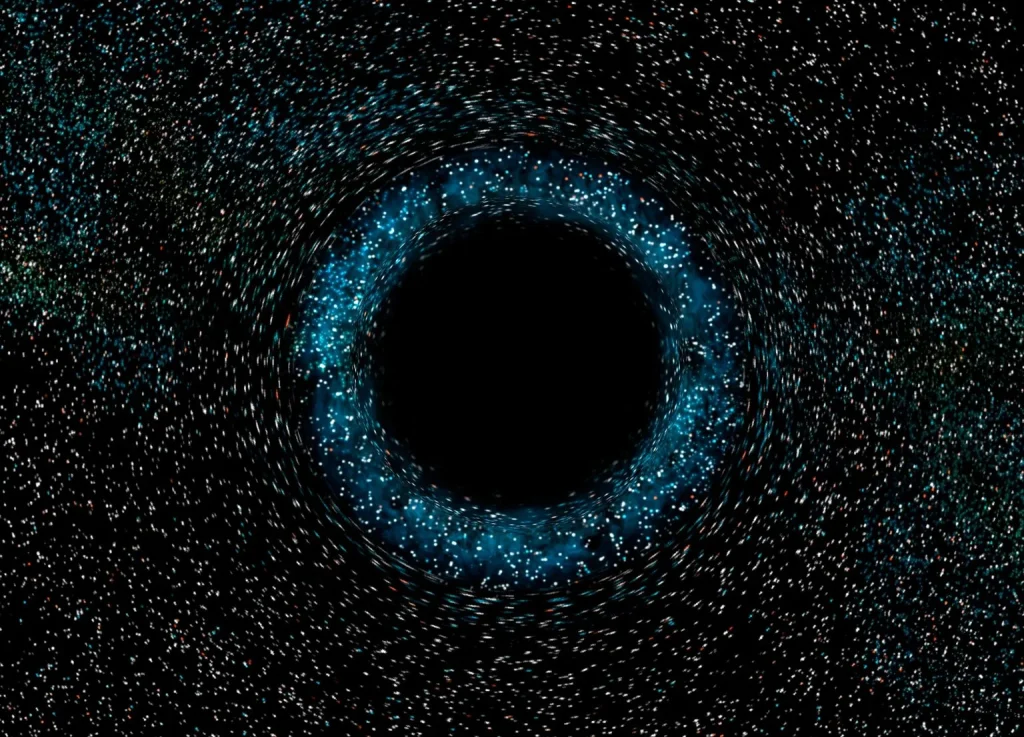
The black hole, classified as an active galactic nucleus (AGN), has drawn interest due to its transition from a dormant state to exceptional activity. Minor variations in burst timing, slightly deviating around the 4.5-day interval, are currently under investigation to refine theoretical models describing accretion disk dynamics.
Astronomers report no significant disturbances to the galaxy’s overall structure despite these powerful bursts.
References:
1 From boring to bursting: a giant black hole awakens – ESA – April 11, 2025
2 Discovery of extreme quasi-periodic eruptions in a newly accreting massive black hole – Lorena Hernandes-Garcia et al. – Nature Astronomy – April 2025 – https://doi.org/10.1038/s41550-025-02523-9

I’m a science journalist and researcher at The Watchers, contributing to the Epicenter edition, where I cover peer-reviewed scientific research and emerging discoveries across Earth and space sciences. With a background in astronomy and a passion for environmental science, I’ve worked in shark and coral conservation in Fiji, conducting reef and shark-behavior research, contributing to mangrove restoration, and earning PADI Open Water and Coral Reef Certifications. I bring a blend of scientific rigor and storytelling to illuminate the discoveries shaping our planet and beyond.

It takes a plasmoid to flare.
<3 * _/\_
There’s no black holes or white holes. It is an electromagnetic eruption from the most powerful magentic field region in the galaxy. This eruption is identical to stellar eruption. But, of course the intensity and magnitude of the stellar eruption is nothing in comparison to this galactic eruption.