
Researchers warn of another mega-quake as Japan commemorates 14th anniversary of 2011 disaster
As Japan marks the 14th anniversary of the 2011 Tohoku mega-quake—a magnitude 9.0 disaster that killed nearly 16 000 and triggered the Fukushima crisis—a new study from Tohoku, Hokkaido, and JAMSTEC researchers warns that strain building in the Chishima Trench off Hokkaido could unleash another magnitude 9.0 quake in the coming decades.

Reactors of Fukushima Power plant after the March 11 disaster. Image credit: Digital Globe/Wikipedia
Researchers from Tohoku and Hokkaido universities and the Japan Agency for Marine-Earth Science and Technology (JAMSTEC) have released the results of their five-year study of the Chishima Trench off Hokkaido.
The results indicate that strain accumulation due to plate movements could lead to a mega-quake in the near future. Using seabed GPS stations installed in 2019, the team observed that the Pacific Plate is sliding toward the Okhotsk Plate at roughly 8 cm (3.1 inches) per year, while a station on the continental plate mirrors this movement—suggesting the plates are locked and building tension.
This echoes patterns seen before the 17th-century quake believed to have rocked the region, raising concerns of a repeat event.
With the government estimating a 7% to 40% chance of a magnitude 8.8 or higher quake within 30 years, researchers warn that a sudden release of this strain could trigger a magnitude 9.0 disaster, potentially unleashing tsunamis and threatening tens of thousands of lives along Hokkaido’s coast.
The team plans to conduct further research at another location off Hokkaido to collect additional data.
Tomita Fumiaki, an assistant professor at Tohoku University’s International Research Institute of Disaster Science, warned that memories of the 2011 Great East Japan Earthquake and Tsunami are fading. With that in mind, he called on people to stay ready for another potential mega-quake.
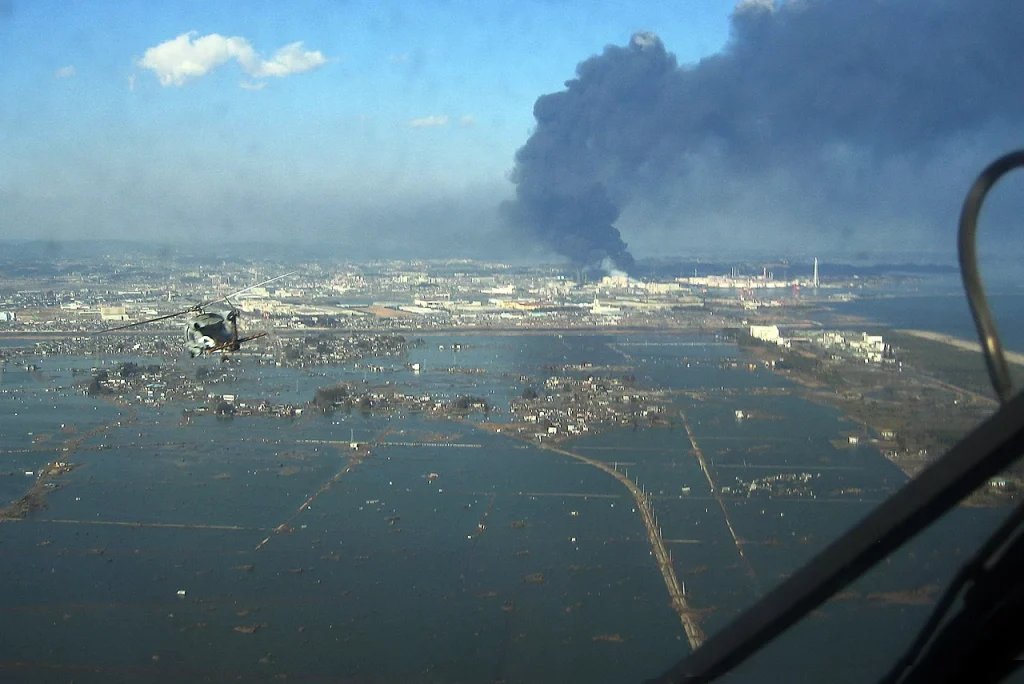
Today, Japan marks the 14th anniversary of the 2011 Tohoku earthquake and tsunami, which claimed nearly 16 000 lives and left 2 526 people missing. The disaster was triggered by an M9.0 mega-quake that generated a nearly 15 m (50 feet) high tsunami, causing the Fukushima Daiichi nuclear meltdown—the world’s second-worst nuclear accident after Chernobyl in 1986.
The earthquake struck at 14:46 JST (05:46 UTC) on March 11, 2011, with its epicenter about 130 km (80 miles) southeast of Sendai in Miyagi Prefecture, at a depth of roughly 32 km (20 miles) beneath the Pacific Ocean floor. It resulted from the rupture of a segment of the Japan Trench subduction zone, where the Pacific Plate thrusts beneath the Eurasian Plate.
It was the fourth most powerful earthquake ever recorded globally and the strongest to strike Japan since the advent of modern seismology.
The quake was felt as far away as Petropavlovsk-Kamchatsky, Russia; Kaohsiung, Taiwan; and Beijing, China. It was preceded by multiple foreshocks, including a M7.2 event centered about 40 km (25 miles) from the main quake’s epicenter. In the following days and weeks, hundreds of aftershocks occurred, including dozens of M6.0 or greater and two exceeding magnitude 7.0.
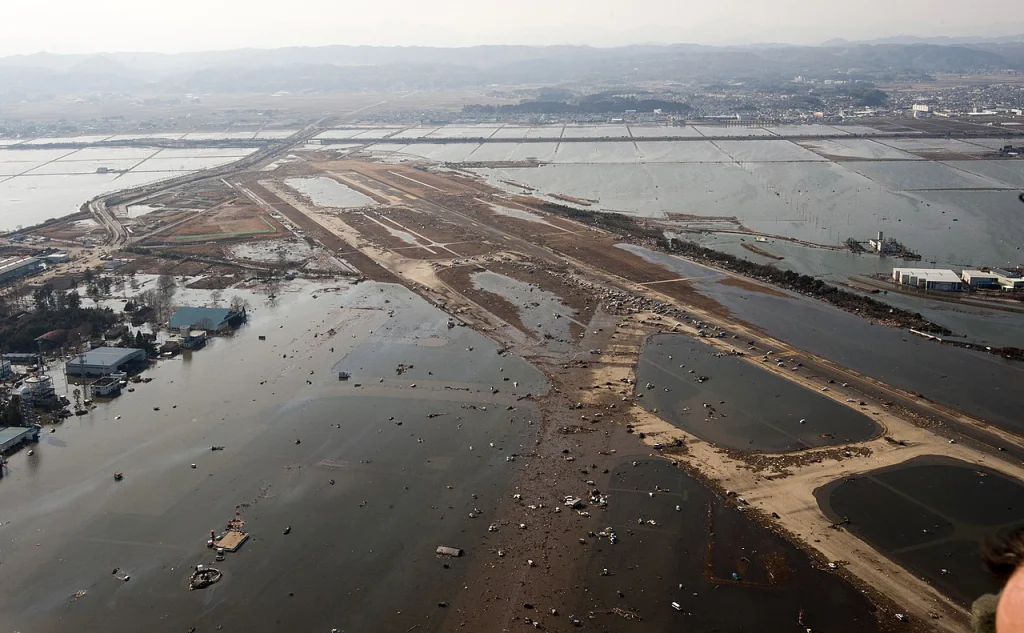
The quake triggered a 13–14 m (43–46 feet) high tsunami, which disrupted the power supply at the Fukushima Daiichi nuclear power plant.
Although all three operating reactors were successfully shut down, the power loss caused their cooling systems to fail within the first few days of the disaster.
Rising residual heat in the reactor cores caused the fuel rods in reactors 1, 2, and 3 to overheat and partially melt, resulting in intermittent radiation releases.
Melted material accumulated at the bottom of the containment vessels in reactors 1 and 2, creating sizable holes in the vessel floors—a fact that was revealed in late May. Those holes partially exposed the nuclear material in the cores.
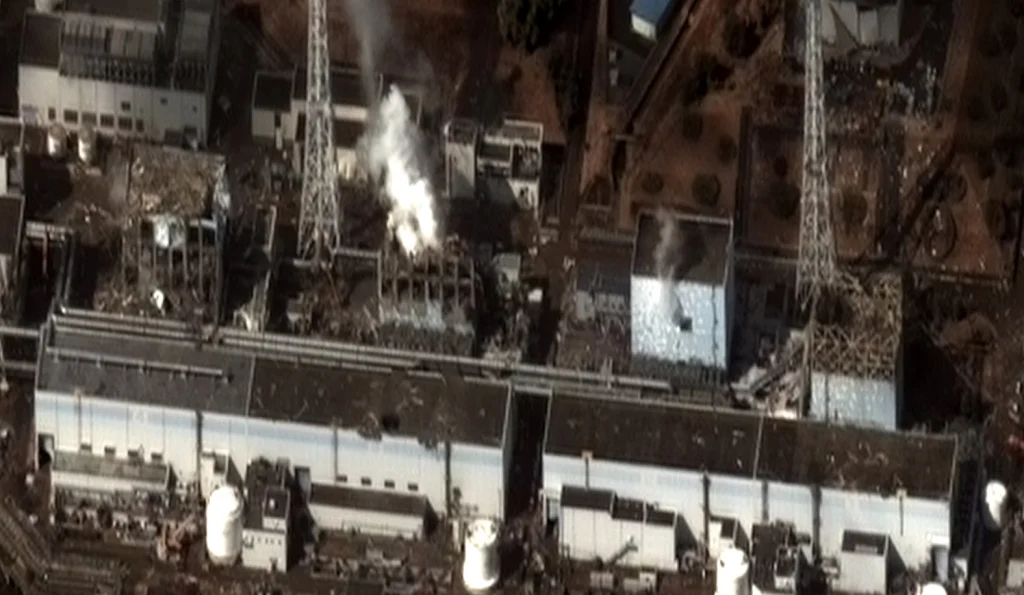
Explosions resulting from the buildup of pressurized hydrogen gas occurred in the outer containment buildings enclosing reactors 1 and 3 on March 12 and March 14, respectively.
Workers sought to cool and stabilize the three cores by pumping seawater and boric acid into them. Due to concerns over potential radiation exposure, government officials established a 30 km (18 miles) no-fly zone around the facility. A land area within a 20 km (12 miles) radius around the plant—covering nearly 600 square km (232 square miles)—was evacuated.
A third explosion occurred on March 15 in the building surrounding reactor 2. The explosion created a second hole in the containment vessel; the first hole had been caused earlier by melted nuclear material passing through the bottom of the vessel.
In response, government officials designated a wider zone, extending to a radius of 30 km (18 miles) around the plant, within which residents were asked to remain indoors. The explosion, along with a fire caused by rising temperatures in spent fuel rods stored in reactor 4, led to the release of higher levels of radiation from the plant.
The severity of the disaster continued to escalate. On April 12, he Nuclear and Industrial Safety Agency rated the incident as level 7, the highest level on the International Nuclear Event Scale, following a report by the Japan Nuclear Energy Safety Organization (JNES).
The combination of a massive earthquake, a devastating tsunami, and the Fukushima nuclear disaster made it one of the most catastrophic natural and technological crises ever recorded.
References:
1 Experts: Unreleased stress energy off Hokkaido is enough to trigger mega-quake – NHK – March 9, 2025

I am an Assistant Editor and Severe Weather & Science Journalist at The Watchers, specializing in real-time severe weather coverage, geophysical event reporting, and research-driven scientific analysis. You can reach me at rishav(at)watchers(.)news.

Commenting rules and guidelines
We value the thoughts and opinions of our readers and welcome healthy discussions on our website. In order to maintain a respectful and positive community, we ask that all commenters follow these rules.