
Eruption at Kilauea producing lava fountains up to 100 m (330 feet) high, Hawai’i
Episode 9 of the ongoing Halemaʻumaʻu eruption began at 10:16 LT (20:16 UTC) on February 11, 2025, producing lava fountains up to 100 m (330 feet) high. The eruption is part of the activity that started on December 23, 2024. The USGS maintains the Volcano Alert Level at Watch and the Aviation Color Code at Orange.
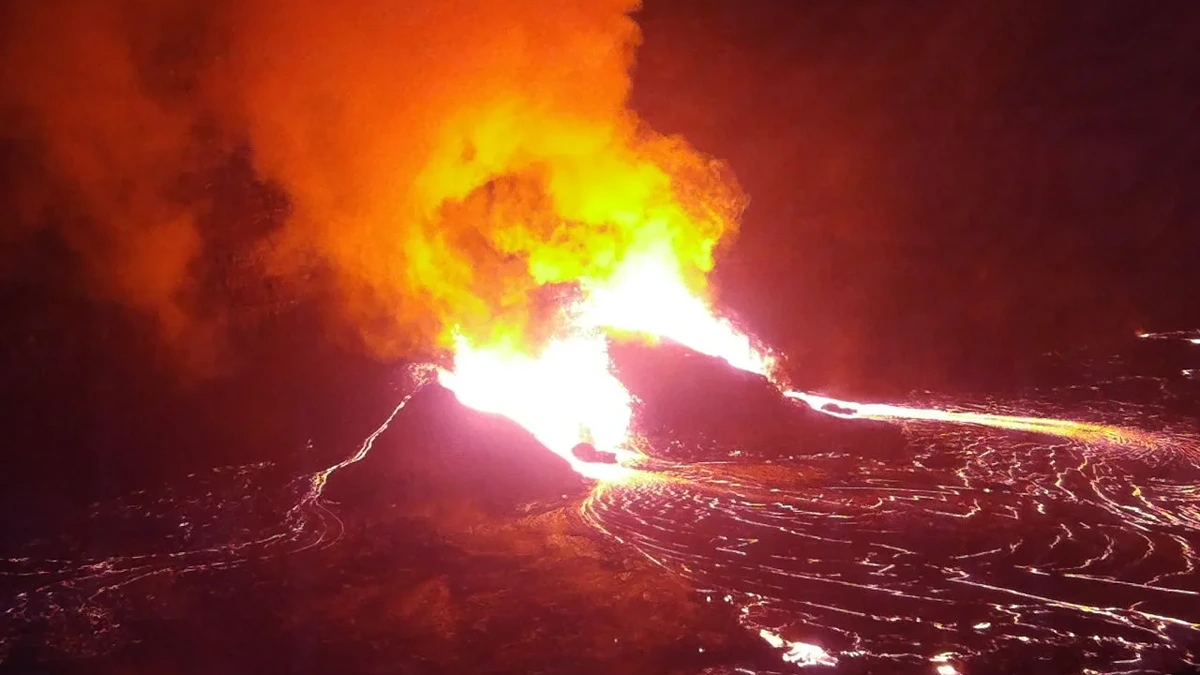
A view from the south rim of Halemaʻumaʻu crater, looking west across Kīlauea’s summit caldera. Captured by the S2cam at 01:05 UTC on February 12, 2025. Image credit: USGS
Episode 9 of the ongoing volcanic activity at Kīlauea’s Halemaʻumaʻu summit began at 10:16 LT (20:16 UTC) on February 11, 2025, producing lava fountains up to 100 m (330 feet) high. The eruption is part of the activity that started on December 23, 2024.
The U.S. Geological Survey’s (USGS) Hawaiian Volcano Observatory (HVO) has maintained the Volcano Alert Level at Watch and the Aviation Color Code at Orange, indicating ongoing activity with heightened volcanic hazards.
The eruption was preceded by sporadic spatter fountains on February 10, gradually increasing in intensity overnight. Lava fountains from the north vent of Halema’uma’u summit reached an estimated height of 100 m (330 feet) by mid-morning on February 11, covering about a quarter of the summit floor.
Slow lava effusion from the south vent began at approximately 20:50 UTC.
Tiltmeter readings at the summit indicate an inflationary tilt recovery of 9 micro radians since the previous eruption episode. Seismic tremors have increased, and the UWD tiltmeter registered a shift from inflation to deflation starting at 20:25 UTC.
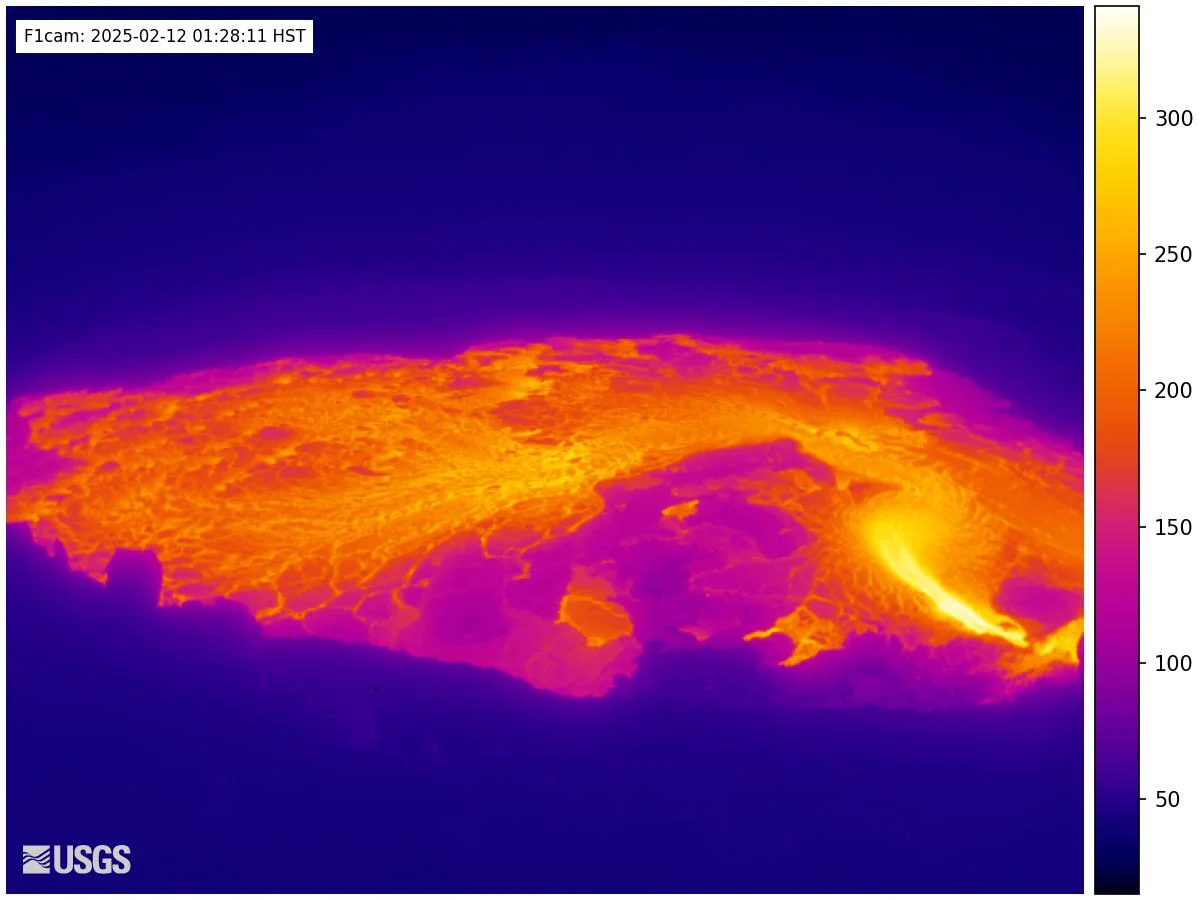
The episode follows a pattern observed since December 23, 2024, where each eruptive event has lasted between 13 hours and 8 days, separated by pauses ranging from less than 24 hours to 12 days.
The ongoing eruption is confined within the closed area of Hawai’i Volcanoes National Park. High concentrations of volcanic gases, mainly water vapor (H2O), carbon dioxide (CO2), and sulfur dioxide (SO2) continue to be released. SO2 emissions contribute to vog (volcanic smog) which can affect air quality downwind.
Another key hazard is Pele’s hair, thin strands of volcanic glass produced by lava fountains. Strong winds can carry these delicate, sharp filaments over long distances, where they settle on the ground. Pele’s hair can cause skin and eye irritation, and residents and visitors are advised to avoid contact.
Lava flows from this episode remain confined to Halema’uma’u and the southwest side of Kaluapele, Kīlauea’s summit caldera. No activity has been detected in the East Rift Zone or Southwest Rift Zone, unlike previous eruptions.
Geological instability around the Kīlauea caldera remains a concern, as Halema’uma’u’s walls are prone to rockfalls, ground cracking, and collapses, during earthquakes. The summit area remains closed to the public since 2007 because of these risks.
Kīlauea is one of the most active volcanoes on Earth overlapping the eastern flank of Mauna Loa on Hawai’i Island. The current eruption continues a long history of summit and rift zone activity.
The Halema’uma’u summit where the eruption is taking place was formed in stages around 1 500 years ago and underwent further collapse during the 18th century. Lava flows from Kīlauea cover about 90% of its surface with 70% being younger than 600 years.
A prolonged eruption at Kīlauea’s East Rift Zone produced lava flows covering more than 100 km2 (39 mi2) from 1983 to 2018, destroying homes and adding new land to the coastline. Recent activity remains confined to the summit caldera with no indications of new activity along the rift zones.
References:
1 Kilauea – USGS/HVO – February 11, 2025
2 Kilauea – GVP – Accessed on February 12, 2025

Rishika holds a Master’s in International Studies from Stella Maris College, Chennai, India, where she earned a gold medal, and an MCA from the University of Mysore, Karnataka, India. Previously, she served as a Research Assistant at the National Institute of Advanced Studies, Indian Institute of Science, Bengaluru, India. During her tenure, she contributed as a Junior Writer for Europe Monitor on the Global Politics website and as an Assistant Editor for The World This Week. Her work has also been published in The Hindu newspaper, showing her expertise in global affairs. Rishika is also a recipient of the Women Empowerment Award at the district level in Haryana, India, in 2022.

Commenting rules and guidelines
We value the thoughts and opinions of our readers and welcome healthy discussions on our website. In order to maintain a respectful and positive community, we ask that all commenters follow these rules.