
Ashfall advisory issued as Kīlauea episode 48 begins at north vent, Hawaii
The National Weather Service (NWS) in Honolulu issued an Ashfall Advisory for Hawaiʻi Volcanoes National Park and areas to the north and northeast, including Volcano and Mountain View, after Kīlauea’s episode 48 lava fountaining began inside Halemaʻumaʻu crater on June 1, 2026.
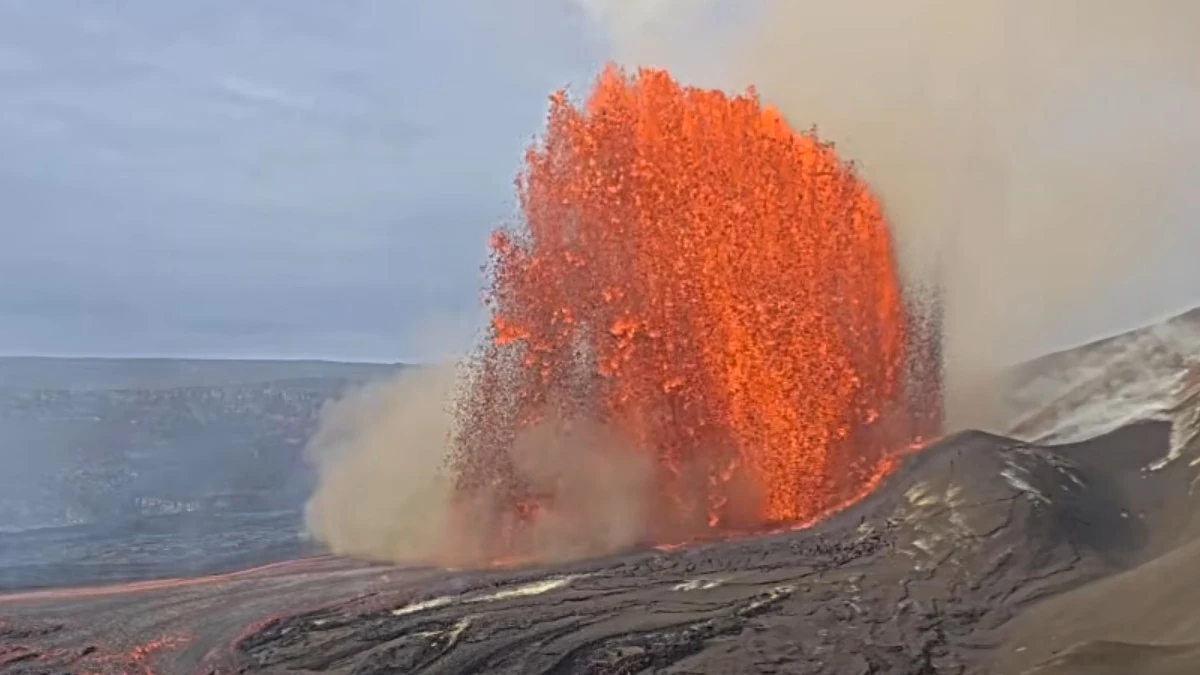
USGS/HVO Eruptive episode 48 at Kīlauea volcano, Hawaiʻi — June 1, 2026. Credit: USGS/HVO
Lava fountaining episode 48 of the ongoing Halemaʻumaʻu eruption at Kīlauea began at 04:40 HST (14:40 UTC) on June 1, after more than 90 lava overflow events from the south vent that started at 17:41 HST on May 30 (03:41 UTC on May 31), according to the Hawaiian Volcano Observatory (HVO) and U.S. Geological Survey (USGS).
Fountaining was focused on the north vent and reached more than 200 m (650 feet) above the vent, while the plume was observed up to 7.3 km (24 000 feet) above sea level.
Seismic and deformation signals suggest that the fountain had already reached its peak height and effusion rate by 07:13 HST (17:13 UTC), although HVO said fountaining would likely continue for many more hours.
Ground-level winds were blowing from the northwest, with potential tephra dispersal toward the southwest into the Kaʻū Desert, Pāhala, and farther. Higher-level winds at 3–6 km (10 000–20 000 feet) above sea level were from the south, potentially carrying tephra north and east into public overlooks in Hawaiʻi Volcanoes National Park and nearby communities.
NWS Honolulu issued the Ashfall Advisory at 05:31 HST (15:31 UTC), in effect until noon HST (22:00 UTC), for Hawaiʻi Volcanoes National Park and areas to the north and northeast, including Volcano and Mountain View.
Meanwhile, ash and tephra up to several cm in diameter and strands of Pele’s hair were already reported at Uēkahuna overlook in Hawaiʻi Volcanoes National Park. Tephra was also reported falling on Highway 11 near and west of Nāmakanipaio campground between mile markers 32 and 34.
Fine ash and Pele’s hair were reported from Volcano village, Mauna Loa Estates, and Ohia Estates, northeast of Hawaiʻi Volcanoes National Park.
NWS advised people in the advisory area to limit exposure to tephra, especially those with respiratory sensitivities, and to wear a mask, gloves, eye protection, and long clothing when clearing ashfall, close windows and doors, and cover or disconnect water catchment systems.
Tephra consists of small glassy volcanic fragments, including volcanic ash, pumice, scoria, Pele’s hair, and reticulite, created by lava fountains. A combination of fountaining dynamics and wind conditions determines where tephra falls during each episode.
Sulfur dioxide gas had not been reported with this tephra fall as of the 07:13 HST status report. Lava flows have remained confined to Halemaʻumaʻu crater and the southwest side of Kaluapele, Kīlauea’s summit caldera. No significant activity was noted along Kīlauea’s East Rift Zone or Southwest Rift Zone.
The ongoing Halemaʻumaʻu eruption has been episodic since December 23, 2024, with activity from the north and south vents inside Kīlauea’s summit caldera.
References:
1 Volcanic Activity Notice for Kīlauea, 2026/H253 – USGS/HVO – June 1, 2026
2 Ashfall Advisory – NWS/Honolulu – June 1, 2026

I'm a dedicated researcher, journalist, and editor at The Watchers. With over 20 years of experience in the media industry, I specialize in hard science news, focusing on extreme weather, seismic and volcanic activity, space weather, and astronomy, including near-Earth objects and planetary defense strategies. You can reach me at teo /at/ watchers.news.

Commenting rules and guidelines
We value the thoughts and opinions of our readers and welcome healthy discussions on our website. In order to maintain a respectful and positive community, we ask that all commenters follow these rules.