
AVO raises Mount Kupreanof to Yellow/Advisory after increased seismicity and gas emissions, Alaska
The Alaska Volcano Observatory (AVO) raised Mount Kupreanof to Aviation Color Code Yellow and Volcano Alert Level Advisory at 17:01 UTC on May 12, 2026, after seismic activity and sulfur dioxide emissions increased over recent months at the Alaska Peninsula volcano.

Kupreanof fly-by during transit from Veniaminof to Cold Bay. Credit: USGS/AVO, Ellie Boyce
AVO reported that seismicity was first detected in February 2026 and increased in recent months, with earthquakes as large as M3.1 recorded beneath the volcano. Sulfur dioxide emissions were detected beginning April 4, with satellite-derived emission rates of about 100 to 1 000 tons per day, above the reported background rate of less than 100 tons per day.
The observatory said the seismic and gas signals are consistent with magmatic intrusion beneath Mount Kupreanof. However, available data do not show that an eruption is imminent. Further signs of increased unrest would be expected before an eruption, AVO said.
Mount Kupreanof has no local real-time geophysical monitoring network. Seismicity is detected using regional stations, with the closest functioning seismometers about 27 km (17 miles) east of the volcano as part of the Mount Veniaminof network. This limits detection of smaller events below M2 and produces larger location uncertainties.

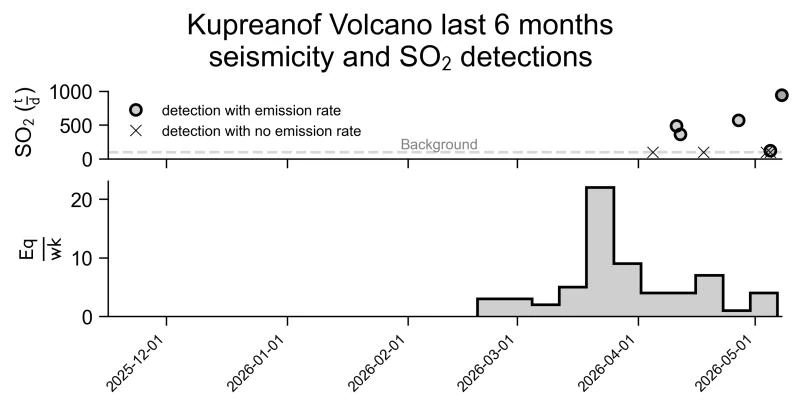
Kupreanof has a persistent fumarole field west of the summit and no known historical eruptions, though a debris-flow or block-and-ash-flow deposit of suspected Holocene age has been mapped south of the volcano.
Future activity, if it occurs, could be hydrothermal or magmatic. Eruptions would likely produce lahars and pyroclastic flows on the volcano’s flanks and into surrounding uninhabited valleys, while ash plumes could affect communities and aircraft downwind.
References:
1 Volcanic Activity Notice for Kupreanof volcano – USGS/AVO – May 12, 2026

Teo Blašković founded The Watchers in 2011 and edited it until 2026, covering seismic and volcanic activity, extreme weather, space weather and near-Earth objects. Articles on this page are his archive.
