
Evidence of powerful cosmic airburst over the United States adds to Younger Dryas Impact Hypothesis
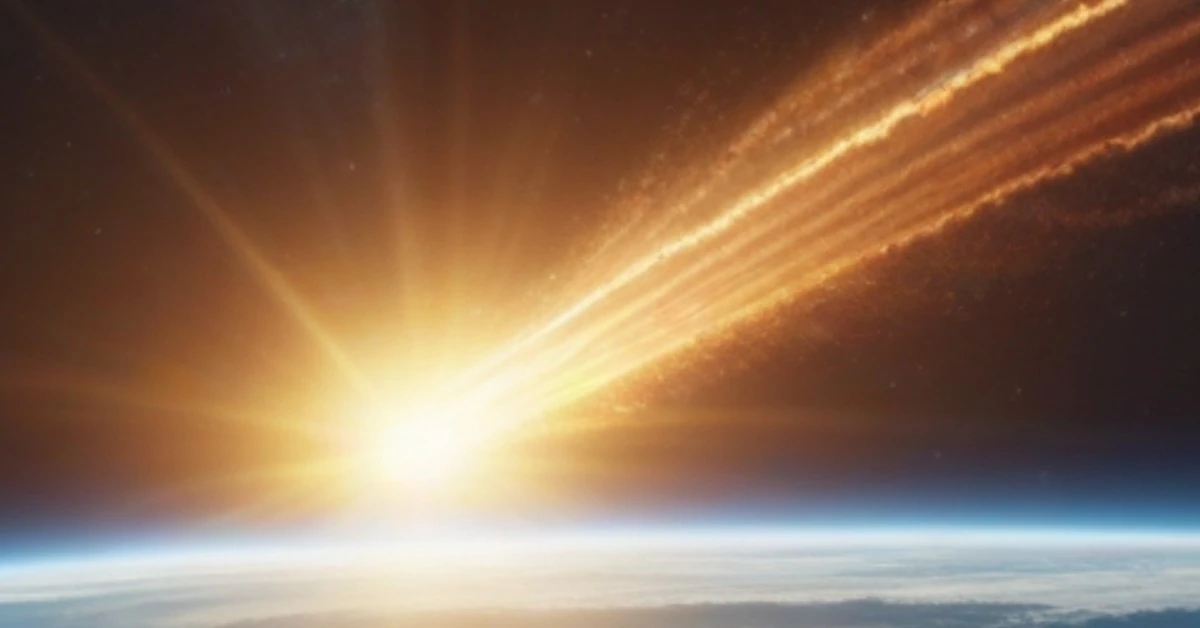
Image credit: TW
A study conducted by UC Santa Barbara reveals additional evidence supporting the Younger Dryas Impact Hypothesis, indicating hints of a large airburst event in the eastern United States some 12 800 years ago.
- New data from the University of California, Santa Barbara strengthens the Younger Dryas Impact Hypothesis (YDIH), which proposes that a large comet or asteroid impacted Earth, primarily over Northern America, some 12 800 years ago, drastically altering Earth’s climate.
- The study, published in Airbrusts and Cratering Impacts, finds evidence of a significant airburst at several locations in the eastern United States.
- The collective evidence meets the criteria for classification as an “impact spherule datum.”
The researchers examined sediments from New Jersey, Maryland, and South Carolina and found high quantities of platinum, microspherules, and melted glass, all of which indicated extreme heat and pressure from a cosmic event — an airburst, like the 1908 Tunguska event that devastated Siberian forests.
“What we’ve found is that the pressures and temperatures were not characteristic of major crater-forming impacts but were consistent with so-called ‘touchdown’ airbursts that don’t form much in the way of craters,” said lead author James Kennett, a professor at UC Santa Barbara.
The most convincing evidence came from shocked quartz grains. Quartz is a common, extremely hard mineral. However, extreme pressure can fracture its crystal structure, revealing a distinct pattern of lines known as lamellae. While shocked quartz is a hallmark of impact craters, attributing it to airbursts has been difficult.
The researchers detected a new sort of shocked quartz in the sediment samples. These grains have uneven, web-like fractures, as opposed to the parallel fractures found in craters. They propose that this particular pattern corresponds to the lower pressures encountered during an airburst.
Furthermore, the presence of amorphous silica (melted glass) within these fractures supports the hypothesis of an airburst. Similar characteristics have been discovered in quartz exposed to the high temperatures and pressures of above-ground explosions.
“Evidence shows that glass-filled, shock-fractured quartz possibly was produced during YDB airbursts through the two processes: (i) ground surface impacts by hypervelocity fragments of the airburst bolide and (ii) jetting that filled grain fractures with molten material,” the authors said in the study.
This discovery contributes to a growing body of evidence supporting the YDIH.
The Younger Dryas period, which began 12 800 years ago, saw a quick transition from a warmer trend to a colder one. This climate change coincided with the loss of several megafaunal species in North America, as well as the decline of the Clovis culture.
The fractured comet that generated the airburst is thought to have been far larger than the object that caused the Tunguska disaster. Its influence would have resulted in massive wildfires and environmental upheavals, potentially contributing to documented climate change and extinction.
While the exact cause of the Younger Dryas remains unknown, the discovery of shocked quartz with airburst-like properties in eastern North America lends credence to the YDIH theory.
Further investigation at numerous sites throughout the world will be required to confirm the link between this ancient cosmic event and the profound environmental shifts of the Younger Dryas period.
The unique features of shocked quartz found in the eastern US sediments point towards a powerful cosmic airburst. As Kennett himself states, “These are from very-low-altitude ‘touchdown’ airbursts almost certainly associated with cometary impact.”
The data study provided is consistent with the YDIH recorded at ∼50 other sites across North and South America, Europe, Asia, and the Greenland ice sheet.
References:
1 Platinum, shock-fractured quartz, microspherules, and meltglass widely distributed in Eastern USA at the Younger Dryas onset (12.8 ka) – Christopher R. Moore, Malcolm A. LeCompte and James P. Kennett et al., – Airbursts and Cratering Impacts. 2024. Vol. 2(1). DOI: 10.14293/ACI.2024.0003

Harsha Borah is an experienced content writer with a proven track record in the industry. Harsha has worked with LitSpark Solutions and Whateveryourdose, honing skills in creating engaging content across various platforms. A gold medalist in a state-level writing competition organized by Assam Tourism, Harsha’s travelogue on Tezpur was widely appreciated. Harsha’s article, "The Dark Tale of the Only Judge in India to Be Hanged," ranks second on Google and has garnered over 11 000 views and 8 900 reads on Medium. Outside of writing, Harsha enjoys reading books and solving jigsaw puzzles.

Good article, and while reading i remembered Graham Hancocks book “Fingerprint of the Gods” -1995….where he theorised exactly this phenomenon, spherules in the black Clovis layer, and many compelling fragments that boosted his theory. His research was called Pseudo Archaeology, and was rejected by all academia….humble pie to be eaten hopefully now someone else has done the research and its mainstream!
Hmmmm turns out it may not have been prehistoric man and their internal combustion engines that wiped out the magafanum mammals