
Space telescopes reveal massive asteroid collision in Beta Pictoris

Image credit: JHU
The combined data from NASA’s James Web Space Telescope and Spitzer Space Telescopes revealed a massive asteroid collision in the Beta Pictoris system, providing a unique view into the early stages of planet formation.
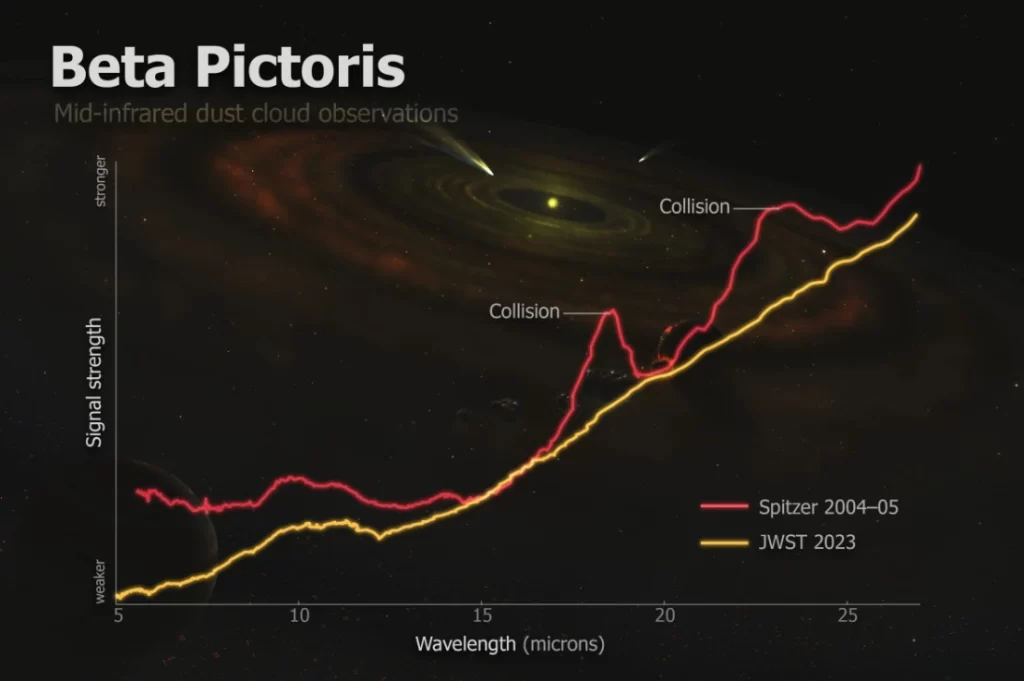
- The study was based on a combination of fresh observations by the JWST’s sophisticated technology and older data from the Spitzer Telescope observed between 2004 and 2005, which found dust particles orbiting Beta Pictoris star system.
- Utilizing JWST’s technology, the researchers witnessed that there was a significant change in the energy signature of these dust particles implying that a catastrophic collision between asteroid-sized debris smashed them into fine dust.
A new study has been conducted by researchers at John Hopkins University which provides evidence of a colossal asteroid collision in the neighboring Beta Pictoris star system, giving fresh insights on planetary formation processes. This study was made possible by combining data from NASA’s James Webb Space Telescope (JWST) and older data from the Spitzer Telescope.
Beta Pictoris is a young star system located only 63 light years from Earth. It is only 20 million years old and is a perfect laboratory for astronomers to understand the planetary formation process. In recent years, it has widely attracted researchers because of its massive debris disk and the presence of at least two gas giants.
The study presented at the 244th Meeting of the American Astronomical Society provides concrete evidence that a massive asteroid collision took place in the Beta Pictoris system about 20 years ago with an additional 63 years accounting for the light it took to reach Earth.
“Beta Pictoris is at an age when planet formation in the terrestrial planet zone is still ongoing through giant asteroid collisions, so what we could be seeing here is basically how rocky planets and other bodies are forming in real-time,” said Christine Chen, the principal researcher stressed the importance of this observation.
Asteroids which are relics of the early stages of a star system, provide significant details about the formation of new planets. About 4.5 billion years ago, asteroids collided in our solar system which led to the birth of new planets. The Beta Pictoris system, which is substantially younger, captures a snapshot of this process in motion.
The JWST observations revealed that the Spitzer observed dust particles about 19 – 20 years ago had been replaced by much smaller ones, implying a recent collision. This event has produced 100 000 more dust than the asteroid that wiped out the dinosaurs from Earth.
Beta Pictoris has two gas giants, Beta Pictoris b and Beta Pictoris c. The presence of these indicates that massive planets originate earlier on during a star system’s life cycle while rocky planets take longer to form accounting for smaller materials such as asteroids.
“The question we are trying to contextualize is whether this whole process of terrestrial and giant planet formation is common or rare,” said co-author Kadin Worthen, a doctoral student in astrophysics at Johns Hopkins. “We’re basically trying to understand how weird or average we are.”
This research has also brought to the forefront the immense capabilities of the JWST’s advanced technology which can provide surprising new facts about exoplanetary occurrences. Unlike conventional studies, where the telescope observes new details, this particular research concentrated on what the telescope did not see i.e. the premise of the original dust vanishing and a finer, more immaculate dust taking its position implying that a big collision has taken place..
“This real-time observation of a massive asteroid collision not only enhances our understanding of Beta Pictoris but also provides a valuable reference for studying other young star systems,” Chen concluded. “Future research can build on these findings to further unravel the mysteries of planetary formation.”
References:
1 Webb Telescope Reveals Asteroid Collision in Neighboring Star System – JHU/HUB – June 10, 2024

Harsha Borah is an experienced content writer with a proven track record in the industry. Harsha has worked with LitSpark Solutions and Whateveryourdose, honing skills in creating engaging content across various platforms. A gold medalist in a state-level writing competition organized by Assam Tourism, Harsha’s travelogue on Tezpur was widely appreciated. Harsha’s article, "The Dark Tale of the Only Judge in India to Be Hanged," ranks second on Google and has garnered over 11 000 views and 8 900 reads on Medium. Outside of writing, Harsha enjoys reading books and solving jigsaw puzzles.

Commenting rules and guidelines
We value the thoughts and opinions of our readers and welcome healthy discussions on our website. In order to maintain a respectful and positive community, we ask that all commenters follow these rules.