
Strange behavior of Antarctic noctilucent clouds
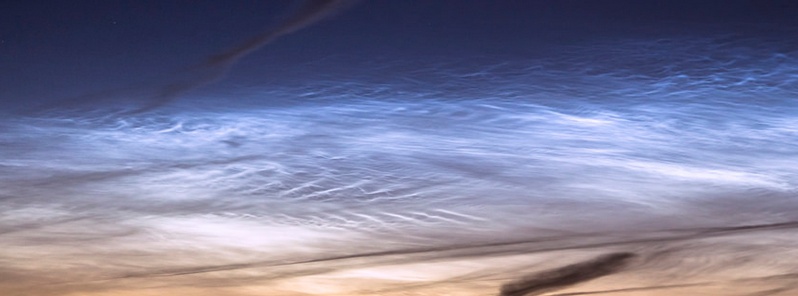
Image credit: Noctilucent clouds by Pawel Maryanov (CC - Flickr)
The southern noctilucent clouds (NLCs) season is over now, but looking back over the entire season reveals something unexpected.
In an 8-year plot of the Antarctic noctilucent cloud frequencies, the 2014/15 season is clearly different from the rest, SpaceWeather reports.
"This past season was not like the others," notes Cora Randall, a member of the AIM science team and the chair of the Department of Atmospheric and Oceanic Sciences at the University of Colorado.
"The clouds were much more variable, and there was an enormous decrease in cloud frequency 15 to 25 days after the summer solstice. That's when the clouds are usually most abundant."

These data come from the AIM spacecraft, which was launched in 2007 to monitor NLCs from Earth orbit. The curves show the abundance ("frequency") of the clouds vs. time for 120 days around every southern summer solstice for the past 8 years.
Previous research shows that NLCs are a sensitive indicator of long-range teleconnections in Earth's atmosphere, which link weather and climate across hemispheres. The strange behavior of noctilucent clouds in 2014/15 could be a sign of previously unknown linkages.
"Preliminary indications are that it is indeed due to inter-hemispheric teleconnections," says Randall. "We're still analyzing the data, so stay tuned."
Attention now turns to the northern hemisphere, where the season for NLCs typically begins in May.
Source: SpaceWeather

Teo Blašković founded The Watchers in 2011 and edited it until 2026, covering seismic and volcanic activity, extreme weather, space weather and near-Earth objects. Articles on this page are his archive.
Published in the last 24 hours
- High Risk of excessive rainfall covers Florida’s Space Coast as St. Johns River near Cocoa reaches 5.67 m
- Four small asteroids will pass close to Earth from November 21 to 23
- Cyclone Akvan weakens after landfall near Gopalpur; more than 300 000 evacuated in Odisha, India
- A broad low over southeastern Florida and the northwestern Bahamas has a 30 percent chance of subtropical or tropical development within 48 hours and a 50 percent chance within 7 days, the National Hurricane Center says

Whats the significance?
it looks to me like the sort of beautifull positive strangeness we should learn to expect from the photon vortex energy.