
Morrill Fire becomes largest in Nebraska history as statewide fires top 243 000 ha (600 000 acres)
A wildfire outbreak in western and central Nebraska has burned more than 243 000 ha (600 000 acres) since March 12, 2026, according to state officials, including the Morrill Fire, which Gov. Jim Pillen described as the largest wildfire in Nebraska history. One fatality has been confirmed as strong winds and critically dry vegetation fueled a rapid fire spread across the Nebraska Sandhills. The fires have also burned parts of Crescent Lake National Wildlife Refuge within the Sandhills, a region regarded as the world’s most intact temperate grassland.
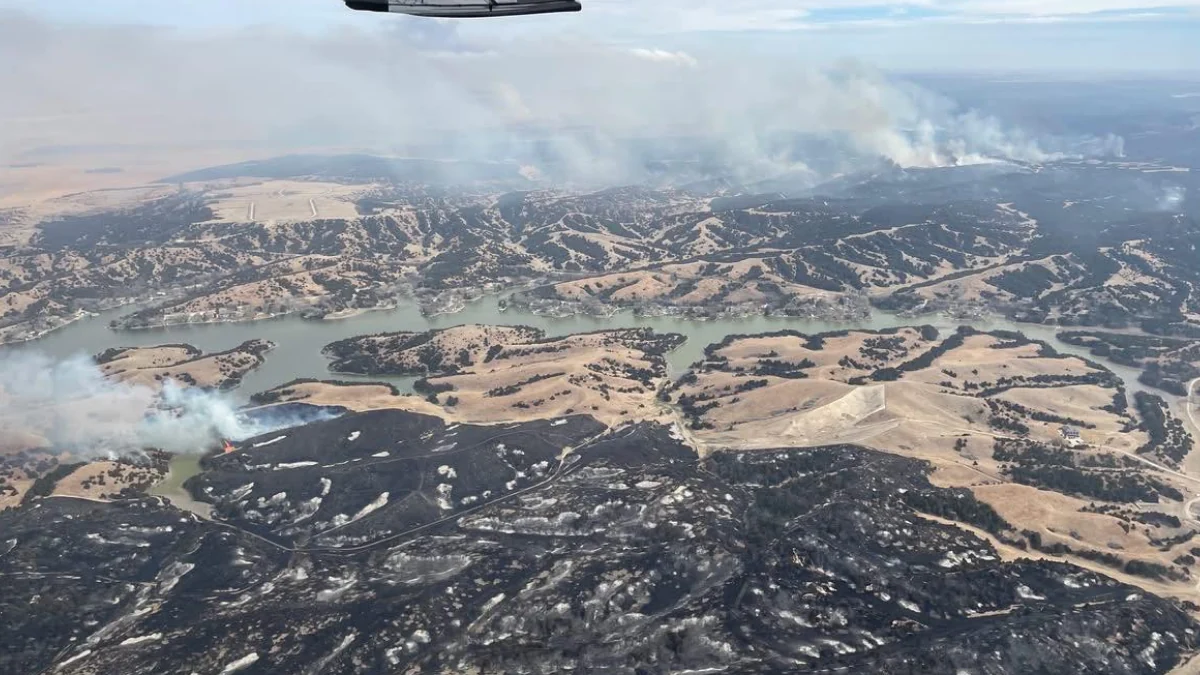
Aerial view of Cottonwood Fire and the areas scorched by it in Nebraska on March 15, 2026. Credit: NEMA
Multiple wildfires ignited across western and central Nebraska on March 12, rapidly spreading across the grasslands of the Nebraska Sandhills. The largest of them, the Morrill Fire, became the largest wildfire in Nebraska history.
The fires have collectively burned more than 243 000 ha (600 000 acres), equivalent to approximately 2 430 km² (940 square miles), according to state officials. Governor Jim Pillen said on March 14 that an 86-year-old woman died while attempting to flee the Morrill Fire.
The Morrill Fire is the largest of the active blazes and has burned about 186 000 ha (460 000 acres) as of March 15, according to state and media reports. Officials reported that the fire spread more than 110 km (70 miles) in less than 12 hours during the early stages of the event.
Parts of Crescent Lake National Wildlife Refuge have burned within the Morrill Fire perimeter, based on fire-mapping data. The refuge lies within the Nebraska Sandhills, a region regarded as the world’s most intact temperate grassland.
The Nebraska Sandhills are widely regarded as one of the most important remaining examples of native prairie ecosystems globally, largely because vast areas of grassland have not been converted to agricultural use yet.
Meanwhile, the Cottonwood Fire, burning southeast of the main fire zone, has burned more than 49 000 ha (121 000 acres). Authorities reported more than two dozen wildfire ignitions across western and central Nebraska during the same week.
Governor Pillen declared a State of Emergency on March 13 and issued a statewide burn ban as officials attempted to prevent additional wildfire ignitions.
As of March 14, four of the largest fires were the Morrill Fire, Cottonwood Fire, Road 203 Fire, and Anderson Bridge Fire. State officials said the major fires remained at 0% containment during the early stages of suppression.
The wildfire outbreak developed during a period of critically dry vegetation and strong winds, leaving prairie fuels highly susceptible to ignition and rapid fire spread.
Strong winds further accelerated the fires, with gusts up to 105 km/h (65 mph) reported across parts of Nebraska, creating conditions that favored rapid fire spread across open grassland terrain.
Fire suppression efforts have involved local fire departments, state agencies, and aerial firefighting operations, with additional support from the Nebraska National Guard, working to slow the spread of the fires.
Reference:
1 Critical intact prairie widely burned in Nebraska’s largest wildfire – Wildfire Today – March 16, 2026
2 Grandmother killed in Nebraska wildfire was ‘fearless’ and ‘loved by many’ – NPM – March 15, 2026

I am an Assistant Editor and Severe Weather & Science Journalist at The Watchers, specializing in real-time severe weather coverage, geophysical event reporting, and research-driven scientific analysis. You can reach me at rishav(at)watchers(.)news.

Commenting rules and guidelines
We value the thoughts and opinions of our readers and welcome healthy discussions on our website. In order to maintain a respectful and positive community, we ask that all commenters follow these rules.