
At least 3 dead in Kagoshima and Kumamoto following record rains in southern Japan
At least three people have been confirmed dead in Kumamoto and Kagoshima prefectures, after record-breaking rainfall triggered deadly floods and landslides across southern Japan between August 10 and 11, 2025.
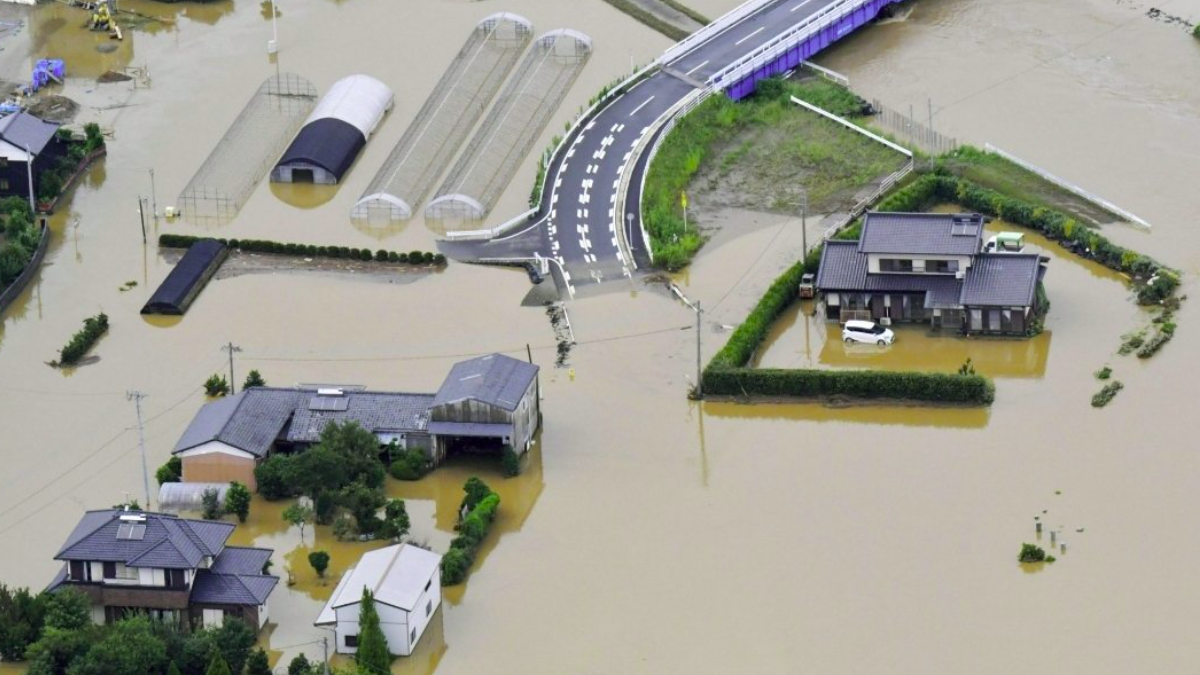
Flooding in Japan on August 11, 2025. Credit: miuJ19
A quasi-stationary low-pressure front over Kyushu produced record-breaking rainfall in southern Japan between August 10 and 11, causing the heaviest impacts in Kumamoto Prefecture and leaving at least three people dead.
In Aira City, Kagoshima Prefecture, a mudslide caused a house to collapse. A woman in her 30s who was living in the house was confirmed dead on August 11.
On August 12, officials in Kumamoto’s Kosa Town confirmed the death of a man in his 50s after he was caught in a landslide. A woman in her 70s was also confirmed dead after being found in a car that sank in an irrigation canal in Yatsushiro City.
Flood in Japanpic.twitter.com/QjEdoQPOvY
— Devil (@whyNotMio) August 12, 2025
Officials in Kumamoto Prefecture confirmed that at least two people remain missing in the prefecture — a man and a woman in their 60s after being swept away by a river in Fukutsu City, Fukuoka Prefecture.
The Japan Meteorological Agency (JMA) reported more than 370 mm (14.6 inches) of rain in Tamana City in just six hours, a local record and nearly double the average August total.
On 11 August 2025, heavy rains caused flooding in Kumamoto Prefecture, Japan. In some places up to 400 mm of precipitation fell in a day, which is more than the monthly rainfall in August!#Japan #flooding #Flood #ClimateEmergency pic.twitter.com/FCmXjdMi4M
— Tom Friday (@Tom2000Friday) August 11, 2025
Japan is the cleanest country ever. Even flood water are so clear. pic.twitter.com/ywtwIToz2H
— CONTEXT VIDEOS (@Context2X) July 25, 2025
Parts of Kumamoto reportedly received over 400 mm (15.7 inches) in 24 hours between August 10 and 11.
The deluge caused rivers to overflow, inundating roads and residential areas, while landslides destroyed homes and blocked access routes.
At least three houses have collapsed, while over 700 have been flooded in Kagoshima, Kumamoto, and Fukuoka prefectures due to the intense rainfall.
熊本の上天草・松島町の状況 現場からは以上です。 pic.twitter.com/OWWSVo7Shz
— シゲさん_右脳感覚いなか暮らし (@shuret_77) August 11, 2025
The Fire and Disaster Management Agency (FDMA) said more than 3 million people across Kyushu were under evacuation advisories, including about 384 000 in Kumamoto under the highest warning level.
Heavy rainfall is expected to persist in areas from the Sea of Japan side of western Japan.
The threat of flooding and landslides remains for areas around swollen or overflowing rivers, and officials urge citizens to remain alert. Lightning, violent gusts, tornadoes, and hail will also be a threat for the region over the next couple of days.

I’m a science journalist and researcher at The Watchers, contributing to the Epicenter edition, where I cover peer-reviewed scientific research and emerging discoveries across Earth and space sciences. With a background in astronomy and a passion for environmental science, I’ve worked in shark and coral conservation in Fiji, conducting reef and shark-behavior research, contributing to mangrove restoration, and earning PADI Open Water and Coral Reef Certifications. I bring a blend of scientific rigor and storytelling to illuminate the discoveries shaping our planet and beyond.
Published in the last 24 hours
- In January 2000, chunks of ice weighing up to 6 pounds fell out of clear blue skies over Spain for 10 days. One smashed through a car windshield, and scientists still can’t fully explain where they came from Epicenter
- El Niño reaches 2.0°C on NOAA’s index, a tenth of a degree behind 1997–98 at the same point, as forecasters expect it to challenge the all-time record this winter
- The fastest wind gust ever measured on Earth, 253 mph, hit an oil island off Australia during Cyclone Olivia in 1996, and nobody noticed for more than a decade, until experts reading old data quietly took the record from New Hampshire's Mount Washington Epicenter
- In 1954, a grapefruit-sized meteorite crashed through a roof in Sylacauga, Alabama, and struck Ann Hodges as she napped on her couch Epicenter
