
Klyuchevskoy volcano enters high-hazard phase, paroxysmal eruption forecast within 72 hours
Eruptive activity at Klyuchevskoy volcano intensified after M 8.8 earthquake on July 29, 2025, with a large lava flow descending the WSW flank, continuous lava fountaining, and a significant ash plume. Based on volcanic tremor data and current eruptive behavior, a paroxysmal eruption is considered likely within the next 72 hours.

Eruption at Klyuchevskoy volcano on August 5, 2025. Credit: Institute of Volcanology and Seismology, Far Eastern Branch of the Russian Academy of Sciences (IViS FEB RAS)
A paroxysmal eruption is forecast at Klyuchevskoy volcano, Kamchatka Peninsula, within the next three days following a sharp twofold increase in volcanic tremor recorded shortly after M8.8 earthquake struck Avacha Bay on July 29.
Klyuchevskoy volcano has been in a summit explosive-effusive eruption phase since April 20 and is currently ejecting incandescent fragments up to 500 m (1 640 feet) above the crater rim and producing an ash column reaching approximately 8 km (26 200 feet) above sea level.
Lava flows are advancing down the southwestern slope toward the Bogdanovich Glacier basin, triggering rapid glacial melt. The resulting meltwater is generating powerful mudflows that are sweeping through surrounding terrain.
The situation has increased significantly since July 25, when the first lava flows appeared, and particularly after the large-magnitude earthquake. One of the major infrastructural failures includes the destruction of a dam built in 2023 on the Studenaya River. The river is now flowing through both of its natural channels, increasing downstream flooding risk.
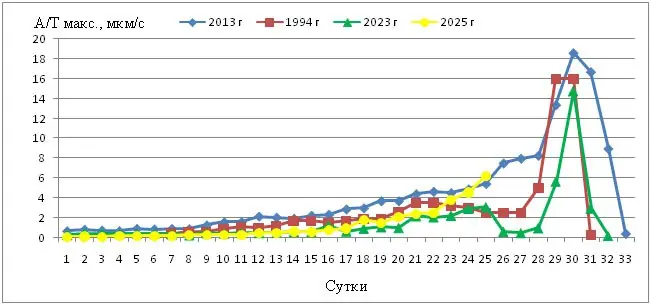
Volcanologists consider the current tremor profile and eruptive behavior to be highly similar to those preceding previous paroxysmal eruptions of Klyuchevskoy on October 1, 1994, October 20, 2013, and October 31, 2023.
Those events were characterized by ash columns reaching up to 12 km (39 400 feet) a.s.l., multi-kilometer lava flows, and extensive mudflows caused by glacier melt. Infrastructure damage was reported as far as 60 km (37 miles) from the summit.
During the peak phases, ashfall several millimeters (up to 0.1 inch) thick was observed in multiple settlements. Each of these paroxysms was followed by rapid decrease in tremor amplitude.
The public is strongly advised to avoid the entire area surrounding the volcano, including the Tolbachik volcanic zone, where flooding hazards are elevated due to meltwater drainage along the Studenaya River. Hiking, observation, and any form of travel near the volcano are currently considered dangerous.

I'm a dedicated researcher, journalist, and editor at The Watchers. With over 20 years of experience in the media industry, I specialize in hard science news, focusing on extreme weather, seismic and volcanic activity, space weather, and astronomy, including near-Earth objects and planetary defense strategies. You can reach me at teo /at/ watchers.news.

Where is my Nobel Prize in geophysics ? I am kidding you. I will never accept a Nobel Prize, although time will show that my physics theory deserves one million Nobel Prizes.