
Explosive eruption at Sheveluch sends ash to 11 km (36 000 feet), Aviation Code Raised to Red, Russia
Explosive activity at Sheveluch volcano, Kamchatka, Russia, sent volcanic ash to 11 km (36 000 feet) above sea level on March 29, 2026, prompting authorities to raise the Aviation Color Code to Red.

Ash rising over Sheveluch volcano on March 29, 2026. Credit: JMA/Himawari-9, Zoom Earth, The Watchers
Explosive activity was recorded at Sheveluch volcano in Kamchatka, Russia, on March 29, based on video observations from the Kamchatka Volcanic Eruption Response Team (KVERT) and satellite imagery.
The eruption lasted approximately 30 minutes and produced an ash plume rising to 11 km (36 000 feet) above sea level, according to the Tokyo Volcanic Ash Advisory Centre.
KVERT raised the aviation color code to Red at 02:52 UTC following confirmation of the explosive event.
Observations showed that the ash plume drifted east from the volcano, extending about 10 km (6 miles) from the summit. The event occurred within an ongoing explosive–extrusive phase characterized by continued lava dome growth in the northern sector of the Young Sheveluch dome and persistent gas-steam emissions.
Subsequent satellite analysis showed no additional explosive activity later in the day.
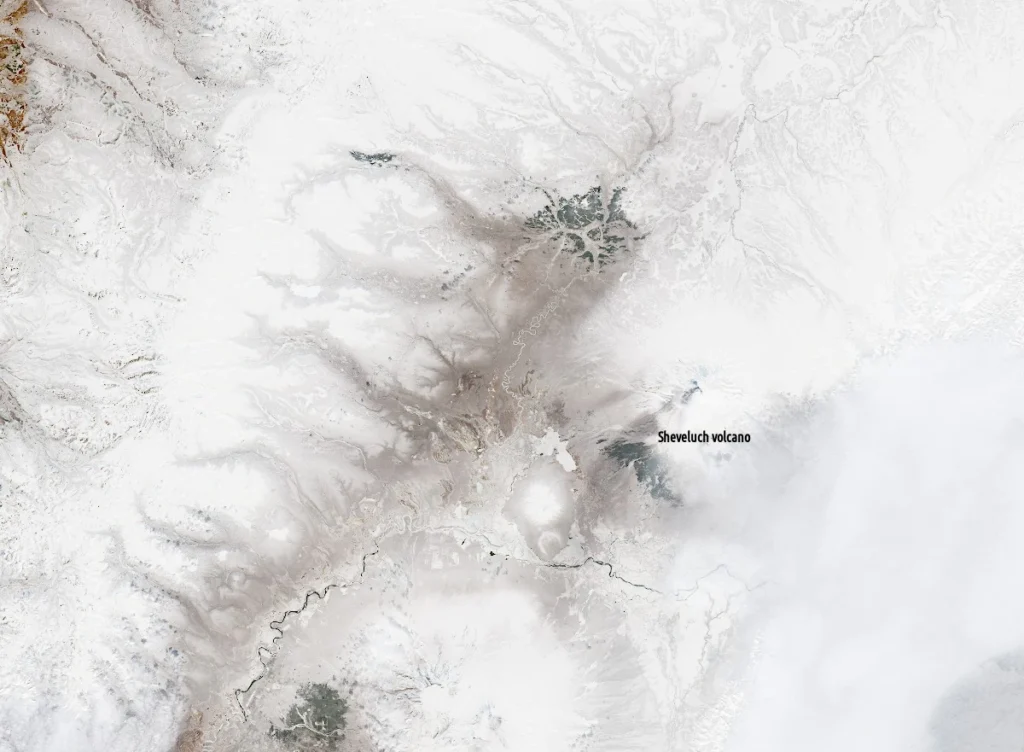
By 11:29 UTC on March 29, KVERT lowered the aviation color code to Orange after determining that no new ash-producing explosions were occurring. However, a residual ash cloud at approximately 4.5 km (14 800 feet) above sea level was tracked moving about 390 km (242 miles) to the northeast.
Sheveluch remains in an active eruptive phase, with dome growth continuing and intermittent ash-producing explosions possible. KVERT stated that further ash emissions up to 12 km (39 400 feet) above sea level could occur at any time, maintaining an ongoing hazard to both international and low-flying aircraft in the region.
The volcano has exhibited sustained activity in recent weeks. Prior reports noted repeated ash emissions reaching similar altitudes and ongoing extrusion of lava within the summit dome complex.
References:
1 Volcanic Activity Notice for Sheveluch volcano – FEB RAS/KVERT – March 29, 2026

Teo Blašković founded The Watchers in 2011 and edited it until 2026, covering seismic and volcanic activity, extreme weather, space weather and near-Earth objects. Articles on this page are his archive.
Published in the last 24 hours
- In September 1859, a solar storm lit up the night sky so brightly that gold miners in the Rocky Mountains woke up after midnight and started cooking breakfast, convinced the aurora glowing over their camp was the sunrise Epicenter
- A patch of warm Pacific water that could become the strongest El Niño in more than 70 years sits thousands of miles from any American town, yet it is already the main reason NOAA expects a wetter winter across the South and a milder one across the North
- A 19-year-old Nebraska teacher reportedly tied her pupils together with twine and led them to safety through a blizzard in January 1888 Epicenter
- NASA built the Opportunity rover to last 90 days on Mars, and Martian winds helped keep it alive for nearly 15 years by blowing dust off its solar panels, until a planet-wide dust storm in 2018 blocked sunlight and silenced the rover Epicenter
