
Explosive eruption at Bezymianny volcano sends ash to 11.4 km (37 000 feet), Kamchatka
A powerful explosive eruption took place at Bezymianny volcano in Kamchatka, Russia, on November 26, 2025, with ash reaching 11.4 km (37 400 feet) a.s.l., as of 04:00 UTC. The Aviation Color Code was raised to Red due to ongoing explosions that could affect regional and international flights.
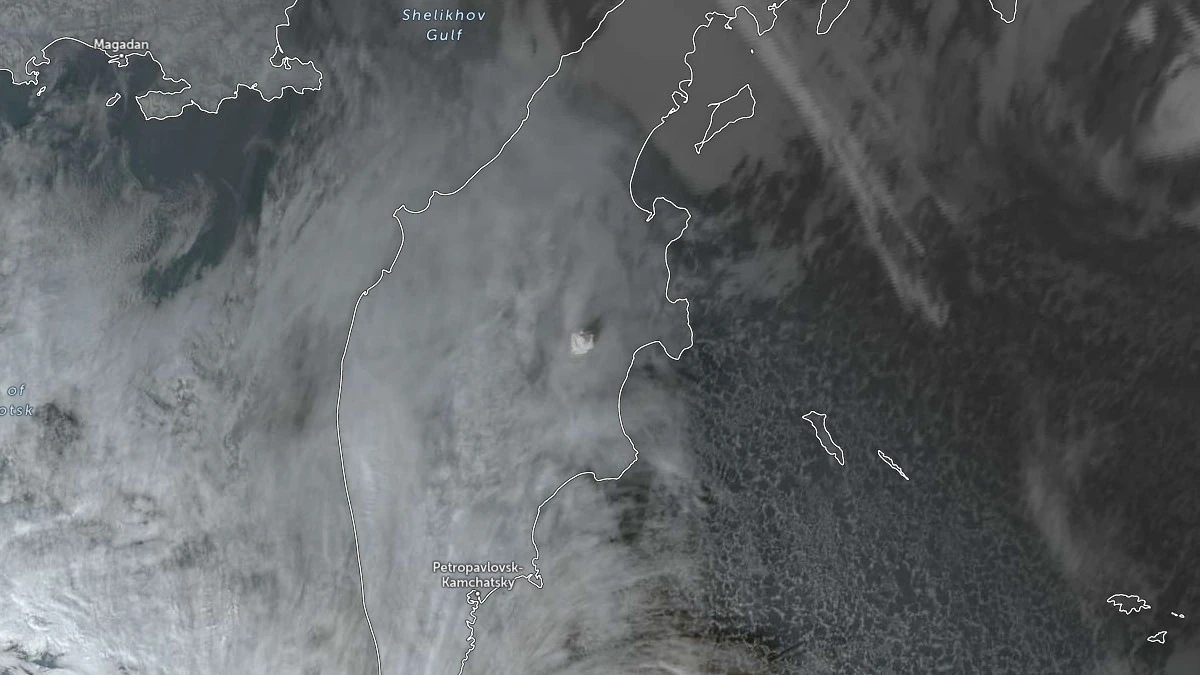
Ash rising above Bezymianny volcano on November 26, 2025. Credit: JMA/Himawari-9, Zoom Earth, The Watchers
Explosive activity at Bezymianny volcano, Kamchatka, persists according to the Kamchatkan Volcanic Eruption Response Team (KVERT).
The agency reported continuing explosions that sent ash up to approximately 11.4 km (37 400 feet) above sea level at 16:00 LT (04:00 UTC) on November 26.
A dense ash cloud, estimated at 70 x 50 km (43 x 31 miles), was observed drifting east-northeast of the volcano at an azimuth of 57°, based on Himawari-9 satellite imagery acquired at 04:00 UTC.
The Aviation Color Code remains Red, indicating an ongoing eruption with ash emissions posing potential hazards to both international and low-flying aircraft.
KVERT reported that activity at Bezymianny had been gradually increasing prior to the eruption, with a large bright thermal anomaly visible in satellite imagery between November 16 and 20.
The Far Eastern Branch of the Russian Academy of Sciences (FEB RAS) noted that on most days during that period, hot avalanches descended the southeastern flank, crater incandescence was visible, and occasional ash plumes, produced either at the summit or by avalanches, rose as high as 4 km (13 100 feet) a.s.l.
Scientists from the Kamchatka Volcanological Station (Volkstat) visited the volcano on November 20 and observed hot avalanches descending the southwestern part of a newly formed viscous lava dome.
The modern Bezymianny, much smaller than its massive neighbors Kamen and Kliuchevskoi on the Kamchatka Peninsula, was formed about 4 700 years ago over a late-Pleistocene lava-dome complex and an edifice built about 11 000–7 000 years ago.
Three periods of intensified activity have occurred during the past 3 000 years. The latest period, preceded by about 1 000 years of quiescence, began with the dramatic 1955–56 eruption. That eruption, similar in character to the 1980 eruption of Mount St. Helens, produced a large open crater formed by the collapse of the summit and an associated lateral blast.
Subsequent episodic but ongoing lava-dome growth, accompanied by intermittent explosive activity and pyroclastic flows, has largely filled the 1956 crater.

I'm a dedicated researcher, journalist, and editor at The Watchers. With over 20 years of experience in the media industry, I specialize in hard science news, focusing on extreme weather, seismic and volcanic activity, space weather, and astronomy, including near-Earth objects and planetary defense strategies. You can reach me at teo /at/ watchers.news.

Commenting rules and guidelines
We value the thoughts and opinions of our readers and welcome healthy discussions on our website. In order to maintain a respectful and positive community, we ask that all commenters follow these rules.