
Powerful M8.8 earthquake and tsunami strike Kamchatka Peninsula, sixth strongest earthquake on record
A powerful earthquake registered by the USGS as M8.8 hit near the coast of Kamchatka, Russia, at 23:24 UTC on July 29, 2025 (11:24 local time on July 30). The earthquake occurred at a depth of approximately 21 km (13 miles) and generated a Pacific-wide tsunami, prompting warnings, advisories, and evacuations across multiple countries and territories.
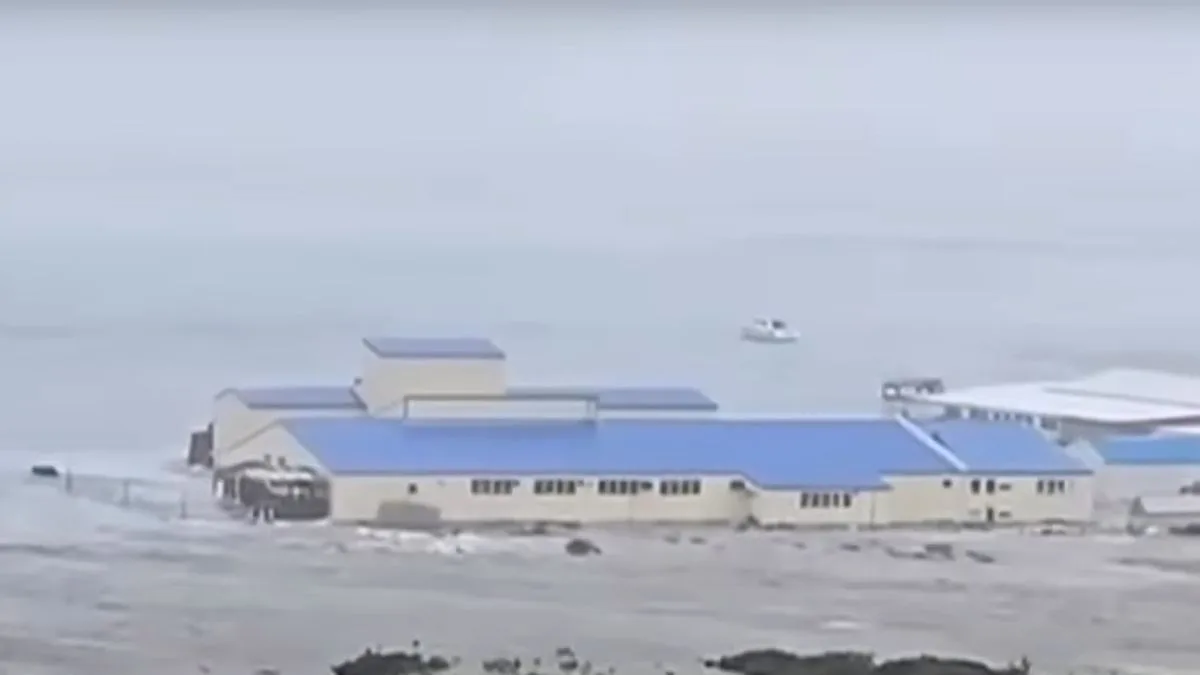
Tsunami waves hit Kamchatka, Russia after M8.8 earthquake on July 29, 2025. Credit: Reuters (stillshot)
- This is the largest earthquake in the world since the 2011 M9.0 Tōhoku, Japan earthquake
- It is also the sixth-strongest earthquake ever recorded instrumentally and the strongest in Russia since the 1952 M9.0 Kamchatka earthquake
- The last earthquake of similar magnitude was the M8.8 Maule, Chile earthquake in 2010
- The earthquake generated a Pacific-wide tsunami, with waves up to 4 m (13 feet) recorded in Russia’s Kuril Islands
- Tsunami warnings, advisories, and watches were issued for Japan, the United States, Canada, Hawaii, and multiple Pacific territories
- Evacuations were conducted in coastal regions of Russia, Japan, Hawaii, and other areas under threat from tsunami waves
- Tsunami wave heights ranged from 0.3 to 1 m (1 to 3.3 feet) across the Pacific, with hazardous currents reported along the U.S. West Coast and Alaska
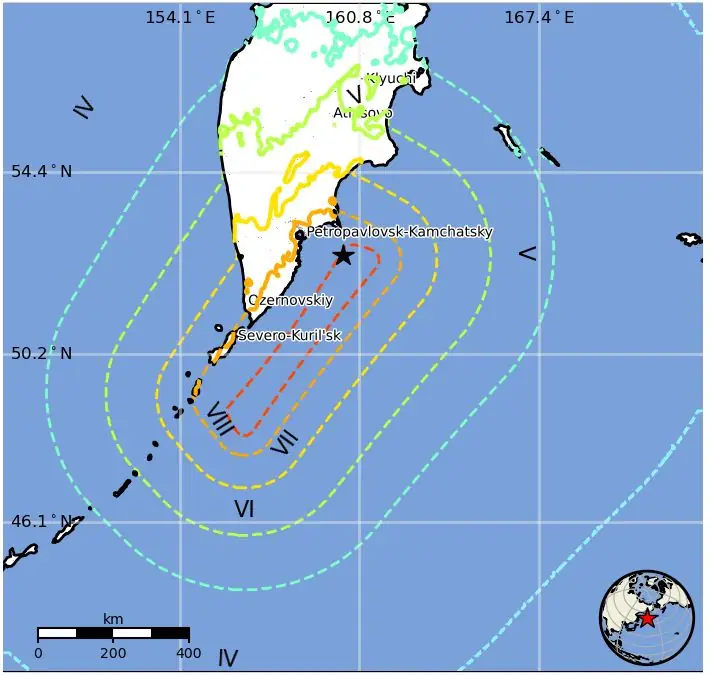
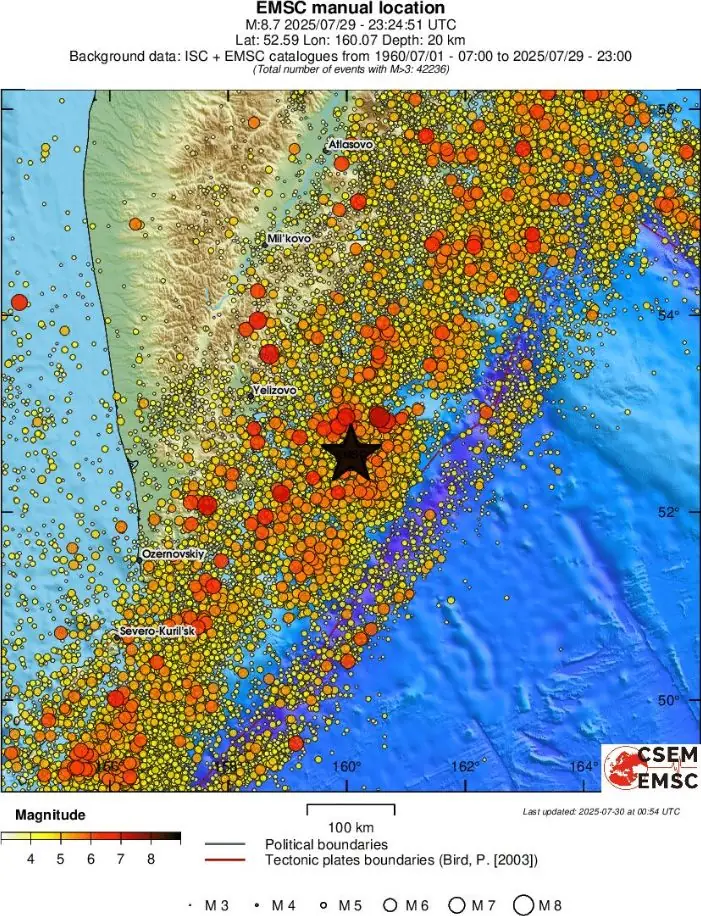
The epicenter was located 120 km (74 miles) ESE of Petropavlovsk-Kamchatsky (population 181 216), and 126 km (79 miles) ESE of Vilyuchinsk (population 25 204), Kamchatka, Russia.
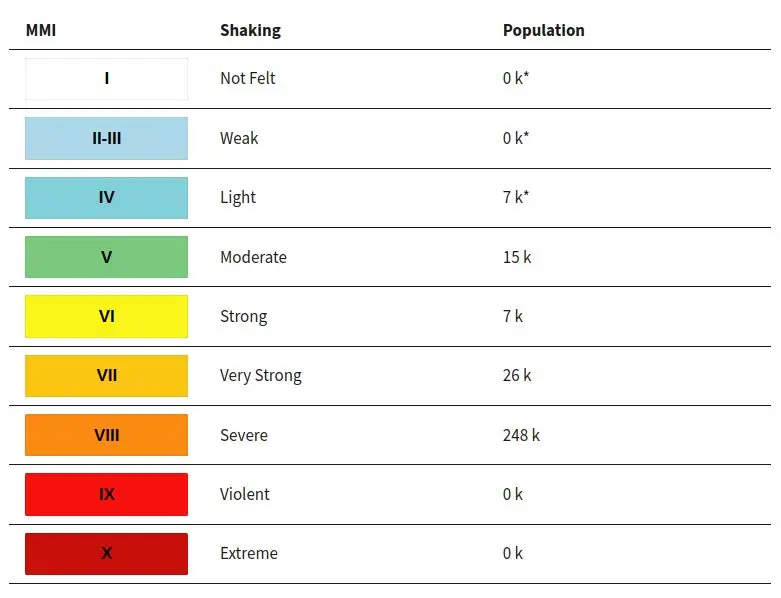
248 000 people are estimated to have felt severe shaking, 26 000 very strong, 7 000 strong, and 15 000 moderate.
The strongest tsunami waves were observed along Russia’s eastern coast, particularly in Severo-Kurilsk, where wave heights reached 3 to 4 m (10 to 13 feet). Authorities initiated coastal evacuations, and local reports confirmed moderate infrastructure damage.
In the town of Severo-Kurilsk, waves flooded coastal infrastructure, damaged a local fish processing facility, and partially submerged vessels anchored in port. A kindergarten building sustained structural damage, and temporary power outages occurred in the Sakhalin region.
Approximately 2 700 residents were evacuated. Local authorities reported minor injuries associated with evacuation movements and building vibrations, but no fatalities.
In Japan, tsunami waves of up to 0.6 m (2 feet) were recorded along the northern coastline, including Hokkaido. Precautionary evacuations were ordered in vulnerable areas, including coastal districts near the Fukushima Daiichi nuclear plant. Evacuation orders were issued for more than 900 000 residents in low-lying zones.
Transportation services, including regional rail and ferry lines, were temporarily suspended. Flights from several regional airports were delayed or canceled. The Fukushima Daiichi nuclear power plant reported no incidents, with staff sheltering in place as a precaution and safety systems functioning normally.
In Hawaii, the Pacific Tsunami Warning Center (PTWC) issued an alert covering the entire archipelago. Forecasts indicated potential wave heights of up to 1 m (3.3 feet).
Authorities ordered evacuations of coastal zones and advised residents to move at least 120 m (400 feet) inland or to elevated structures. Wave arrival times varied across the islands, with strong currents persisting for several hours.
The U.S. National Tsunami Warning Center (NTWC) issued a tsunami advisory for the West Coast of the United States, from the California–Mexico border to Cape Flattery, Washington. Observed and forecast wave heights ranged from 0.3 to 0.6 m (1 to 2 feet).
While no inundation of dry land was expected, officials warned of hazardous conditions in harbors, bays, and nearshore waters. Dangerous currents were also reported in parts of coastal British Columbia.
Tsunami activity was observed in the Aleutian Islands, Alaska, with recorded wave amplitudes of approximately 0.3 m (1 foot). A tsunami warning for parts of the Aleutian chain was downgraded after initial assessments confirmed limited impact.
Elsewhere in the Pacific, tsunami watches and advisories were issued for Guam, Micronesia, New Zealand, Taiwan, the Philippines, and other territories. Most observed wave amplitudes remained below 0.5 m (1.6 feet).
U.S. Tsunami Warning Centers (NTWC and PTWC) warned that multiple waves were possible, and the first wave may not be the largest. Tsunami activity could persist for more than 24 hours after the initial arrival, depending on local bathymetry and resonance effects. Residents in affected regions were urged to avoid coastal areas, beaches, ports, and estuaries until official all-clear notices are issued.
Significant aftershocks followed the mainshock, including one at M6.9, increasing the risk of further tsunami generation or localized instability.
The USGS issued a Yellow alert for shaking-related fatalities and a Red alert for economic losses. Extensive damage is probable, and the disaster is likely widespread. Estimated economic losses are 0-4% GDP of Russia. Past events with this alert level have required a national or international level response.
Overall, the population in this region resides in structures that are resistant to earthquake shaking, though vulnerable structures exist. The predominant vulnerable building types are adobe block and unreinforced brick with mud construction.
Recent earthquakes in this area have caused secondary hazards such as tsunamis that might have contributed to losses.
According to the USGS, this earthquake was the result of shallow reverse faulting along the subduction interface between the Pacific and North America plates. At the location of the event, the Pacific plate is converging toward the North America plate at a rate of approximately 80 mm (3.1 inches) per year.
The earthquake’s location and focal mechanism are consistent with thrust faulting on the interface of the Kuril-Kamchatka subduction zone.
The estimated rupture dimensions are approximately 390 x 140 km (242 x 87 miles). The event released significant accumulated stress along a highly active convergent boundary where the Pacific plate subducts northwestward beneath the North America plate.
The July 29 M8.8 earthquake is the largest to occur globally since the 2011 M9.0 Tōhoku earthquake in Japan. It ranks among the ten strongest earthquakes recorded instrumentally since 1900 and is the strongest earthquake to strike Russia since the M9.0 Kamchatka earthquake of 1952.
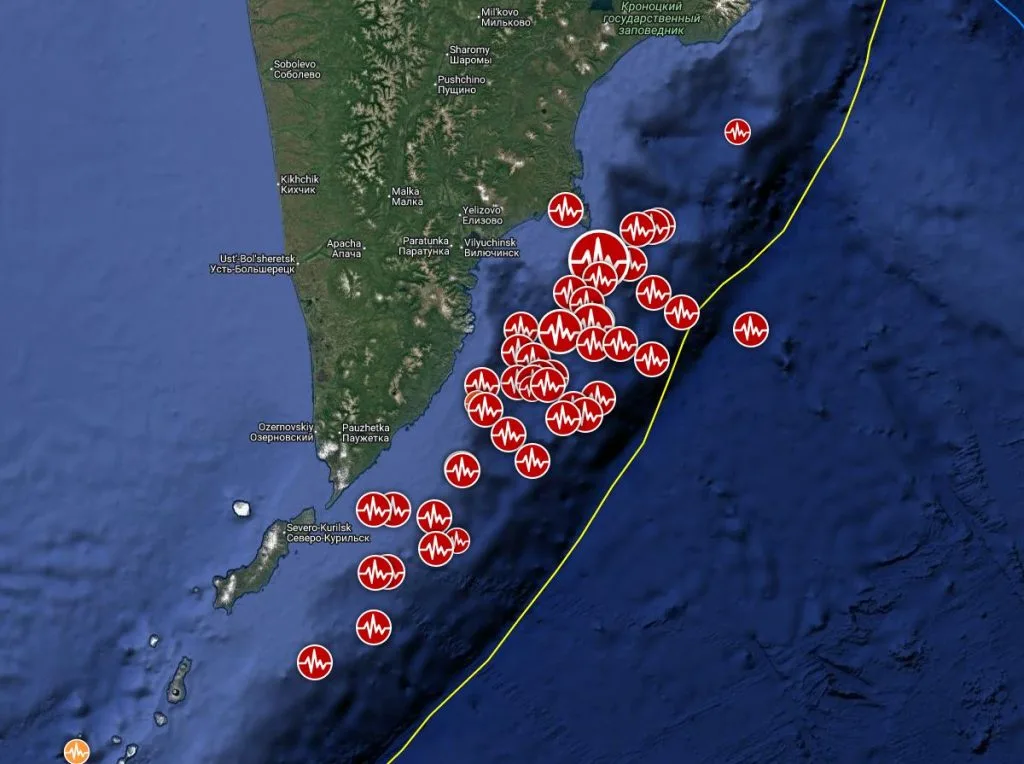
The 2025 mainshock occurred during a period of elevated seismic activity offshore the Kamchatka Peninsula that began approximately ten days earlier. In the days leading up to the mainshock, over 50 earthquakes of magnitude 5.0 and above were recorded in the region, including an M7.4 earthquake on July 20 and three events of magnitude 6.6.
As of 04:00 UTC on July 30, a total of 24 aftershocks of magnitude 5.0 or higher had been recorded, including M6.9 and M6.3 events. These aftershocks are distributed around the rupture area and are consistent with typical patterns of stress adjustment following a megathrust earthquake.
This segment of the Kuril-Kamchatka subduction zone has generated nearly 700 earthquakes of magnitude 5.0 and higher since 1990, not including the 2025 sequence.

The region has previously hosted two major megathrust events within the past century. In 1923, an M8.4 earthquake occurred approximately 150 km (93 miles) north of the 2025 epicenter.
The largest historical event in the region was the M9.0 earthquake of 1952, whose epicenter was located less than 30 km (19 miles) from that of the 2025 event. The 1952 rupture extended approximately 600 km (373 miles) to the southwest along the subduction interface.
At the convergence rate of 80 mm (3.1 inches) per year, the region has accumulated an estimated 6 m (20 feet) of potential slip since 1952. Preliminary assessments suggest the 2025 earthquake filled a gap in the rupture zone between the 1923 and 1952 events.
Further analysis will refine the spatial extent of the 2025 rupture and its relationship to previous large-magnitude earthquakes along the Kamchatka segment of the subduction zone.
Estimated population exposure to earthquake shaking
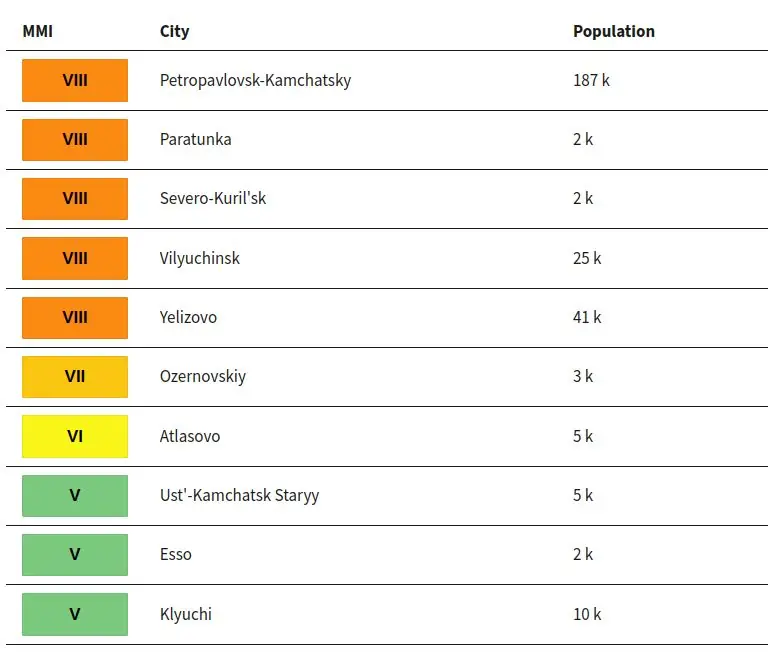
Selected cities exposed
Regional seismicity
References:
1 M8.8 earthquake Kamchatka, Russia – USGS – July 29, 2025
2 M8.8 earthquake Kamchatka, Russia – EMSC – July 29, 2025
3 M8.8 earthquake Kamchatka, Russia – PTWC – July 29, 2025

I'm a dedicated researcher, journalist, and editor at The Watchers. With over 20 years of experience in the media industry, I specialize in hard science news, focusing on extreme weather, seismic and volcanic activity, space weather, and astronomy, including near-Earth objects and planetary defense strategies. You can reach me at teo /at/ watchers.news.

The Almighty is warning earth-dwellers that the Tribulation (Revelation 6-18) is on our doorstep.
Amen. But all one has to do is look outside their window at nature. Every tree that has been limbed back, every flower that died due to lack of water.. etc.. all being reborn.. coming back. I have pine trees in my yard that are growing in FEET.. FEET.! Not inches. Went on a trip for a week. Came home to DEAD flowers.. DEAD.. Gave them some water and encouragement. The next day, looked as if nothing had happened. Revelation is indeed happening. Sadly, very few churches will even attempt to discuss the last chapters of the bible. Preachers pretending it does not exist. In the end, would be wise to remember, that GOD SEES ALL. You cannot hide. Run all you want.. he sees everything.. knows everything.. hears everything..
I have said repeatedly that the geological upheaval has started, and it will intensify in a surprising ways. Now, look to the number of earthquakes around the world.
Definitely, earth’s magnetic field has weakened further and that means the pressure of cosmic- solar radiation on the ionosphere will increase, causing massive earthquakes and explosive volcanic eruptions.
However, the events that will happen in the near future will show the people of the world the true reason behind the massive earth changes.
Nature always exposes the myth-makers.