
Sulfur dioxide from 2023 Icelandic eruption traveled 2 000 km (1 240 miles) to Arctic’s Svalbard Islands
A Chinese research team tracked sulfur dioxide (SO2) from Iceland’s Sundhnukagigar volcano, which traveled over 2 000 km (1 243 miles) to the Svalbard Islands in the Arctic in 2023, causing significant smog. The findings, published in The Innovation Geoscience, documented the long-distance environmental impact of the eruption.
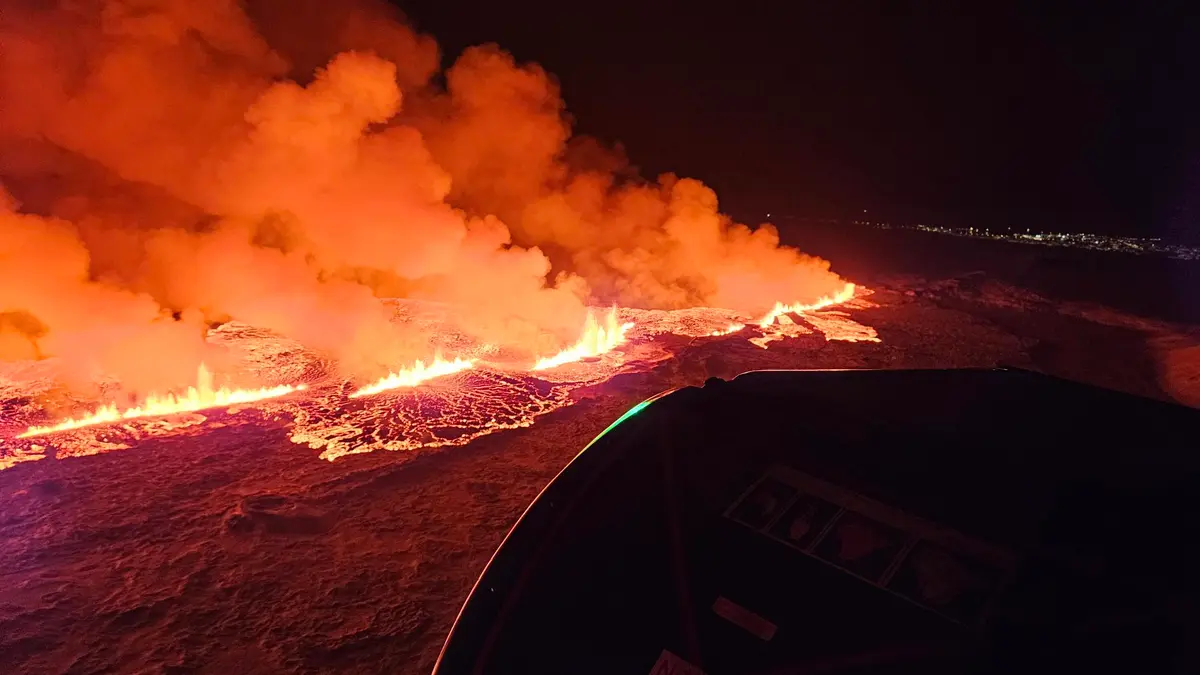
The December 18, 2023 eruption as photographed from a helicopter of the Icelandic Coast Guard. At the right in the background, Grindavík, Iceland, is visible. Image credit: Icelandic Meteorological Office
A research team from the Hefei Institutes of Physical Science recorded the long-range transport of sulfur dioxide (SO2) from Iceland’s Sundhnukagigar eruption in August 2023 to the Arctic. Led by Professors Si Fuqi and Luo Yuhan, the team used satellite and ground-based instruments to trace the 2 000 km (1 243 miles) movement of the gas to Ny-Ålesund in the Svalbard Islands. The volcano released elevated concentrations of gases into the atmosphere during the event.
The study used the Environmental Trace Gases Monitoring Instrument (EMI) aboard two Chinese satellites, GaoFen (GF5-02) and DaQi (DQ-01). These instruments provided global scans, detecting SO2 concentrations with high precision. On August 23–24, 2023, satellite data showed the SO2-rich air mass spreading south and east, temporarily affecting Scotland and Ireland.
By August 25, the pollution plume shifted northward, reaching the Arctic Svalbard region by the morning of August 26. Ground-based data from China’s Yellow River Station in Ny-Ålesund showed a sharp increase in SO2 levels, peaking at 7.34 Dobson Units (DU), approximately 40 times the typical concentration. The station, the region’s only continuous atmospheric monitoring site, also measured aerosol extinction coefficients and vertical SO2 profiles.
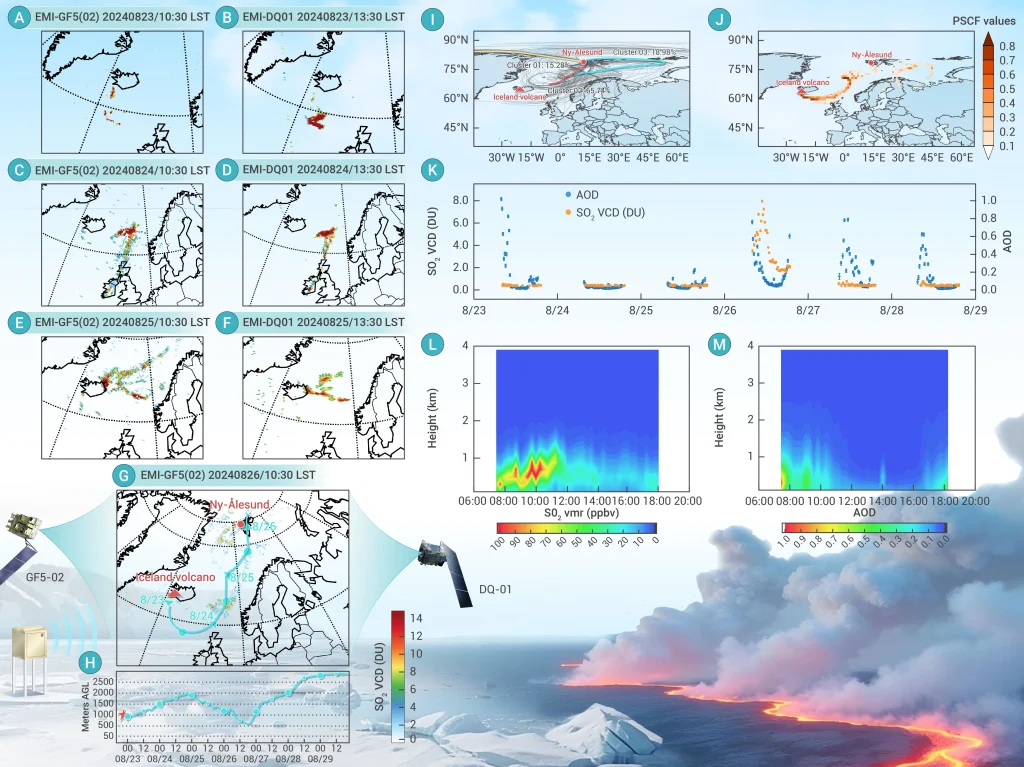
The team’s analysis found that 80% of the SO2 pollution in Ny-Ålesund originated from the Sundhnukagigar eruption. Using the Potential Source Contribution Function (PSCF) method and a 108-hour backward trajectory analysis, researchers confirmed the path of the volcanic plume. Cluster analysis showed that southwest winds, responsible for 65.74% of observed trajectories, aided the pollutant transport.
Satellite data showed SO2 concentrations exceeding 15 DU at the eruption’s peak. Ground measurements in Ny-Ålesund on August 26 recorded SO2 levels of 100 µg/m3 up to 1 km (0.62 miles) above the surface. These findings aligned with satellite data and forward trajectory simulations that mapped the spread of the pollutants over three days.
Volcanic eruptions release large amounts of gases and ash, contributing to environmental issues including acid rain and Arctic haze. Fine ash particles smaller than 2.5 microns pose respiratory risks, while sulfate particles can reflect sunlight, possibly contributing to global cooling. The Sundhnukagigar volcano, one of Iceland’s 50 active volcanoes, has erupted seven times since 2024 and remains active.
The researchers used hyperspectral satellite technology, which provides higher spectral and spatial resolution than traditional methods. By combining satellite data with ground-based measurements from the multi-axis differential optical absorption spectroscope (MAX-DOAS) at Yellow River Station, the team tracked the pollution event in detail. This approach enabled dynamic monitoring and source analysis of the pollutants.
The study also noted broader implications of volcanic activity related to global warming. Persistent volcanic emissions in permafrost regions could accelerate glacier and permafrost melting, potentially destabilizing the Earth’s crust and increasing volcanic activity. The findings support the need for multi-instrument, high-resolution monitoring to assess such impacts.
China’s Yellow River Station provided critical data, tracking gases including ozone and bromine oxide in addition to SO2. The station’s continuous operation allowed the team to document the Arctic haze event on August 26, 2023. This event was initially flagged by researchers from Stockholm University and NILU, who alerted the team to the pollution increase in Ny-Ålesund.
The research was supported by the Youth Innovation Promotion Association of the Chinese Academy of Sciences and the HFIPS Director’s Fund. Additional support came from NOAA’s HYSPLIT model and MeteoInfo software for PSCF analysis.
References:
1 Arctic haze induced by an Icelandic volcanic eruption: Evidence from China’s highest-resolution trace gas monitoring – Kaili Wu, Yuhan Luo, Qidi Li, Haijin Zhou, Liang Xi, Fuqi Si – March 13, 2025 – https://doi.org/10.59717/j.xinn-geo.2024.100131 – OPEN ACCESS

I’m a science journalist and researcher at The Watchers, contributing to the Epicenter edition, where I cover peer-reviewed scientific research and emerging discoveries across Earth and space sciences. With a background in astronomy and a passion for environmental science, I’ve worked in shark and coral conservation in Fiji, conducting reef and shark-behavior research, contributing to mangrove restoration, and earning PADI Open Water and Coral Reef Certifications. I bring a blend of scientific rigor and storytelling to illuminate the discoveries shaping our planet and beyond.

Commenting rules and guidelines
We value the thoughts and opinions of our readers and welcome healthy discussions on our website. In order to maintain a respectful and positive community, we ask that all commenters follow these rules.