
Strong earthquake swarm shakes Katla volcanic system beneath Mýrdalsjökull, Iceland
A strong seismic swarm began beneath Iceland’s Mýrdalsjökull glacier, part of the Katla volcanic system, around 10:30 UTC on October 20, 2025. Several earthquakes above magnitude 3 were recorded, the largest reaching M4.5 at 10:51 UTC. The Icelandic Meteorological Office reports no felt activity and no changes in river levels, conductivity, or deformation, indicating no immediate signs of eruption at the Katla volcano or glacial flooding.
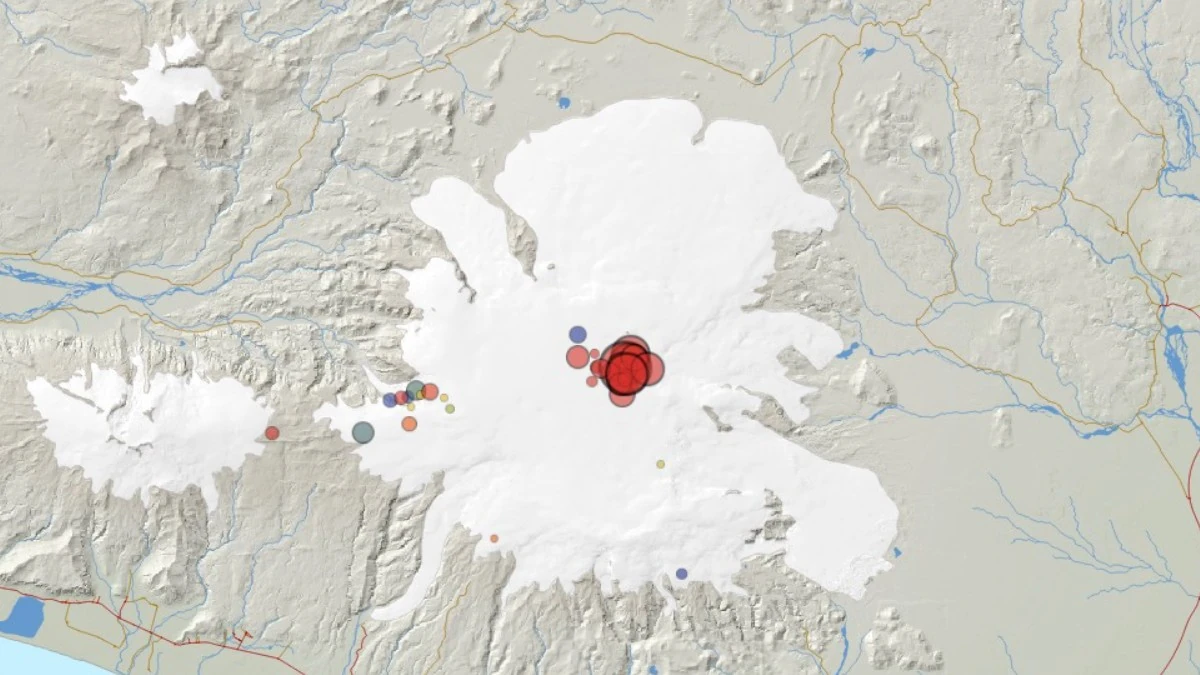
Earthquake swarm at Mýrdalsjökull glacier, Iceland on October 20, 2025. Credit: IMO
A strong seismic swarm began beneath Iceland’s Mýrdalsjökull glacier around 10:30 UTC on October 20, producing several earthquakes above M3.0 and the largest event of M4.5 at 10:51.
The swarm occurred within the Katla volcanic system, beneath the western part of the ice cap. No felt reports have been received, and hydrological parameters remain stable.
The Icelandic Meteorological Office (IMO) reports that no changes have been detected in the rivers draining the glacier. Water levels, temperature, and conductivity measurements show no deviation from normal values. Those indicators, together with seismic and deformation data, are used to detect early signs of magmatic or hydrothermal activity that can trigger melting or jökulhlaups.
Four earthquakes exceeded magnitude 3, and the largest event, first listed as M4.4 and later revised to M4.5, was recorded at 10:51 UTC about 8.5 km (5.3 miles) east-northeast of Goðabunga at shallow depths up to 2 km (1.2 miles).


According to IMO, the last M3+ event under Mýrdalsjökull occurred on October 3, 2025. In May and June 2023, a similar swarm produced several M3+ earthquakes and one M4.8, also without eruption. Comparable activity was recorded in 2016, when Katla produced a sequence of M4+ events that ended without surface change.
Mýrdalsjökull overlies Katla, one of Iceland’s most active and hazardous subglacial volcanoes. Katla’s caldera lies beneath up to 700 m (2 300 feet) of ice and has produced repeated explosive phreatomagmatic eruptions.
The last major eruption occurred in 1918 and generated a large jökulhlaup that reshaped the Mýrdalssandur outwash plain. Katla’s eruptions typically combine explosive magma–ice interaction with rapid melting that can release large volumes of water and sediment in hours. Because of this setting, Katla remains among the most closely monitored volcanoes in Iceland.
Current data indicate that today’s seismic swarm is consistent with crustal fracturing rather than direct magma intrusion. IMO notes that there are no deformation signals or hydrological anomalies, and the volcano’s Aviation Color Code remains Green. Nevertheless, large earthquakes beneath ice-covered volcanoes can loosen ice and rock, and the agency advises caution regarding localized ice or slope collapse.
Continuous monitoring of Katla integrates seismic, geodetic, and hydrological networks. Particular attention is given to possible changes in the rate and depth of earthquakes, the onset of harmonic tremor that can signal magma or fluid movement, and deformation patterns detected by GPS and satellite interferometry.
Rivers draining the glacier are instrumented to detect any rise in discharge, conductivity, or temperature that could signal subglacial melting. At present, all such measurements remain within normal limits.
The current swarm follows the pattern of intermittent shallow activity typical for Katla. While these swarms do not always precede an eruption, they reflect an active geothermal and tectonic environment beneath the glacier.
References:
1 Strong seismic swarm in Mýrdalsjökull glacier, Iceland – IMO – October 20, 2025

Teo Blašković founded The Watchers in 2011 and edited it until 2026, covering seismic and volcanic activity, extreme weather, space weather and near-Earth objects. Articles on this page are his archive.
Published in the last 24 hours
- Second nationwide US flight halt since 9/11: how the November 13 FAA ground stop compares with September 2001 and January 2023 Epicenter
- FAA grounds all departing flights across the US after communications outage hits air traffic control centers nationwide
- In September 1859, a solar storm lit up the night sky so brightly that gold miners in the Rocky Mountains woke up after midnight and started cooking breakfast, convinced the aurora glowing over their camp was the sunrise Epicenter
- A patch of warm Pacific water that could become the strongest El Niño in more than 70 years sits thousands of miles from any American town, yet it is already the main reason NOAA expects a wetter winter across the South and a milder one across the North
