
Acid rain reported across multiple islands as Manaro Voui volcano continues erupting at Alert Level 3, Vanuatu
Continuous eruptive activity at Manaro Voui volcano on Ambae Island, Vanuatu, is producing ash plumes rising to about 4 km (2.5 miles) above sea level and generating acid rain affecting multiple islands as of March 6, 2026. Authorities maintain Alert Level 3, indicating a minor eruption, while ashfall and acidic rainfall are damaging crops, contaminating water supplies, and raising health concerns across parts of northern Vanuatu.
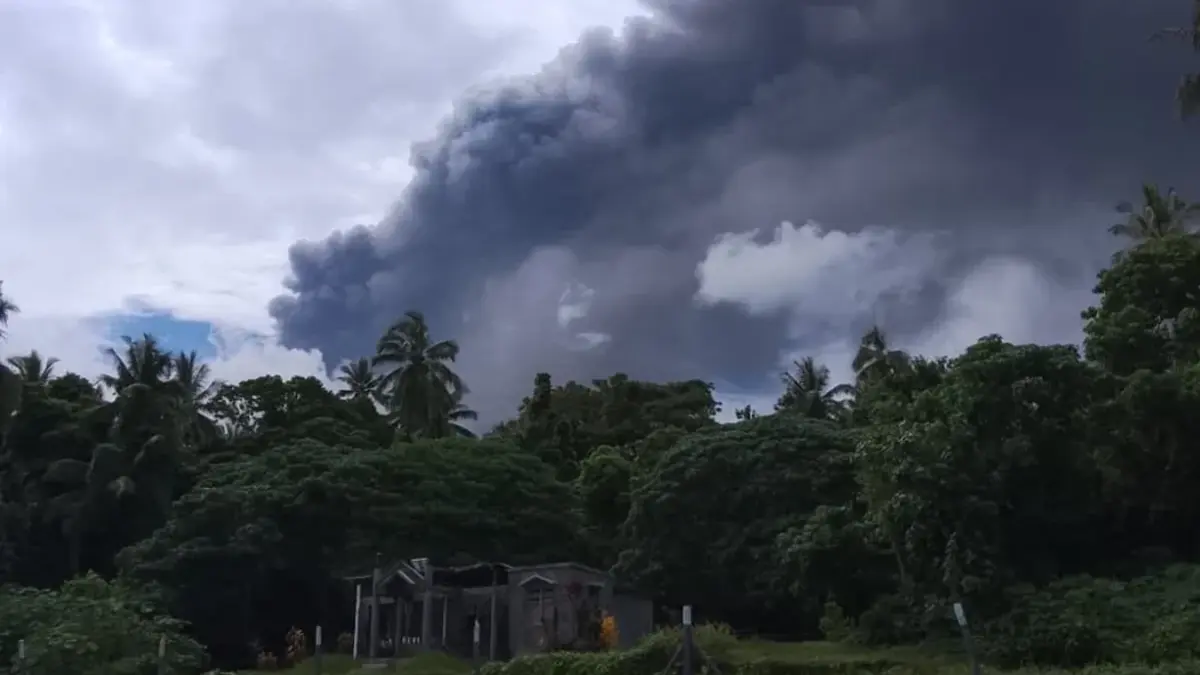
Vanuatu's cabinet is convening an emergency meeting Friday to discuss the escalating situation on Ambae Island following increased volcanic activity at the Manaro volcano. Credit: Ministry of the Prime Minister - Vanuatu
Manaro Voui volcano on Ambae Island in northern Vanuatu continues to emit ash, gas, and steam from vents within its summit crater lake system. Monitoring authorities report ash plumes reaching approximately 4 km (2.5 miles) above sea level while sustained volcanic degassing is generating acid rain affecting several islands in the region.
Authorities have established a 3 km (1.9 miles) danger zone around the crater due to volcanic gas emissions, ashfall, and the potential for explosive activity. Aviation advisories have also been issued as volcanic ash remains present in the atmosphere over Ambae.
Volcanic ash and sulfur dioxide released during the eruption are reacting with atmospheric moisture and producing acid rain, reported not only on Ambae but also on nearby islands, including Espiritu Santo, Malakula, Pentecost, and Ambrym. Levu Antfalo, director of the Vanuatu Meteorology and Geo-Hazards Department (VMGD), said the acidic precipitation is capable of damaging crops and contaminating water supplies.
“It burns because it contains sulphuric oxide,” Antfalo said. “It rains down and becomes acid rain. It burns crops and pretty much anything it comes in contact with, including water sources.”
The acid rain is particularly affecting communities that rely on rainwater collection systems such as tanks, drums, or uncovered containers. Authorities say groundwater accessed through boreholes appears less affected. Heavy ashfall is also altering the pH levels of rivers and freshwater systems, increasing acidity and potentially affecting aquatic food sources, including fish and prawns that local communities depend on.
Antfalo warned that volcanic ash and toxic air can also pose health risks to residents with respiratory conditions, urging communities to take precautions and protect their water supplies. Recent wind changes have caused volcanic ash to spread across much larger areas of Ambae Island, covering vegetation and agricultural land.
Local residents report strong rumbling noises from the volcano that can be heard across neighboring islands, including Santo, Pentecost, and Ambrym. Some residents say the noise has become so intense that it interferes with conversations and public gatherings.
Nixon Garae, a tugboat captain based in Luganville on Santo Island, said relatives living on Ambae described the volcanic rumbling as extremely loud.
“They said the noise is very loud because when people are talking, you can’t hear the other person talking,” Garae said. “It is causing ear pain because it’s very loud and heavy.” Residents also reported that the noise disrupted church services, with some congregations struggling to hear sermons over the volcanic rumbling.
Despite the environmental impacts, the government of Vanuatu has not ordered a mandatory mass evacuation of Ambae Island. Climate Change Minister Ralph Regenvanu said the volcano remains at Alert Level 3 and authorities are continuing to monitor the situation.
“Even though on Ambae we are hearing the activity of the volcano changing — sometimes increasing and sometimes decreasing — it is still only at alert level three,” Regenvanu said. He added that evacuation plans are in place should volcanic activity intensify.
“If we go to alert level four, which is the worst-case scenario, the whole island would be declared a disaster zone and evacuations would begin,” he said. During an emergency cabinet meeting on March 6, the Council of Ministers endorsed recommendations from the National Disaster Committee outlining response measures for the ongoing eruption.
The government approved 20 million vatu (USD 170 000) to support emergency operations and authorized the National Disaster Management Office (NDMO) to deploy a team to Ambae on Saturday, March 7, to assess the most affected areas of the island.
Authorities say residents living in heavily impacted areas are encouraged to relocate temporarily to less affected parts of the island if they feel unsafe. Prime Minister Jotham Napat said Penama Province authorities are preparing evacuation plans should volcanic activity escalate further.
Local concerns remain high due to the volcano’s history of major eruptions. Edwin Tarai, a former resident of Ambae who was evacuated during the 2018 eruption and now lives on Santo, said communities are worried about the government’s next steps.
“There is no plan of moving out at the moment, but there is a concern,” Tarai said. “People are complaining and wondering what the government’s next move will be.” Manaro Voui forms part of the Vanuatu volcanic arc, created by the eastward subduction of the Australian Plate beneath the Pacific Plate.
Yannick Behr, a volcano duty officer at GNS Science in New Zealand, said Ambae is a typical shield volcano within this tectonic system, and eruptions occur relatively frequently along the volcanic chain.
“These volcanoes sit on a rifting zone caused by the eastward subduction of the Australian plate,” Behr said. “That tectonic process keeps volcanism active, so eruptions occur quite regularly along this zone.”
During a major eruptive episode between 2017 and 2018, heavy ashfall and acid rain forced the evacuation of approximately 11 000 residents from Ambae Island, making it one of the largest volcanic evacuations in the South Pacific in recent decades.
Authorities continue to monitor seismic activity, gas emissions, and ash production at Manaro Voui while advising residents to stay outside the established danger zone and prepare for possible evacuation if volcanic activity intensifies.
References:
1 Acid rain falls on Vanuatu islands as volcano continues to belch ash – RNZ – March 6, 2026

I’m a science journalist and researcher at The Watchers, contributing to the Epicenter edition, where I cover peer-reviewed scientific research and emerging discoveries across Earth and space sciences. With a background in astronomy and a passion for environmental science, I’ve worked in shark and coral conservation in Fiji, conducting reef and shark-behavior research, contributing to mangrove restoration, and earning PADI Open Water and Coral Reef Certifications. I bring a blend of scientific rigor and storytelling to illuminate the discoveries shaping our planet and beyond.
