
Magma accumulation under Svartsengi nears eruption threshold, Iceland
Around 6 to 7 million m3 (212 to 247 million ft3) of magma have accumulated beneath Svartsengi, Iceland since the eruption on July 16, 2025. At the current rate of accumulation, the estimated threshold of 12 million m3 (424 million ft3) could be reached in the latter half of September, increasing the likelihood of a new eruption.

Satellite image of lava field in Iceland acquired on August 31, 2025. Credit: Copernicus EU/Sentinel-2, The Watchers
Uplift and magma intrusion beneath Svartsengi have continued steadily in recent weeks, according to the Icelandic Meteorological Office (IMO) update posted on September 4.
Model-based estimates indicate that approximately 6 to 7 million m3 (212 to 247 million ft3) of magma have built up in the subsurface reservoir since the most recent eruption.
The July 2025 event released an estimated 12 million m3 (424 million ft3) from the same storage area. Based on patterns observed in previous eruptions, the probability of a new dike intrusion or eruption increases when a similar volume has accumulated again.
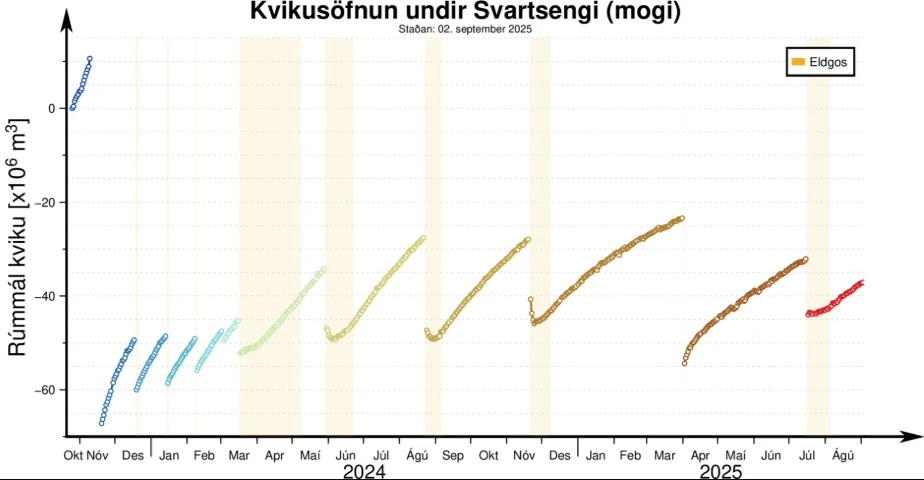
Assuming the current rate of accumulation persists, this condition is expected to be met in the second half of September.
However, there remains substantial uncertainty regarding the timing of a possible eruption. Since March 2024, magma volumes released during eruptions have ranged between 12 and 31 million m3 (424 to 1 095 million ft3), suggesting that the threshold is not fixed.
Even minor changes in the rate of magma supply could delay or accelerate the next eruptive event by several weeks.
The latest hazard assessment remains valid until September 16, 2025.
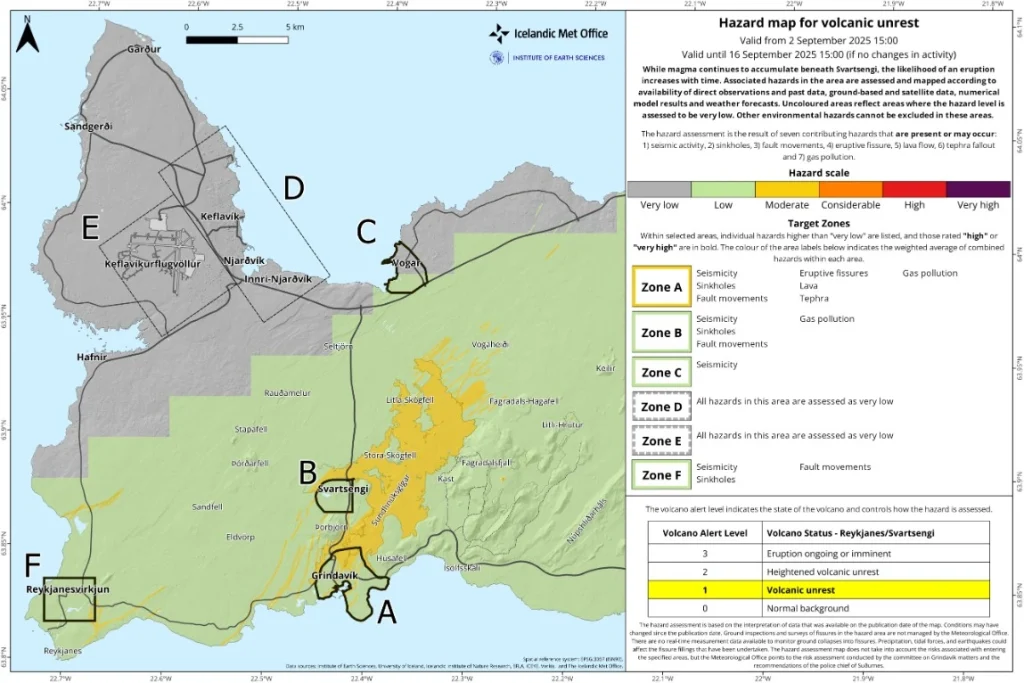
The new lava field, produced during the July eruption, is still classified under “some hazard” (yellow). Zone C (Vogar) has been revised in the updated map, and the hazard of ground collapse into fissures is no longer assessed in that area.
If a new eruption occurs, the most likely source area is between Sundhnúkur and Stóra-Skógfell. Indicators of an imminent eruption include increased microseismicity, rapid ground deformation detected by GPS and fiber-optic instruments, and pressure fluctuations in monitoring boreholes.
Based on previous events, warning times are expected to be short, ranging from 20 minutes to just over 4 hours.
Seismic activity continues west of Lake Kleifarvatn, in the Krýsuvík geothermal region. Land subsidence is currently being measured in the area.
Although Krýsuvík has historically shown signs of both uplift and subsidence linked to geothermal and magmatic processes, current unrest is likely triggered by deep intrusions beneath the Fagradalsfjall–Sundhnúkur system.
No indications suggest magma is nearing the surface at Krýsuvík.

Teo Blašković founded The Watchers in 2011 and edited it until 2026, covering seismic and volcanic activity, extreme weather, space weather and near-Earth objects. Articles on this page are his archive.
Published in the last 24 hours
- The storms drenching California this week are fed by a river in the sky, a band of water vapor that can carry up to 15 times the flow of the Mississippi River, and this winter’s near-record El Niño could keep aiming more of them at the West Coast
- Malawi continues Bris AI weather forecasting tests ahead of operational integration Epicenter
- Right about now, Voyager 1 is crossing a line no human-made object has ever reached, a full light-day from Earth, which means a message NASA sends tonight won't arrive until tomorrow night, and the spacecraft's answer won't make it home until the night after that
- G1 geomagnetic storm watch remains in effect as NOAA forecasts Kp 4.67 late on November 17 and early on November 18
