
Gleissberg minimum study suggests shift to stronger solar cycles through mid-century
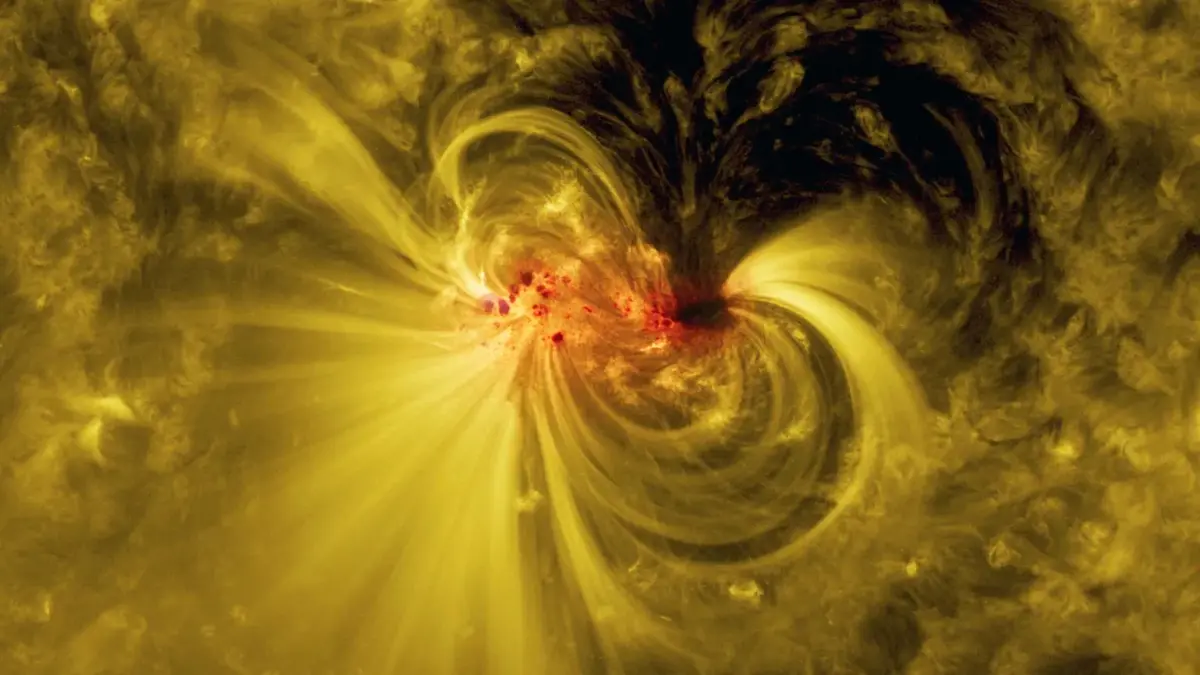
Image shows a blended view of a sunspot in visible and extreme ultraviolet light. Image credit: NASA’s Goddard Space Flight Center/SDO
According to a new study, inner zone proton flux peaked in 2022 and declined sharply thereafter, indicating the end of the Centennial Gleissberg Cycle minimum, which spanned Solar Cycles 24 and early 25.
The study suggests that rising solar irradiance and declining proton flux may mark the beginning of a more active solar phase that could continue through the mid-21st century.
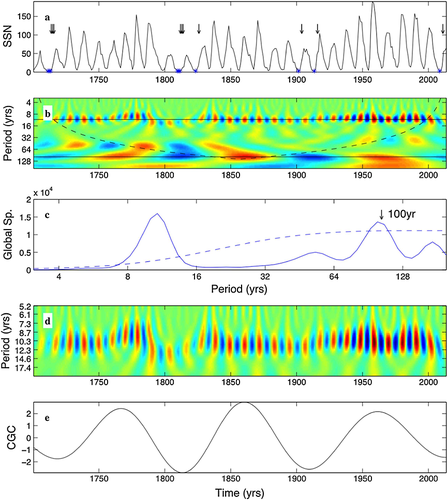
A study published on March 2, 2025, by Kalvyn Adams and colleagues presents evidence that the minimum of the Centennial Gleissberg Cycle (CGC) has ended, marking the onset of a more active solar phase expected to continue into the coming decades. The CGC is an 80–100-year modulation of the Sun’s 11-year sunspot cycle.
The researchers identified the most recent CGC minimum as spanning Solar Cycles 24 and the early portion of 25. A sharp reversal in proton flux and rising solar irradiance during Solar Cycle 25 signals the end of the minimum and the onset of a more active solar phase.
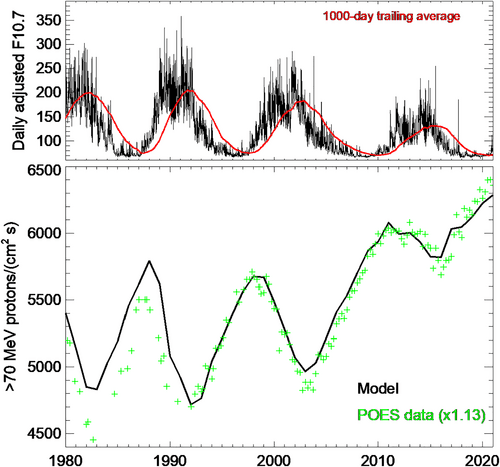
Using data from NOAA POES satellites—NOAA-15 and NOAA-19—the team examined inner zone proton flux over the South Atlantic Anomaly (SAA). Between 1980 and 2021, proton flux increased significantly during a period of declining solar activity. From 2022 to 2024, the trend reversed sharply, suggesting a possible turning point in the CGC.
A correlation was observed between proton flux and F10.7 flux, an indicator of solar Extreme Ultraviolet (EUV) irradiance. F10.7 levels declined gradually over several decades while proton flux increased, reaching a peak in 2022. A sharp rise in F10.7 during Solar Cycle 25 coincided with a rapid decline in proton flux, aligning with increased solar activity.

The reduction in proton flux is attributed to atmospheric expansion driven by increased EUV radiation. A denser upper atmosphere increases collisions with neutral particles, resulting in proton loss. This trend was observed consistently across multiple proton energy channels (>35 MeV, >70 MeV, >140 MeV).
Building on previous research by Bregou et al. (2022), the researchers incorporated three additional years of data through September 2024. They averaged data over three-month intervals and excluded Solar Energetic Proton events to minimize short-term variability and better analyze long-term trends.
The team calculated a 550–650-day lag between the solar minimum and the peak in proton flux, consistent with earlier estimates. This delay reflects the time required for atmospheric changes to influence proton populations and supports the identification of a 2022 proton peak following the 2019 solar minimum.

Observational data was compared with a theoretical model by Selesnick et al. (2007), updated in 2019. The model includes proton sources such as Cosmic Ray Albedo Neutron Decay (CRAND) and loss mechanisms like atmospheric drag. Simulations closely matched the observations after a minor adjustment.
The study found that proton flux declined more rapidly in NOAA-19 data, which operates at 870 km (540 miles) compared to NOAA-15 at 820 km (510 miles).
Solar Cycle 24, which was the weakest cycle in over a century and peaked around 2014, coincided with the minimum phase of the Centennial Gleissberg Cycle. This aligns with historical patterns identified by Feynman and Ruzmaikin (2014), who studied earlier minima in 1810–1830 and 1900–1910. The observed changes suggest the beginning of a transition into a more active solar phase.
Researchers suggest that solar activity may continue to increase over the next 40–50 years. This could lower the average proton flux in Earth’s inner radiation belt, reducing radiation risks to low Earth orbit satellites. However, it may also result in more intense geomagnetic storms and increased atmospheric drag on spacecraft.
The team applied filters to exclude high-latitude proton counts and used Gaussian fitting to estimate peak flux levels in the SAA, reducing noise and improving data clarity.
First proposed by Gleissberg in 1939 based on sunspot records, the CGC is supported by long-term evidence from ice cores and auroral observations. The study links historical cycles with current satellite data to provide a broader perspective on solar variability.
By late 2024, proton flux fell below the 2016 minimum in both satellite datasets, particularly in NOAA-19. This decrease preceded the predicted peak of Solar Cycle 25 and was consistent with increasing sunspot numbers in 2023, supporting the hypothesis of a CGC phase transition.
The rapid increase in F10.7 during Solar Cycle 25 exceeded previous projections, including those in a 2024 NOAA report. This change is consistent with the influence of the CGC, suggesting that Solar Cycle 25 marks the end of the recent minimum period.
The findings may contribute to satellite design and mission planning. Lower proton flux could reduce the degradation of electronics and solar panels, while increased solar radiation may accelerate orbital decay.
While focused on solar and radiation belt dynamics, the study notes that previous CGC minima coincided with periods of reduced global temperatures and changes in atmospheric circulation. The authors recommend incorporating long-term solar cycles like the CGC into space weather forecasting and propose further research into potential links between solar variability and climate.
References:
1 Turnover in Gleissberg Cycle Dependence of Inner Zone Proton Flux – Kalvyn Adams, Emily Bregou, Mary Hudson, Brian Kress, Richard Selesnick – Space Weather – March 2, 2025 – https://doi.org/10.1029/2024SW004238 – OPEN ACCESS
2 The Centennial Gleissberg Cycle and its association with extended minima – Joan Feynman, Alexander Ruzmaikin – Journal of Geophysical Research: Space Physics – August 4, 2014 – https://doi.org/10.1002/2013JA019478 – OPEN ACCESS
3 Long-term study of inner zone proton flux – Emily Bregou et al. – Space Weather – June 26, 2022 – https://doi.org/10.1029/2022sw00307 – OPEN ACCESS

I’m a science journalist and researcher at The Watchers, contributing to the Epicenter edition, where I cover peer-reviewed scientific research and emerging discoveries across Earth and space sciences. With a background in astronomy and a passion for environmental science, I’ve worked in shark and coral conservation in Fiji, conducting reef and shark-behavior research, contributing to mangrove restoration, and earning PADI Open Water and Coral Reef Certifications. I bring a blend of scientific rigor and storytelling to illuminate the discoveries shaping our planet and beyond.

Commenting rules and guidelines
We value the thoughts and opinions of our readers and welcome healthy discussions on our website. In order to maintain a respectful and positive community, we ask that all commenters follow these rules.