
Earth’s orbital cycles linked to massive volcanic eruptions and mass extinctions
A new study published in Science Advances shows that Earth’s orbital cycles influenced the timing of Deccan Traps volcanic eruptions, contributing to environmental changes associated with the end-Cretaceous mass extinction, approximately 66 million years ago.

Image credit: NASA, ESA, and Z. Levay (STScI/AURA))
A recent study published in Science Advances reveals a connection between Earth’s orbital cycles and massive volcanic eruptions in India’s Deccan Traps region.
These eruptions had significant impacts on global climate and may have contributed to the extinction event that eliminated dinosaurs in the late Cretaceous period approximately 66 million years ago.
Led by Thomas Westerhold from MARUM — Center for Marine Environmental Sciences at the University of Bremen, Germany, the research team analyzed sediments from ocean floors in the Atlantic and Pacific oceans. The scientists measured chemical markers, such as osmium isotopes, carbon and oxygen isotopes from marine organisms, and mercury levels, to identify volcanic activities and associated climate changes.
“The formation of the flood basalts and their subsequent weathering will leave a geochemical fingerprint in the ocean,” explained co-author Junichiro Kuroda from the University of Tokyo.
“Therefore, we measured the osmium isotope composition of the South Atlantic and Northwest Pacific deposits. They should show the same fingerprint at the same time.”
Samples from ocean cores revealed two distinct changes in osmium isotopes. These changes matched previously dated pulses of massive volcanism in India’s Deccan Traps, which reach thicknesses of approximately 2 km (1.24 miles) in some areas.
“To our surprise, we found two shifts in the osmium isotope composition in both oceans, coinciding with major eruption phases of the Deccan Traps in the late Cretaceous. Even more surprising, these shifts had different impacts on the environment, as recorded by fossil remains in the drill cores,” said Westerhold.
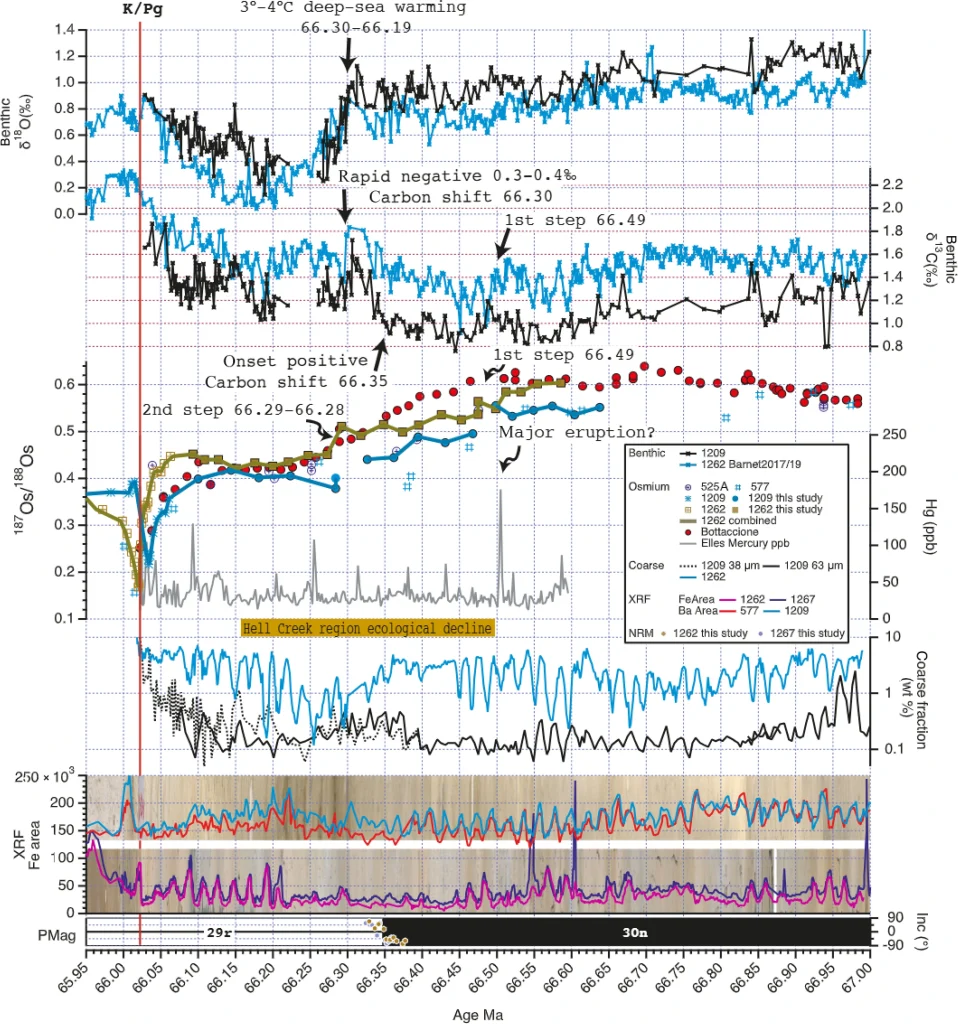
These isotopes indicated significant temperature changes and disruptions to Earth’s carbon cycle. Additionally, mercury levels, which are known to rise during periods of intense volcanic activity, were measured.
These findings challenge the belief that quasi-periodic variations in Earth’s orbit solely influence climate through changes in incoming solar radiation.
The possibility that these orbital cycles also contribute to triggering eruptions adds another dimension to our understanding of how the planet’s internal and external forces interact.
“Just like a metronome, we used the rhythmic changes in solar insolation recorded in geological data to synchronize climate archives from the South Atlantic and Northwest Pacific,” said Westerhold.
“These key records span the last million years of the Cretaceous and are synchronized to within 5 000 years or less—geologically, a blink of an eye 66 million years ago.”
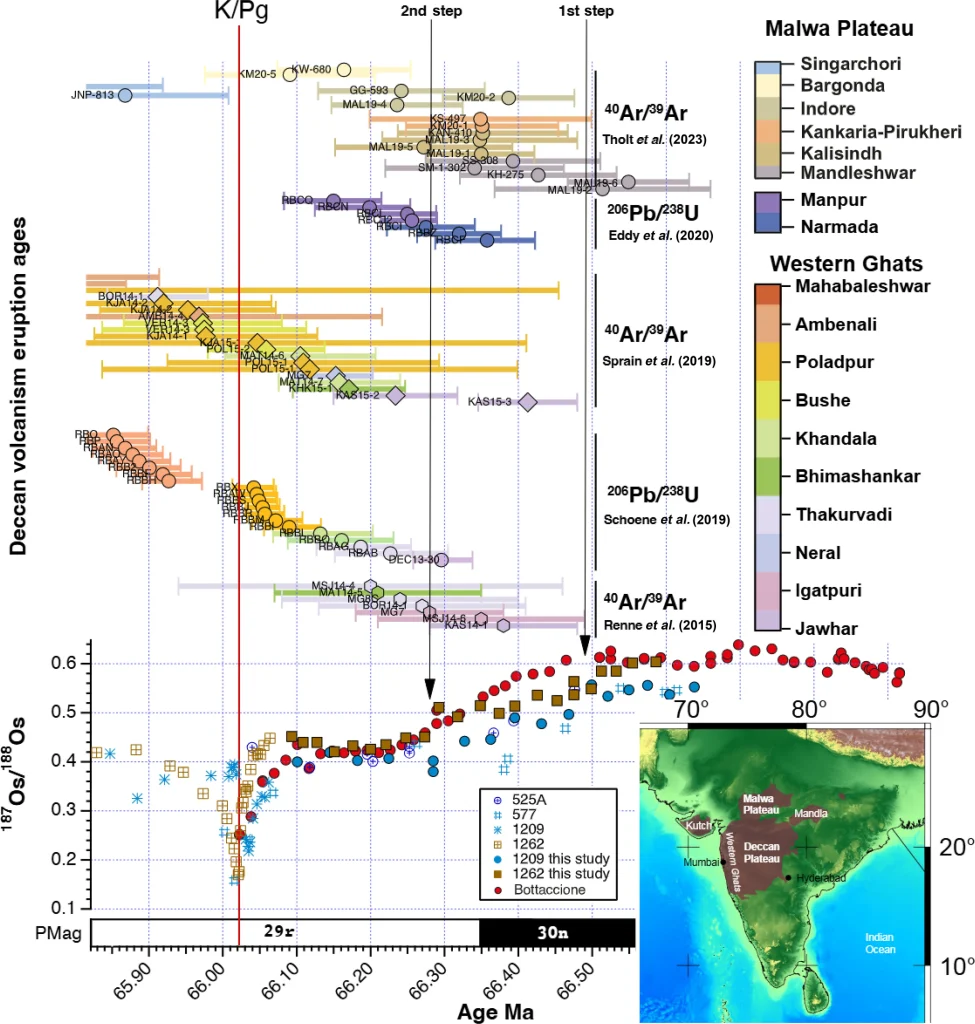
The findings indicated two major volcanic eruptions occurred earlier and were more intense than previously documented. The first eruption about 66.49 million years ago led to moderate global warming, raising ocean temperatures by roughly 1°C (1.8°F).
A more severe eruption 66.28 million years ago correlated with a significant climate event known as the Late Maastrichtian Warming, increasing ocean temperatures by approximately 3–4°C (5.4–7.2°F).
Researchers found that these volcanic eruptions released varying amounts of sulfur dioxide, which initially altered the marine carbon cycle in distinct ways—a factor previously underestimated in studies of mass extinction events.
The timing of these eruptions matched closely with Earth’s orbital cycles. The research suggests that Earth’s orbital changes may influence internal geological processes, potentially triggering volcanic activity.
Aligning volcanic activity with Earth’s orbital cycles offers insights into how cosmic factors, such as planetary orbits, influence geological processes that could affect Earth.
References:
1 Earth orbital rhythms links timing of Deccan trap volcanism phases and global climate change – Thomas Westerhold et al. – Science Advances – March 7, 2025 – https://doi.org/10.1126/sciadv.adr8584 – OPEN ACCESS

I am an Assistant Editor and Severe Weather & Science Journalist at The Watchers, specializing in real-time severe weather coverage, geophysical event reporting, and research-driven scientific analysis. You can reach me at rishav(at)watchers(.)news.

Commenting rules and guidelines
We value the thoughts and opinions of our readers and welcome healthy discussions on our website. In order to maintain a respectful and positive community, we ask that all commenters follow these rules.