
Increased seismic activity observed at Kilauea volcano, Hawaii
Increased seismic activity has been recorded at Kilauea volcano over the past week, with an increase from 10 located events per day to 20 per day.
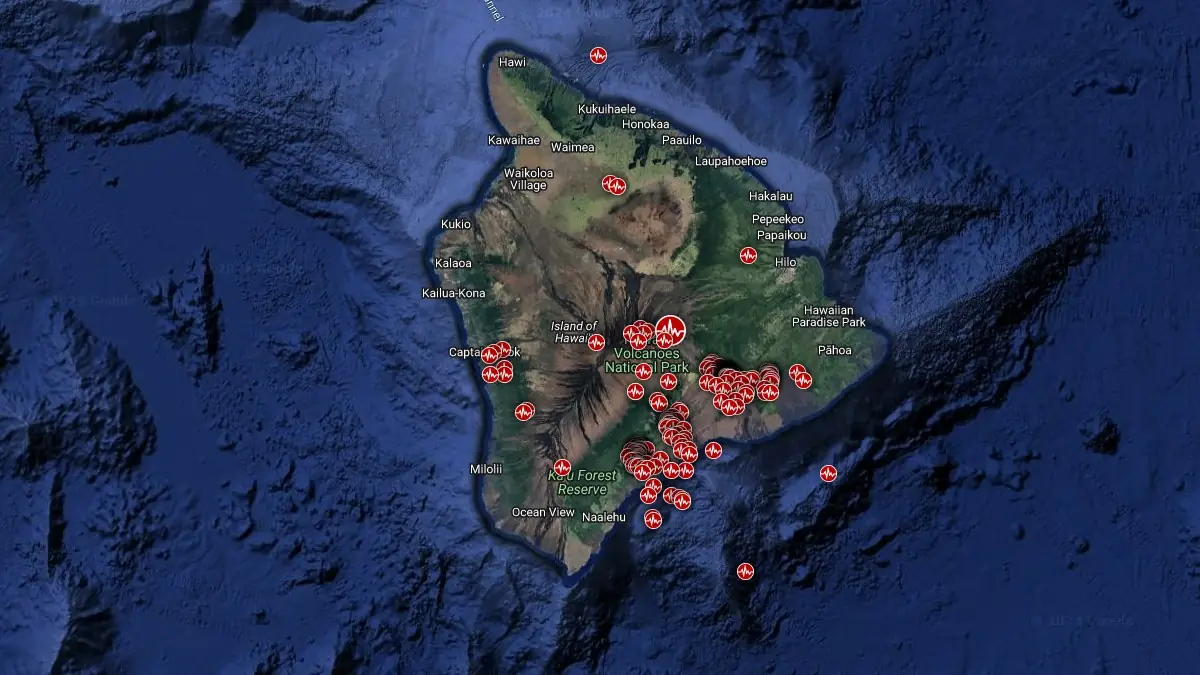
Earthquakes near Kilauea volcano, Hawaii in 7 days to 20:00 UTC on December 4, 2024. Image credit: TW/SAM, Google. Data source USGS
- The increased rates of seismicity and ground deformation observed over the past week indicate a higher level of unrest at Kīlauea’s summit region compared to previous weeks.
- Seismic activity reflects ongoing inflation as magma accumulates within the volcano.
- Near the recent middle East Rift Zone eruption site, minor to severe ground fractures and subsidence features may continue to widen and offset, may have unstable overhanging edges, and should be avoided.
- Hazards associated with the recent lava flows include glassy (sharp) surfaces that can cause serious abrasions and lacerations upon contact with unprotected or exposed skin; uneven and rough terrain that can lead to falls and other injuries; or locally elevated levels of volcanic gases that can lead to breathing difficulty.
The USGS Hawaiian Volcano Observatory (HVO) is reporting increased seismic activity at Kilauea’s summit region over the past week, going from approximately 10 located earthquakes per day to 20 per day.
Short bursts of small earthquakes, averaging 6 events per hour, were observed on November 29 and December 3, concentrated within the Kaluapele and South Caldera region.
Overall, there were approximately 75 earthquakes at the summit, the majority of which were below M2.1.
“Summit tiltmeters and GPS stations have recorded steady inflation in the summit and south caldera regions,” HVO said. This inflation is also seen in recent InSAR (Interferometric Synthetic Aperture Radar) measurements from satellite observation.
The upper Southwest Rift Zone has also exhibited minor seismic increases, with 25 earthquakes below M2.0 recorded over the past 2 days. The upper East Rift Zone (ERZ) saw daily earthquake activity ranging between 25 and 60 events, mostly below M 2.5. The middle ERZ reported approximately 75 earthquakes, located between Makaopuhi and Puʻuʻōʻō, all below M 2.0.
Ground deformation in the ERZ remains steady, with no anomalies detected.
The last sulfur dioxide (SO2) emission measurement on October 17 reported 68 +/- 24 tonnes per day, a value for noneruptive conditions at Kilauea.
The most recent eruption at Kilauea occurred from September 15 to September 20, 2024, near Nāpau Crater. During this event, fissures on the crater floor produced lava flows that covered approximately 0.63 km2 (0.24 mi2). This eruption left the region with unstable terrain, ground fractures, and hazardous conditions due to sharp, glassy surfaces and residual volcanic gases.
Hazards persist around Halemaʻumaʻu Crater due to unstable walls, ground cracking, and rockfalls, especially in areas affected by seismic activity. The public is strongly advised to avoid these regions.
Kilauea is one of the world’s most active shield volcanoes, overlapping the eastern flank of the massive Mauna Loa volcano. The 3 x 5 km (1.9 x 3.1 miles) wide caldera was formed in several stages about 1 500 years ago and during the 18th century, eruptions also originated from the lengthy East and Southwest rift zones, which extend to the ocean in both directions.
Kilauea (known for its frequent eruptions) had a long-term activity in the East Rift Zone from 1983 to 2018, which produced over 100 km2 (38.6 mi2) of lava flows, destroyed homes, and created new land along the coastline.
90% of the volcano’s surface consists of lava flows younger than 1 100 years, showing its geologic activity.
References:
1 HAWAIIAN VOLCANO OBSERVATORY WEEKLY UPDATE – USGS – December 3, 2024
2 Kīlauea – GVP – December 4, 2024
3 Hawaiian Volcano Observatory – USGS – December 4, 2024

Rishika holds a Master’s in International Studies from Stella Maris College, Chennai, India, where she earned a gold medal, and an MCA from the University of Mysore, Karnataka, India. Previously, she served as a Research Assistant at the National Institute of Advanced Studies, Indian Institute of Science, Bengaluru, India. During her tenure, she contributed as a Junior Writer for Europe Monitor on the Global Politics website and as an Assistant Editor for The World This Week. Her work has also been published in The Hindu newspaper, showing her expertise in global affairs. Rishika is also a recipient of the Women Empowerment Award at the district level in Haryana, India, in 2022.

Commenting rules and guidelines
We value the thoughts and opinions of our readers and welcome healthy discussions on our website. In order to maintain a respectful and positive community, we ask that all commenters follow these rules.