
Grindavík evacuated as new volcanic eruption begins on Reykjanes Peninsula, Iceland
A new volcanic fissure opened up between Stóra-Skógfell and Sýlingarfell, near the town of Grindavík, Iceland’s Reykjanes Peninsula, at 23:14 local time (LT) on Wednesday, November 20, 2024. This marked the year’s seventh eruption in this region.

Image credit: Civil Protection/Björn Oddsson
The eruption was preceded by a small earthquake swarm at around 22:30 local time (LT), followed by pressure changes in boreholes operated by HS Orka at 22:37 LT.
“Both independent measurements were a clear sign of the onset of a magma intrusion,” the Icelandic Met Office (IMO) reported.
Although initial reports indicated lava was not moving southward toward Grindavík, the town was evacuated. Nearby Blue Lagoon geothermal spa was closed and some 200 people who were present there were also evacuated.
As per IMO reports, the eruption peaked around 02:00 UTC on November 21, with the fissure no longer expanding and measurements indicating the activity should not increase.
The fissure extended in the north-eastward direction for about 3 km (1.8 miles), with its southern end located near Sýlingarfell.

IMO describes the eruption as significantly smaller than the previous on August 22.
The estimated lava flow rate at 02:10 UTC, November 21 was about 1 300 m³/s (46 000 ft3), compared to approximately 2 500 m³/s (88 000 ft3) during the August eruption. At the same time, the lava front was approximately 500 m (1 640 feet) away from Grindavíkurvegur (Route 43) to the west.
What’s different about this eruption is that it didn’t start with seismic activity increasing in the weeks ahead.
While the amount of magma that had accumulated beneath Svartsengi was similar to the amount before the last eruption, the recent trend indicates that increasingly larger volumes of magma are required to trigger the next event.
This suggests that the pattern observed in earlier eruptions may be changing.
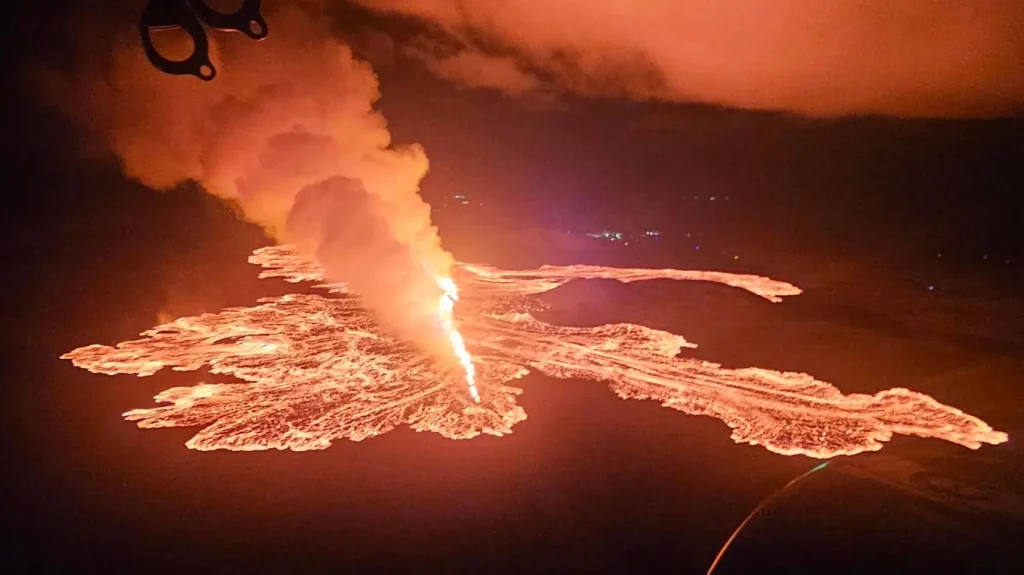
In the last update, posted early Thursday morning, IMO said the eruption continues at a decreased rate, with activity focused around the center of the fissure.
The western lava, the one that runs between Sýlingarfell and Stóra Skógfell, crossed Grindavík road around 04:30 LT and approached Njar ðvíkuræd. The estimated lava flow on this lava tongue is about 300 m (980 feet) per hour. The northern lava does not flow towards any infrastructure.
Gas emissions are being carried southward over Grindavík.
Updates
15:11 UTC, November 21
Lava started flowing toward Blue Lagoon around 12:00 LT and took around 2 hours to reach the resort’s parking lot, which was soon completely engulfed in flames.
Read more:
References:
1 Eruption on the Sundhnúkur Fissure Swarm – IMO – November 21, 2024

I'm a dedicated researcher, journalist, and editor at The Watchers. With over 20 years of experience in the media industry, I specialize in hard science news, focusing on extreme weather, seismic and volcanic activity, space weather, and astronomy, including near-Earth objects and planetary defense strategies. You can reach me at teo /at/ watchers.news.

Commenting rules and guidelines
We value the thoughts and opinions of our readers and welcome healthy discussions on our website. In order to maintain a respectful and positive community, we ask that all commenters follow these rules.