
Reykjanes Ridge earthquake swarm produces hundreds of events near Eldey Island
An earthquake swarm began near Eldey Island on Iceland’s Reykjanes Ridge at around 12:40 UTC on February 8, 2026. The activity consisted of several hundred shallow earthquakes, most below M3. There is no reported damage or indications of eruptive activity.
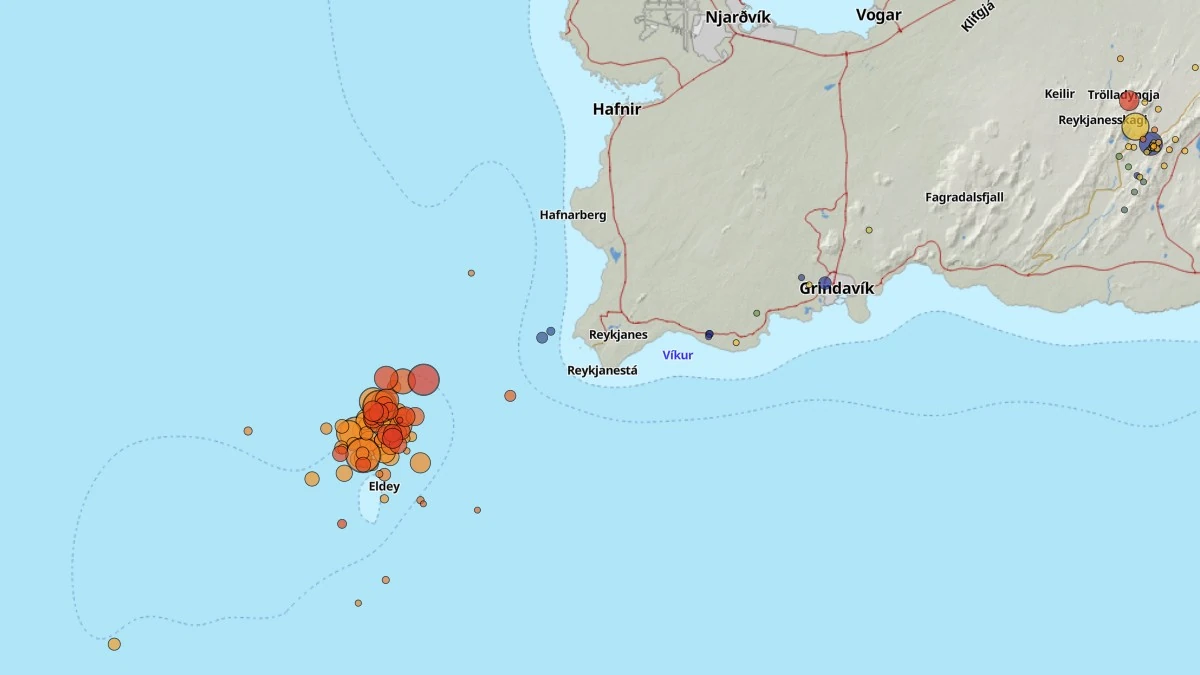
Earthquakes in Iceland detected from February 6 to 9, 2026. Credit: IMO
An earthquake swarm began near Eldey Island on Iceland’s Reykjanes Ridge at approximately 12:40 UTC on February 8. Seismic data show that the activity was confined to the ocean floor and consisted of several hundred small, shallow earthquakes over the following 36 hours.
The Icelandic Meteorological Office (IMO) recorded a rapid increase in seismicity during the initial phase of the swarm, with dozens of earthquakes occurring per hour during periods of peak activity. After a temporary decline, earthquake rates increased again around 03:00 UTC on February 9.
By 16:55 UTC on February 9, the cumulative event count was estimated at approximately 300–400 earthquakes. The majority of the events had magnitudes below 3.0, while the largest earthquakes reached approximately M2.8–M3.4. No earthquakes were reported as felt on land, and no damage has been associated with the swarm.
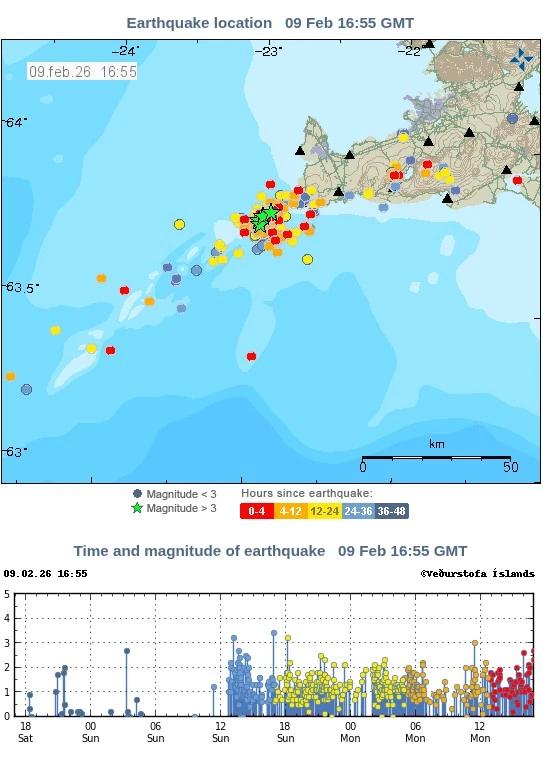
Hypocenters were shallow and located offshore along the Reykjanes Ridge, a divergent plate boundary where the Eurasian and North American plates separate.
Earthquake swarms are common in this setting and are typically linked to tectonic extension and localized magmatic processes at depth beneath the ocean floor.
The current swarm is geographically and mechanically distinct from onshore volcanic systems on the Reykjanes Peninsula. Monitoring data do not indicate a connection to volcanic activity at Svartsengi or near Grindavík, where separate surveillance remains in place due to earlier unrest.

Teo Blašković founded The Watchers in 2011 and edited it until 2026, covering seismic and volcanic activity, extreme weather, space weather and near-Earth objects. Articles on this page are his archive.
Published in the last 24 hours
- In September 1859, a solar storm lit up the night sky so brightly that gold miners in the Rocky Mountains woke up after midnight and started cooking breakfast, convinced the aurora glowing over their camp was the sunrise Epicenter
- A patch of warm Pacific water that could become the strongest El Niño in more than 70 years sits thousands of miles from any American town, yet it is already the main reason NOAA expects a wetter winter across the South and a milder one across the North
- A 19-year-old Nebraska teacher reportedly tied her pupils together with twine and led them to safety through a blizzard in January 1888 Epicenter
- NASA built the Opportunity rover to last 90 days on Mars, and Martian winds helped keep it alive for nearly 15 years by blowing dust off its solar panels, until a planet-wide dust storm in 2018 blocked sunlight and silenced the rover Epicenter
