
Glacial outburst flood in Skaftá River confirmed to originate from Vestari-Skaftár caldera, Iceland
A glacial outburst flood in Iceland’s Skaftá River, first detected on December 8, 2025, has been confirmed to originate from the Vestari-Skaftár caldera beneath Vatnajökull ice cap. Flow at the Sveinstind station has decreased to just over 120 m³/s, down from 200 m³/s earlier in the week. Conductivity remains high and hydrogen sulfide continues to be detected along the river, but no impacts on major roads have been reported.

Satellite image of southeast Iceland acquired on November 21, 2025, showing the Skaftá River and surrounding glacial outwash plains. Credit: CopernicusEU/Sentinel-2, The Watchers
The Icelandic Meteorological Office (IMO) confirmed on December 10 that the ongoing jökulhlaup (glacial outburst flood) in Skaftá River originates from the Vestari-Skaftár caldera beneath Vatnajökull.
The confirmation is based on Sentinel-1 radar imagery, InSAR deformation data, turbulence measurements, and direct field observations by teams from the University of Iceland’s Institute of Earth Sciences and Landsvirkjun.
The discharge at the Sveinstind hydrological station was measured at just over 120 m³/s (4 238 ft³/s), showing a gradual decline from around 160 m³/s (5 650 ft³/s) on December 9 and 200 m³/s (7 063 ft³/s) when the flood began late on December 7.
According to IMO, the flow remains significantly lower than in larger historical Skaftá floods, which have reached up to 3 000 m³/s (105 944 ft³/s). Despite elevated water levels, there have been no disruptions to major roads or settlements downstream.
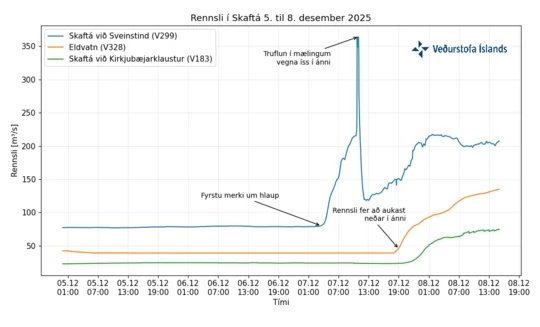
Conductivity in the river has been increasing, indicating the presence of geothermal meltwater from beneath the glacier.
The smell of sulfur, caused by hydrogen sulfide (H2S) gas, remains noticeable along parts of the Skaftá valley. IMO has advised travelers and field researchers to avoid the Skaftá River above Skaftárdalur and the glacial margins of Skaftárjökull, Tungnárjökull, and Síðujökull due to possible gas accumulation and unstable ice.
Hydrogen sulfide is released when geothermal water, rich in dissolved sulfides, emerges from beneath the ice. In confined areas, such as depressions and river valleys, concentrations can rise to levels that irritate the eyes and respiratory tract.
Although no dangerous concentrations have been measured in inhabited areas, IMO continues to monitor gas conditions as part of the ongoing response.
Although located within the broader Grímsvötn volcanic zone under Vatnajökull, the Skaftár calderas are independent geothermal depressions.
They are not part of the Grímsvötn central volcano system, and floods from Skaftá are driven by geothermal melting, not magmatic activity. Grímsvötn drains primarily toward the Skeiðará River, whereas the Skaftár calderas feed into the Skaftá River.
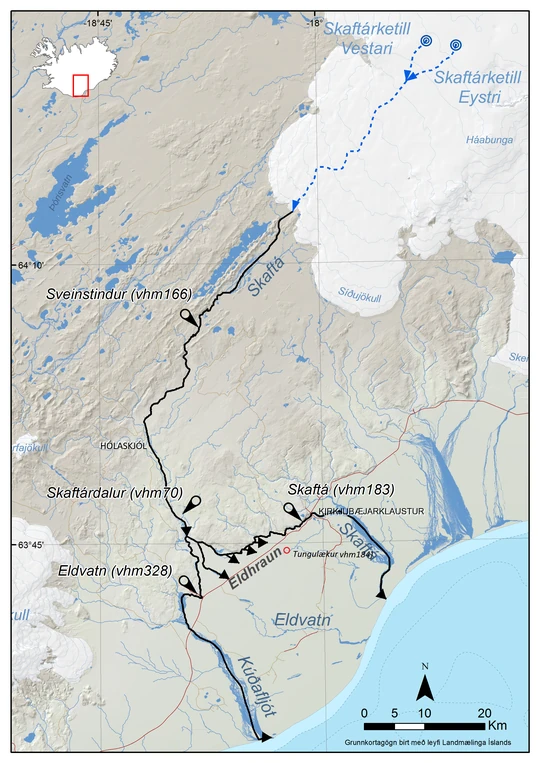
The Vestari-Skaftár caldera last released a major jökulhlaup in the autumn of 2021 while the event in August 2024 originated from the Eystri-Skaftár caldera, located a few kilometers east beneath the same glacier.
Historically, the two calderas have released floods roughly every two years, alternating between eastern and western sources. The three- to four-year gap since the last Vestari flood is unusually long, suggesting gradual accumulation of meltwater and geothermal energy beneath the ice.
Jökulhlaups (glacial outburst floods) in Skaftá occur when meltwater from geothermal activity accumulates in subglacial depressions and is suddenly released through subglacial drainage channels. The water flows from beneath Vatnajökull toward the Skaftá River, often accompanied by increased conductivity, gas emissions, and temporary uplift or subsidence observed in satellite interferometry.
IMO hydrologists expect the flow to decrease steadily over the coming days as drainage stabilizes.
References:
1 Skaftárhlaup yfirstandandi – IMO – December 10, 2025

I'm a dedicated researcher, journalist, and editor at The Watchers. With over 20 years of experience in the media industry, I specialize in hard science news, focusing on extreme weather, seismic and volcanic activity, space weather, and astronomy, including near-Earth objects and planetary defense strategies. You can reach me at teo /at/ watchers.news.

Commenting rules and guidelines
We value the thoughts and opinions of our readers and welcome healthy discussions on our website. In order to maintain a respectful and positive community, we ask that all commenters follow these rules.