
Strong earthquake swarm on the Reykjanes Ridge, Iceland
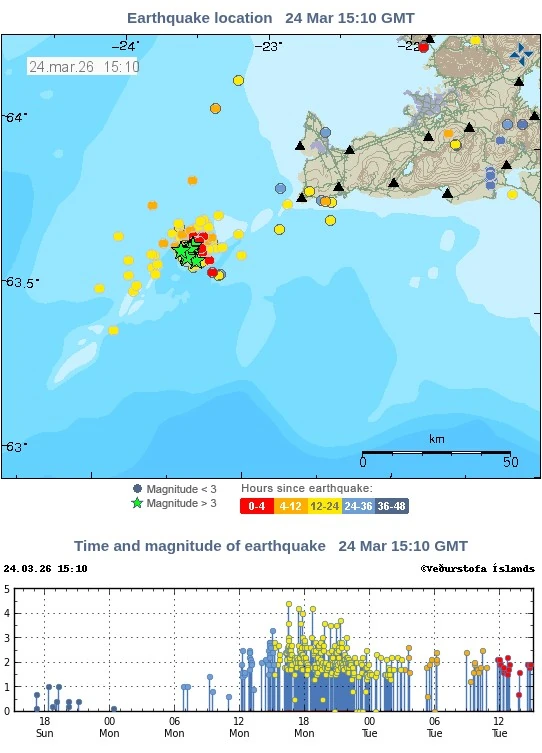
An earthquake swarm with over 300 events over 48 hours is in progress on the Reykjanes Ridge southwest of Eldey, Iceland, since March 23, 2026, with the largest earthquake thus far registered as M4.4. The Icelandic Meteorological Office said there are no indications linking the activity to volcanic processes on the Reykjanes Peninsula.

Earthquakes registered at Reykjanes Ridge, Iceland from March 22 to 24, 2026. Credit: IMO
Seismic data from the Icelandic Meteorological Office (IMO) show that 316 earthquakes were recorded along the Reykjanes Ridge during the 48-hour period ending at 13:55 LT on March 24. Earlier reports noted about 120 events, but the sequence continued to develop and later exceeded 300 recorded earthquakes.
The swarm began approximately 25 km (16 miles) southwest of Eldey, with epicenters primarily clustered around Geirfugladrangur along the Mid-Atlantic Ridge. Magnitude distribution shows that most earthquakes remained small, with 22 events below M1, 135 between M1 and M2, and 143 between M2 and M3, while 16 earthquakes exceeded M3.
The strongest earthquake reached magnitude M4.4 at a depth of 10.1 km (6.3 miles) at 16:30 LT on March 23, marking the largest event recorded in the area since September 2025. Additional significant earthquakes include M4.2 events at depths of 6.8 km (4.2 miles) and 9.1 km (5.7 miles). In total, four earthquakes measuring over magnitude 4 were recorded during the sequence, including an M4.0 event.
Some of the earthquakes were reportedly felt on the Reykjanes Peninsula despite the offshore location of the swarm.
The IMO stated that there are currently no indications linking the seismic activity to volcanic processes on the Reykjanes Peninsula.
“We are not seeing any signs of volcanic unrest… Of course, eruptions can occur there, but there is nothing indicating that at the moment,” said Jóhanna Malen Skúladóttir, natural hazard specialist at the IMO.
The Reykjanes Ridge forms part of the Mid-Atlantic Ridge system, where the Eurasian and North American tectonic plates diverge. Earthquake swarms are common in this setting and are typically associated with tectonic stress release rather than magma intrusion when no deformation or volcanic signals are detected.
A similar sequence was recorded in the same region on February 8, 2026.
The IMO continues to monitor the area around the clock for any changes in seismic or volcanic parameters.
References:
1 Reykjanes ridge – earthquakes during the last 48 hours – IMO – Accessed on March 24, 2026

I’m a science journalist and researcher at The Watchers, contributing to the Epicenter edition, where I cover peer-reviewed scientific research and emerging discoveries across Earth and space sciences. With a background in astronomy and a passion for environmental science, I’ve worked in shark and coral conservation in Fiji, conducting reef and shark-behavior research, contributing to mangrove restoration, and earning PADI Open Water and Coral Reef Certifications. I bring a blend of scientific rigor and storytelling to illuminate the discoveries shaping our planet and beyond.

Commenting rules and guidelines
We value the thoughts and opinions of our readers and welcome healthy discussions on our website. In order to maintain a respectful and positive community, we ask that all commenters follow these rules.