
Ultra-high-energy gamma rays detected from Milky Way’s center reveal extreme cosmic energy
A recent study of data collected by High-Altitude Water Cherenkov (HAWC) in Mexico showed a violent mystery in the Milky Way galaxy. Pat Harding, a physicist at Los Alamos and the Department of Energy’s principal investigator for the project said that the results are a glimpse at the center of the Milky Way to an order of magnitude higher energies than ever seen before.
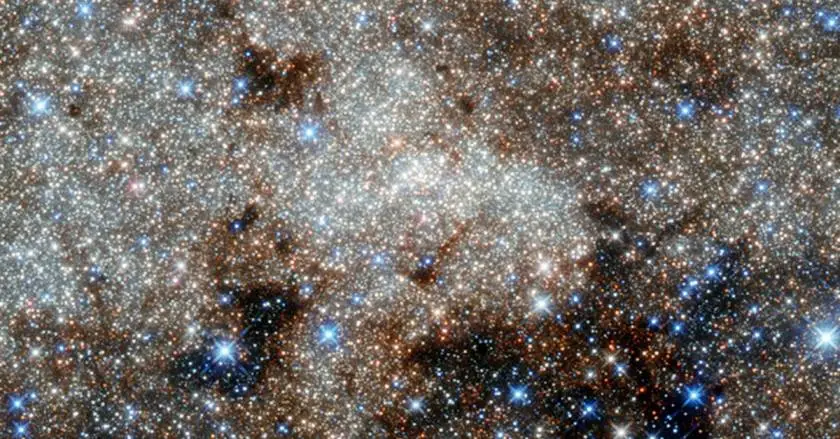
The center of the Milky Way, looking toward the Sagittarius constellation and the invisible black hole called Sagittarius A. Image credit: NASA
- The hunt for PeVatrons, sources capable of accelerating particles to energies in the peta-electronvolt (PeV) ranges, is an active research topic in astrophysics.
- This study has confirmed the presence of a PeVatron at the Galactic Center with the first observations of gamma rays with energies above 100 TeV, which allows PeV cosmic-ray interactions to be probed directly.
- The origin of the observed gamma rays is most likely from interactions of the freshly accelerated PeV protons, which are continuously injected, and the dense ambient gas.
An international team of researchers is reporting the very first observation of ultrahigh-energy (UHE) gamma rays from the Galactic Center (GC) region, using 7 years of data collected by the High-Altitude Water Cherenkov (HAWC) Observatory.
This research for the first time confirms a PeVatron source of ultrahigh-energy gamma rays at a location in the Milky Way known as the Galactic Center Ridge, meaning the Galactic Center is home to some of the most extreme physical processes in the universe.
A PeVatron is a type of astronomical source capable of accelerating particles to energies in the peta-electronvolt (PeV) range. These sources are significant in astrophysics as they might explain some of the highest-energy cosmic rays detected on Earth. Cosmic rays at such high energies are exceedingly rare, but they can provide insights into the most energetic processes in the universe.
PeVatrons are thought to be associated with extreme astrophysical environments, like supernova remnants, pulsars, and regions near black holes, where intense magnetic fields and shock waves can boost particles to PeV energies.
However, pinpointing the exact sources remains challenging, as cosmic rays can travel vast distances and are deflected by interstellar magnetic fields, making it difficult to trace their origins directly.
PeVatron itself is not a well-understood phenomenon but its existence in whatever form directs it to the violent regime in the galactic center.
That region of the Milky Way galaxy involves a supermassive black hole with neutron stars around it and white dwarfs that strip material from the nearby stars.
The area is covered with dense gas clouds that reach a temperature of millions of degrees and tend to prevent much direct optical observation of the region.

During the extreme environment, this observation of gamma rays is crucial for illuminating the cosmic processes at work.
The development of Ultrahigh-energy gamma rays with the presence of a PeVatron source which multiplies particles into a million or billion electron volts (PeV) in energy, a quadrillion times more powerful than the light particles coming out of a light bulb.
PeVatron generated by the cosmic ray travels more than 99% of the speed of light, interacting with dense ambient gas and resulting in ultrahigh-energy gamma rays.
PeVatron’s exact nature is a mystery but the energies involved direct to some of the most violent processes conceivable in the universe: a star’s death in a supernova, the birth of a star is accompanied by the shocks and radiation, a black hole swallowing another black hole are the few violent processes.
“A lot of those processes are so rare you wouldn’t expect them to be happening in our galaxy, or they occur on scales that don’t correlate with the size of our galaxy. For instance, a black hole eating another black hole would be an event only expected outside our galaxy,” said Harding.
A few ultrahigh-energy gamma rays that can travel huge distances and reach Earth is a unique experiment called HAWC designed to capture the rays. On the slopes of the Sierra Negra Volcano, 300 grain silos are filled with water and each silo is lined with photomultiplier detectors at the bottom.
When ultrahigh-energy particles reach Earth’s atmosphere, they disperse into large air showers of lower-energy particles. As charged particles flow through the HAWC’s grain silos at a faster rate than the water’s phase velocity, they produce Cherenkov light, also known as Cherenkov radiation, a blue glow that is comparable to an auditory sonic boom.

The revolutionary Milagro experiment, a gamma ray observatory with a 5 million-gallon water pond and 700 light detectors in the Jemez Mountains outside Los Alamos has led a foundation for the HAWC observatory experiment. The researchers first took data from the Milagro experiment from 2008 and then moved toward the HAWC observatory to capture particles closer to the galactic center.
The study team plans to extend its HAWC observatory findings and narrow down the particular location of the PeVatron source with a new experiment, the Southern Wide-field Gamma-ray Observatory, which is being built in Chile’s Atacama Desert.
With a larger window into the Milky Way’s center, science may be able to gain a better understanding of the mystery at the heart of our galaxy.
References:
1 Observation of the Galactic Center PeVatron beyond 100 TeV with HAWC – A. Albert et al. – The Astrophysical Journal Letters – September 20, 2024 – DOI 10.3847/2041-8213/ad772e – OPEN ACCESS
2 Highest-energy ever gamma rays observed from Milky Way center – LANL – October 22, 2024

The Watchers team and our contributors bring the latest on extreme weather, earthquakes, volcanic eruptions, space weather, and all things science. We're all about making sense of the natural world and keeping you informed on what’s happening. Got a tip or a question? Hit us up using the form at newstips!

Commenting rules and guidelines
We value the thoughts and opinions of our readers and welcome healthy discussions on our website. In order to maintain a respectful and positive community, we ask that all commenters follow these rules.