
Ice Age research provides crucial insight into climate ‘tipping points’ caused by AMOC
Recent research on the Dansgaard-Oeschger event provides a better understanding of climate tipping points during the last Ice Age. The researchers used multiple ice cores collected across Greenland with data spanning up to 120 000 years, providing a new understanding of these abrupt events, how they unfold, and what that might mean for the future. It is really important to understand such tipping points in the climate, because they may result in catastrophic and irreversible change, the lead author of the study said.
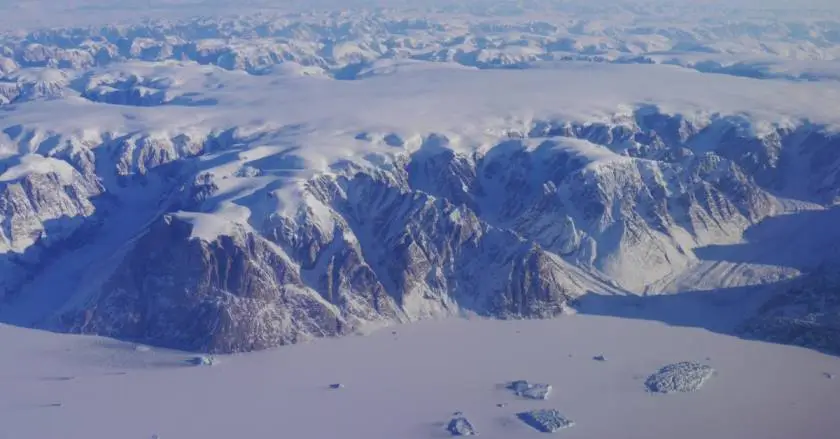
Renland ice cap in eastern Greenland as seen from the air. Image credit: Oregon State University / Lars Berg Larsen
- Reconstructions of Earth’s past climate show evidence for instability and abrupt change, which are of great scientific and societal importance.
- The Dansgaard–Oeschger (DO) oscillation of the last Ice Age, which is most clearly observed in Greenland ice cores, is the prime example of such instability.
- According to previous research, the Dansgaard-Oeschger cycle is caused by rapid on-off switching of the Atlantic Meridional Overturning Circulation, or AMOC, which circulates water throughout the Atlantic Ocean.
- In the study, researchers provide new ice-core observations from southern and coastal eastern Greenland and combine these with existing data to create a Greenland-wide, multiparameter assessment of the climate impact of DO events.
- State-of-the-art climate model simulations of these events provide good agreement with the data.
A recently published research from multiple ice cores collected from various regions of Greenland with 120 000 years of data gives a different viewpoint to the sudden climate tipping points.
Dansgaard-Oeschger is the event representing tipping points in Earth’s climate changes.
“It is really important to understand such tipping points in the climate, because they may result in catastrophic and irreversible change,” said the study’s lead author, Christo Buizert, associate professor in the College of Earth, Ocean and Atmospheric Sciences at Oregon State University.
The Dansgaard-Oeschger occurred more than 25 times in the last Ice Age, the reason given through previous research was that it is caused by on and off switching of the Atlantic Meridional Overturning Circulation (AMOC). The powerful Gulf Stream which carries warm tropical waters towards the North Atlantic is a part of AMOC.
“The AMOC is fundamentally unstable, and when it collapses, big things happen across the globe. There is significant cooling in Europe and around the North Atlantic, and the Indian and Asian monsoons fail. That instability was frequent during the last Ice Age. It is cause for concern for the future because climate models suggest the AMOC will likely weaken again under global warming, potentially impacting billions of people,” said Buizert.
Buizert and his colleague analyzed ice cores from Greenland to get a better understanding of Dansgaard-Oeschger’s impact on climate.

Scientists believed that sea ice from the Nordic Seas north of Iceland was involved in these events but the new research proposes that winter sea ice would have reached modern-day France and New York City which is much farther south, to 40 degrees latitude.
“The model shows that the Nordic Seas alone wouldn’t be big enough to drive a climate change event of this size. It just doesn’t pack enough of a punch,” said Buizert.
Over the last 11 700 years, AMOC has been manageable but the current climate conditions suggest that the AMOC will weaken again but for different reasons than what happened previously.
“We know the AMOC will weaken, but will it collapse? That is the big question. The weakening is likely gradual for the time being, but it could cross a tipping point and become a catalyst for abrupt climate change events like we saw in the past,” he said.
The National Science Foundation financed the research, which was conducted in partnership with scientists from five countries. The University of Copenhagen led the drilling of the Renland ice core in eastern Greenland, Denmark.
Some of the latest research papers highlight growing concerns about the state of the AMOC, a critical component of Earth’s climate system.
In a study published by Dipanjan Dey and international collaborators, the mixing of Atlantic and Arctic waters was identified as playing a vital role in maintaining the AMOC’s stability. The research emphasizes that disruptions in this mixing process could have far-reaching consequences for global climate patterns.
Another significant study, conducted by scientists from the National Centers for Environmental Information (NCEI) and the University of Maryland, revealed a substantial slowdown in AMOC, particularly over the past two decades. Published in Frontiers in Marine Science, the study analyzed over sixty years of oceanic data and raised alarms about the potential impacts this slowdown could have on weather systems and sea levels.
Further evidence comes from a report in Science Advances indicating that AMOC is nearing a tipping point, which could lead to its collapse if current trends continue.
Supporting these findings, a 2021 study pointed out that AMOC is currently at its weakest in over 1 000 years. This research raises concerns about the future trajectory of the system, which plays a key role in underpinning the Gulf Stream. Models from the study suggest that this weakening could trigger severe climate-related consequences, including shifts in weather patterns and rising sea levels.
References:
1 The Greenland spatial fingerprint of Dansgaard–Oeschger events in observations and models – Christo Buizert et al. – PNAS – October 21, 2024 – https://doi.org/10.1073/pnas.2402637121
2 New ice core data provides insight into climate ‘tipping points’ during the last Ice Age – OSU – October 21, 2024

The Watchers team and our contributors bring the latest on extreme weather, earthquakes, volcanic eruptions, space weather, and all things science. We're all about making sense of the natural world and keeping you informed on what’s happening. Got a tip or a question? Hit us up using the form at newstips!

THERE IS NO ACTION THAT CAN BE TAKEN TO PREVENT THE COLLAPSE OF THE AMOC: If you have any doubt about my arguments, that the man-made climate change is a political dogma based on a pseudoscience theory, then please read this article and make your own conclusion. Actually, this political dogma is becoming far worse than all the religious dogmas combined. Namely, all the massive changes that we are witnessing and experiencing are caused by the emission of carbon dioxide. In fact, our emission of carbon dioxide is blamed for events that happened many, many times for millions of years, like this Dansgaard- Oeschger event. So, I think you have to agree with me that this political dogma, has to be called THE RELIGION OF CARBON DIOXIDE. However, there is nothing that can be done to prevent the collapse of AMOC, because it is associated with the rapid change of earth’s magnetic field. At the present time, earth’s magnetic is in the rapid phase of changing and the AMOC will defenitely collapse during the final phase of reversal.