
Researchers uncover critical role of Atlantic-Arctic mixing in regulating AMOC
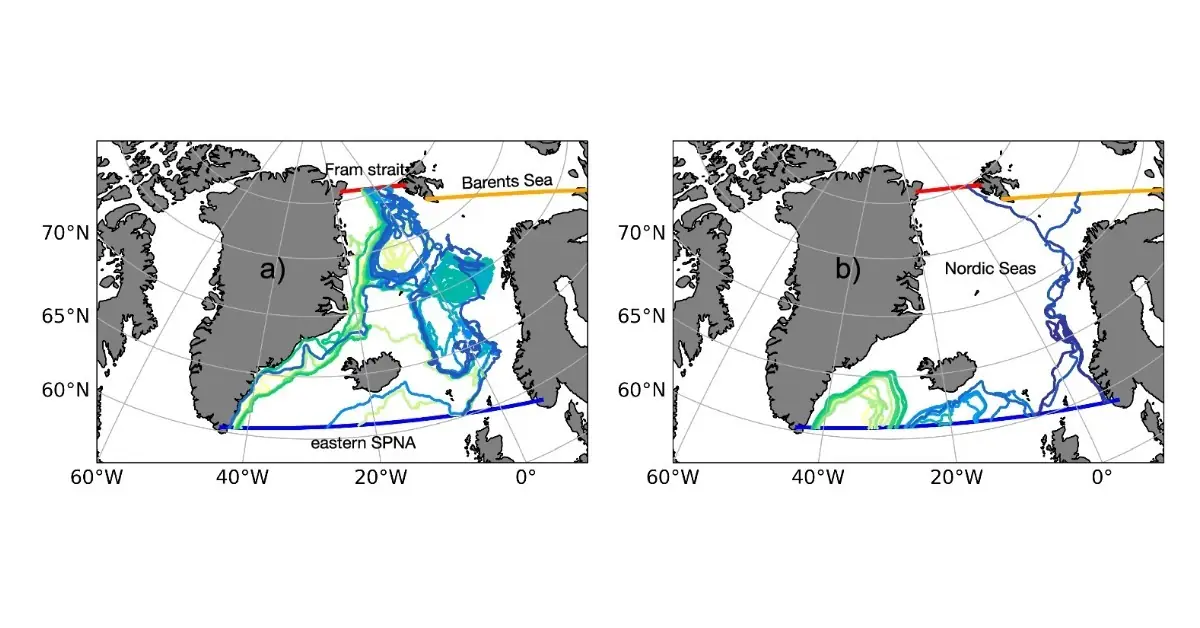
Image credit: Nature, Authors
A recent study led by Dipanjan Dey of the University of Southampton, in collaboration with international scientists, revealed the vital role that Atlantic and Arctic water mixing plays in maintaining the Atlantic Meridional Overturning Circulation (AMOC), an essential component of the global climate system.
- Researchers challenge previous assumptions that focused mainly on heat loss in specific areas without accounting for the critical role of Atlantic-Arctic water mixing.
- The study was conducted over several years and comes at a time when concerns about the stability of global ocean circulation networks have grown considerably.
A team of oceanographers and climate scientists led by Dipanjan Dey of the School of Ocean and Earth Science, University of Southampton, conducted a seminal study on the mixing of Atlantic and Arctic waters and its impact on global ocean circulation.
The study, published in Nature Communications, was conducted with international scientists from the National Oceanography Centre, Southampton, and the Department of Meteorology, Stockholm University, Stockholm. It aims to better understand how these water bodies interact and influence the Atlantic Meridional Overturning Circulation (AMOC), an essential component of the global climate system.
The study stressed the importance of mixing Atlantic and Arctic waters in maintaining the global ocean circulation system, which is necessary for climate regulation, and found that the interplay of these two bodies of water substantially impacts the AMOC, which is responsible for spreading heat and nutrients over the world’s oceans, influencing weather patterns and climatic stability.
The AMOC functions as a massive ocean conveyor belt, transporting warm water from the tropics northward and cold water southward, dispersing heat and nutrients throughout the world’s seas. This system is critical for preserving climate stability, particularly in Northern Europe, where it helps to regulate temperatures.
The study suggested that disturbances in this mixing mechanism could have far-reaching consequences, such as increased extreme weather occurrences and variations in global climate patterns.
“Comprised of 72% Atlantic waters and 28% Arctic waters, the density and depth of the AMOC lower limb is critically dependent on Atlantic-Arctic mixing, primarily in the vicinity of Denmark Strait. In contrast, Atlantic waters gaining density through air-sea interaction along the eastern periphery of Nordic Seas and not entering the Arctic Ocean make a negligible contribution to the lower limb,” the researchers stated.
The study concentrated on the Fram Strait, which lies between Greenland and Svalbard and is the principal link between the Arctic and North Atlantic. This region is essential for transferring water masses between the Arctic and Atlantic Oceans. The scientists extensively researched the strait, analyzing mixing processes and their impacts on the AMOC using advanced oceanographic tools and satellite data.
The study was conducted over several years and comes at a time when concerns about the stability of global ocean circulation networks have grown considerably.
Recent research suggested that the AMOC is diminishing, which might result in substantial climate alterations like colder winters in Europe and North America and disturbed monsoon patterns in the tropics.
Understanding the significance of Atlantic and Arctic water mixing is significant for forecasting the AMOC’s future behavior and its impact on the global climate. The study challenged previous assumptions that focused mainly on heat loss in specific areas without accounting for the critical role of Atlantic-Arctic water mixing.
To investigate the mixing mechanisms in the Fram and Denmark Straits, the research team used a mixture of field measurements, ocean data analysis from 1979 to 2021, and computer simulations. They used cutting-edge oceanographic gear, including autonomous underwater vehicles, to assess temperature, salinity, and current speeds at various depths.
The researchers also examined historical data and utilized climate models to estimate the effects of different mixing scenarios on the AMOC. According to the study, 33% of the change of warm, salty water into cooler, fresher, and denser water is caused by the mixing of Atlantic and Arctic seas, with the remaining 67% attributable to ocean-atmosphere interactions.
“Reduced sub-surface mixing of Atlantic waters is thus potentially the key to overall AMOC slowdown, further reducing the depth to which surface overturned Atlantic waters are returned southward. In summary, in a future weakened AMOC, the lower limb will likely shoal to shallower depths, as was apparent during the Last Glacial Maximum. Beyond the direct climate impacts of a weakened AMOC on poleward heat transport, a shoaled lower limb will further shorten timescales for carbon dioxide outgassing from the ocean to the atmosphere,” the researchers concluded.
References:
¹ Formation of the Atlantic Meridional Overturning Circulation lower limb is critically dependent on Atlantic-Arctic mixing – Dey, D., Marsh, R., Drijfhout, S. et al. – Nat Commun 15, 7341 (2024) – August 26, 2024 – https://doi.org/10.1038/s41467-024-51777-w – OPEN ACCESS
2 Study reveals crucial role of mixing Atlantic and Arctic waters in global ocean circulation – University of Southampton – August 28, 2024

Harsha Borah is an experienced content writer with a proven track record in the industry. Harsha has worked with LitSpark Solutions and Whateveryourdose, honing skills in creating engaging content across various platforms. A gold medalist in a state-level writing competition organized by Assam Tourism, Harsha’s travelogue on Tezpur was widely appreciated. Harsha’s article, "The Dark Tale of the Only Judge in India to Be Hanged," ranks second on Google and has garnered over 11 000 views and 8 900 reads on Medium. Outside of writing, Harsha enjoys reading books and solving jigsaw puzzles.

Commenting rules and guidelines
We value the thoughts and opinions of our readers and welcome healthy discussions on our website. In order to maintain a respectful and positive community, we ask that all commenters follow these rules.