
Ancient asteroid impact shifted Ganymede’s axis by 7 degrees, changing its geological history
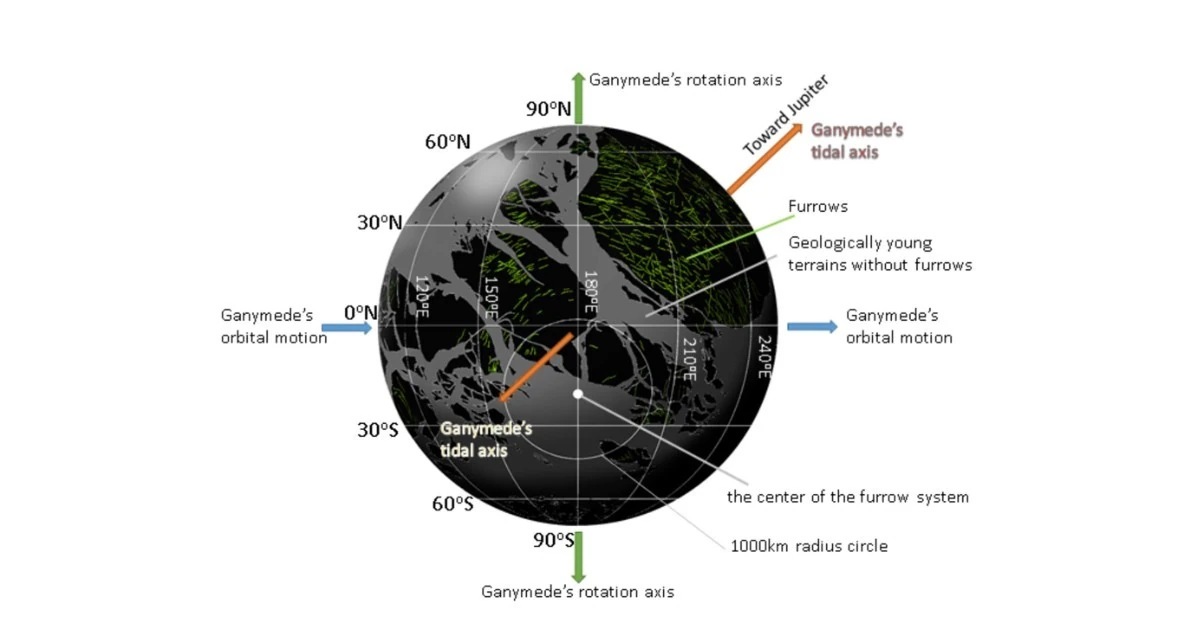
Image credit: Nature, Authors
A massive asteroid struck Ganymede, Jupiter’s and the Solar System’s largest moon, roughly 4 billion years ago, producing a significant shift in its rotational axis. This event, which formed the conspicuous Valhalla Basin, was so powerful that it shifted Ganymede’s axis about 7 degrees, changing the moon’s geological history.
- The discovery was important because it gave information about the early dynamics of the Solar System and the impact history of extraterrestrial bodies.
- The research combined data from previous missions with advanced simulations to investigate this event. Future missions like ESA’s JUICE will offer additional data, potentially revealing more about Ganymede’s past and its mysterious subsurface ocean.
A new research conducted by Naoyuki Hirata of the Graduate School of Science, Kobe University, discovered that a massive asteroid collision four billion years ago severely shifted the axis of Ganymede, Jupiter’s largest moon and the largest in the Solar System. This finding provides important information regarding the moon’s geological past and the early activities of our solar system. The research was published in the Journal Scientific Reports on September 03, 2024.
“Ganymede has an ancient impact structure called a furrow system. The furrow system is the largest impact structure in the outer solar system, and the impact should have significantly affected Ganymede’s early history; however, its effects are poorly understood. No attention has been given to the center of the furrow system coinciding with Ganymede’s tidal axis, indicating that mass redistribution induced by the furrow-forming impact caused a reorientation (true polar wander) of Ganymede. We propose that the impact ejecta created a mass anomaly that reoriented the impact site toward the tidal axis,” the researchers stated.
According to the findings, an asteroid with a diameter of 300 km (186 miles) collided with Ganymede, causing its entire axis to tilt nearly 7 degrees. The impact formed a temporary crater with a diameter of 1 400 to 1 600 km (870 to 994 miles), now known as the Valhalla Basin, a conspicuous feature on Ganymede’s surface with concentric rings.
According to Hirata’s study, the asteroid impact was so massive that it shifted the mass distribution within Ganymede, causing the rotational axis to reorient. This phenomenon is comparable to one observed on Pluto, where an impact-induced a shift in its axis, as discovered by NASA’s New Horizons spacecraft.
Ganymede’s axis shift occurred due to the massive energy released by the asteroid collision. The force was strong enough to alter the moon’s internal structure, causing it to rearrange its spin axis. This event impacted Ganymede’s geological evolution in the long term, changing its magnetic field and its subsurface ocean.
The axis shift occurred during the Late Heavy Bombardment period, characterized by frequent collisions between celestial bodies in the inner Solar System. This epoch was essential in altering the surfaces of planets and moons, leaving behind lasting geological traits.
The study combined data from previous missions, including NASA’s Galileo probe, with powerful computer calculations.
Hirata and his team rebuilt the collision and its aftermath, allowing them to calculate how the moon’s axis moved. This research also included determining the magnitude of the impactor and the subsequent crater, which helped to estimate the forces involved in this ancient event.
The discovery stressed the importance of continuing to explore Ganymede and the other moons of the Jupiter system. The next European Space Agency JUICE mission, scheduled to enter orbit around Ganymede in 2034, is expected to give further data that will help address remaining issues regarding the moon’s past and potential subsurface oceans.
“We predict that future explorations would reveal remnant topographic profiles or gravity anomalies associated with the furrow-forming impact and reorientation. Additionally, various possible explanations for the reorientation of Ganymede, such as an impactor-origin mascon beneath the basin or a thickness variation in the lithosphere, should be studied.,” the researchers stated.
References:
¹ Giant impact on early Ganymede and its subsequent reorientation – Hirata, N – Sci Rep 14, 19982 (2024) – September 03, 2024 – https://doi.org/10.1038/s41598-024-69914-2 – OPEN ACCESS

Harsha Borah is an experienced content writer with a proven track record in the industry. Harsha has worked with LitSpark Solutions and Whateveryourdose, honing skills in creating engaging content across various platforms. A gold medalist in a state-level writing competition organized by Assam Tourism, Harsha’s travelogue on Tezpur was widely appreciated. Harsha’s article, "The Dark Tale of the Only Judge in India to Be Hanged," ranks second on Google and has garnered over 11 000 views and 8 900 reads on Medium. Outside of writing, Harsha enjoys reading books and solving jigsaw puzzles.

Commenting rules and guidelines
We value the thoughts and opinions of our readers and welcome healthy discussions on our website. In order to maintain a respectful and positive community, we ask that all commenters follow these rules.