
Catastrophic floods hit Rio Grande do Sul, Brazil, leaving at least 83 dead, over 100 missing
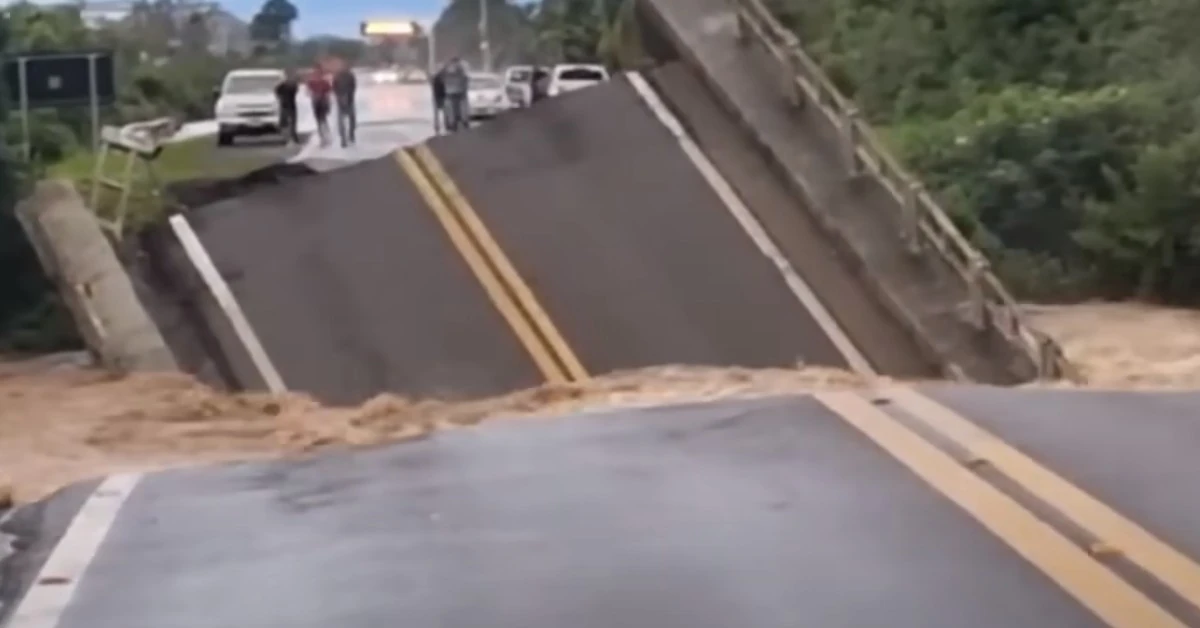
Image credit: Balanco Geral (stillshot)
A powerful atmospheric river has caused destructive flooding across Rio Grande do Sul, Brazil since Monday, April 29, 2024, leading to the deaths of at least 83 people, with more than 100 others missing. The state governor described the situation as the worst disaster in the state’s history.
In 96 hours to late afternoon (LT) on Tuesday, April 29, recorded rainfall amounts from various locations include 448 mm (17.6 inches) in Segredo, 410 mm (16.1 inches) in Lagoa Bonita do Sul, and 371 mm (14.6 inches) in Faxinal do Soturno. Greater Porto Alegre reported between 200 mm (7.9 inches) and 250 mm (9.8 inches).
The region typically experiences this magnitude of rainfall over two months.
“The numbers make it clear,” MetSul meteorologists said on April 30. “We are facing an exceptional rain event in Rio Grande do Sul, favored by an unusual climate situation in South America with an unusual hot air mass for this time of year over the states of Central Brazil.”

“What is already serious will get worse,” MetSul said.
“The scenario we see… without mincing words, is likely to evolve into an extremely serious one. Several cities must face a situation from calamity to disaster.
In places where it has already rained 200 mm to 400 mm [7.8 – 15.7 inches], data from numerical models indicate another 150 mm to 300 mm [5.9 – 11.8 inches] or more by Saturday.”
In a press conference on Wednesday, May 1, Governor Eduardo Leite described the floods as the worst disaster in the state’s history.
“We are experiencing in Rio Grande do Sul the worst moment, the worst disaster in our history. It is absolutely, absurdly, extraordinarily serious what is happening in Rio Grande do Sul right now,” Leite said. “And unfortunately, it will get worse.”
He expressed grave concerns about the situation worsening and confirmed his communication with President Luiz Inácio Lula da Silva, seeking federal assistance to manage what he referred to as akin to “facing a war.”
The state has seen a collapse of infrastructure, including bridges and roads, leading to several towns becoming isolated.
Governor Leite declared the suspension of educational activities across the state for the remainder of the week and sought substantial assistance from the Brazilian armed forces.
Numerous reports indicate widespread utility outages, including electricity and water supply disruptions. Additionally, the authorities have reported multiple incidents involving flooded roads and landslides.
Furthermore, the structural integrity of several bridges has been compromised, leading to more areas becoming inaccessible as rivers and streams have risen sharply beyond their banks.
On Wednesday, the state’s crisis Cabinet convened to prioritize and streamline the emergency responses. Vice-Governor Gabriel Souza emphasized that the primary goal was to rescue people trapped in isolated and island areas. The government’s coordinated efforts included handling over 130 rescue requests that were registered by Wednesday morning.
On May 3, the death toll rose from 10 to 21, and the number of missing from 21 to 60.
The crisis has affected 107 municipalities, impacting 19 110 people, as of May 2. Over 4 300 individuals have been displaced from their homes.
Rescue operations are ongoing, with the Brazilian Air Force deploying helicopters to reach those stranded in isolated areas.
Prior to the floods, the state government had already predicted severe flooding risks due to the continuous heavy rains.
Meteorologists warn of prolonged severe weather and potentially extending the crisis in Rio Grande do Sul and affecting neighboring regions.
As reported by MetSul meteorologists on May 1, the rains were brought by a persistent atmospheric river — an extended system of moisture that is expected to continue for several days, exacerbating the already extreme rainfall in the region.
This atmospheric river originates from a significant humidity corridor that transports vast amounts of moisture from the Amazon region across the interior of South America to the southern territories, including Rio Grande do Sul and Uruguay. This setup results in extraordinarily high precipitation levels over consecutive days.
Compounding the situation, a large mass of dry and hot air has settled over Central Brazil, creating an atmospheric blockage. This blockage channels the humid air from the Amazon and propels it southward, where it meets the hotter tropical air moving northward.
This interaction leads to a highly unstable atmosphere, characterized by intense and persistent rainfall, along with sporadic hail and gales.

Meteorological models indicate that this dynamic system will remain active over Rio Grande do Sul and Uruguay throughout much of the first week of May. The excessive moisture, coupled with the atmospheric conditions described, is expected to sustain the high volumes of rainfall, posing a continued threat of severe flooding across the region.
Atmospheric rivers are common phenomena in Brazil, typically originating in the Amazon. They form humidity corridors that frequently advance southward, impacting the southern parts of the country throughout the year. These corridors are particularly active during the warmer months in the Midwest and Southeast regions of Brazil.
Updates
05:38 UTC, May 5
On Saturday night (LT), May 4, provincial authorities reported the death toll reached 55 and the number of missing 74. In addition, more than 69 000 are displaced.
Heavy rains have affected nearly two-thirds of the 497 cities in the state, destroying roads and bridges and triggering landslides.
Additionally, a dam at a small hydroelectric power plant partially collapsed, and another dam in Bento Goncalves is at risk of failing. In Porto Alegre, the capital, Guaiba Lake overflowed, inundating streets and leading to the indefinite suspension of all flights at the city’s international airport.
In response to the devastation, State Governor Eduardo Leite stated that a recovery effort akin to the post-World War Two Marshall Plan is necessary to address the widespread damage.
Porto Alegre, 4 de maio de 2024
— Kelly Matos (@kellymatos) May 4, 2024
Chico Santana #ajudaRioGrande pic.twitter.com/CvhGJGHHi1
#Brasil Porto Alegre, capital de Río Grande del Sur, donde están viviendo las peores inundaciones de su historia, por el rápido ascenso de las aguas del Lago Guaíba. La cifra de víctimas aumentó a 56. Más de 24.000 personas han quedado sin hogar.
— Centinela35 (@Centinela_35) May 4, 2024
: Jonathas Costa pic.twitter.com/XavBoyuqzn
10:24 UTC, May 6
By early May 6, 2024, the storm affected 334 of the state’s 496 cities, including the capital Porto Alegre, claimed at least 75 lives, left over 100 people missing, and impacted more than 1 million residents. This severe weather event is described as the most disastrous in the state since 1941, surpassing previous records in terms of both scope and damage.
Full update at:
17:15 UTC, May 7
The death toll has increased to 83 and the number of missing to 111. 276 others have been injured, authorities reported on May 7.
The emergency and rescue activities are still ongoing.
References:
1 CHUVA NO RIO GRANDE DO SUL: MAIS CHUVA EXTREMA TORNARÁ SITUAÇÃO CRÍTICA – MetSul – April 30, 2024
2 RIO ATMOSFÉRICO PERSISTENTE PIORA SITUAÇÃO DA CHUVA NO RIO GRANDE DO SUL – MetSul – May 1, 2024
3 Heavy rains kill at least 10 in southern Brazil, governor warns of historic disaster – Reuters – May 1, 2024
4 Death toll from rains in southern Brazil climbs to 56 – Reuters – May 5, 2024

I'm a dedicated researcher, journalist, and editor at The Watchers. With over 20 years of experience in the media industry, I specialize in hard science news, focusing on extreme weather, seismic and volcanic activity, space weather, and astronomy, including near-Earth objects and planetary defense strategies. You can reach me at teo /at/ watchers.news.

Commenting rules and guidelines
We value the thoughts and opinions of our readers and welcome healthy discussions on our website. In order to maintain a respectful and positive community, we ask that all commenters follow these rules.