
Very strong and shallow M6.9 earthquake – northern Mid-Atlantic Ridge
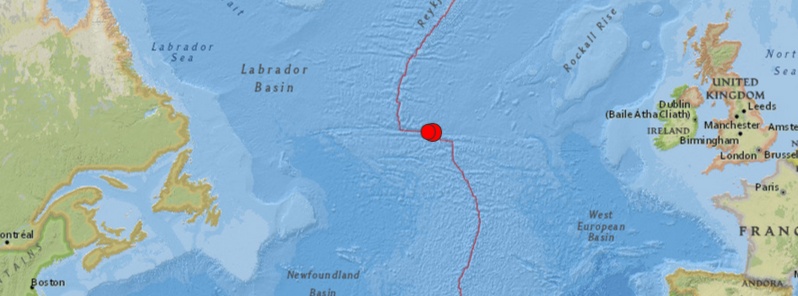
Image credit: USGS
A very strong and shallow M6.9 (USGS) earthquake was registered at Charlie-Gibbs Fracture Zone, northern Mid-Atlantic Ridge on February 13, 2015 at 18:59 UTC. USGS is reporting depth of 10 km (6.21 miles). EMSC is reporting M6.8 at a depth of 15 km (9.32 miles).
Epicenter was located 1 172 km (728 miles) SE of Nanortalik, Greenland and 1 401 km (871 miles) SSW of Hafnarfjordur, Iceland.
There are no people living within 100 km radius.

A destructive widespread tsunami threat does not exist based on historical earthquake and tsunami data.
However, there is small possibility of a local tsunami that could affect coasts located usually no more than a hundred kilometers from the epicenter, PTWC said.

From 18:48 to 19:33 UTC, USGS registered 4 earthquakes at this location:

Image credit: USGS
- 5.22015-02-13 19:33:10 UTC14.2 km
- 6.92015-02-13 18:59:11 UTC10.0 km
- 4.92015-02-13 18:58:06 UTC10.0 km
- 5.32015-02-13 18:48:16 UTC10.0 km

Teo Blašković founded The Watchers in 2011 and edited it until 2026, covering seismic and volcanic activity, extreme weather, space weather and near-Earth objects. Articles on this page are his archive.
Published in the last 24 hours
- High Risk of excessive rainfall covers Florida’s Space Coast as St. Johns River near Cocoa reaches 5.67 m
- Asteroid 2026 WJ to pass Earth at 1.7 lunar distances at 04:20 UTC on November 22, with 2026 WD following at 4.4 lunar distances on November 23
- Cyclone Akvan crossed the north Andhra Pradesh and south Odisha coasts close to Gopalpur on November 20 with 70-80 km/h winds gusting to 90, and has weakened into a deep depression
- A broad low over southeastern Florida and the northwestern Bahamas has a 30 percent chance of subtropical or tropical development within 48 hours and a 50 percent chance within 7 days, the National Hurricane Center says
