
Low solar activity with chances of unsettled to active conditions in the next 48 hours
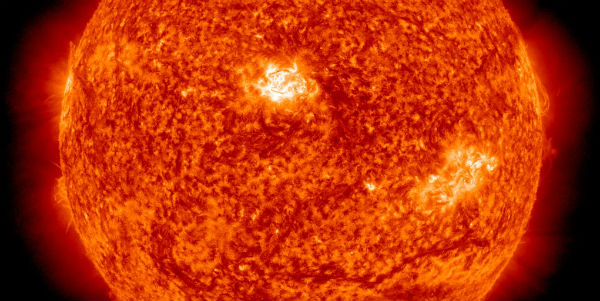
Image credit: Latest AIA 304 image ((Courtesy of NASA/SDO and the AIA, EVE, and HMI science teams))
Solar activity has been at low levels for the past 24 hours. There are currently three numbered sunspot regions on the disk – AR 1633 (Beta region), AR 1634 (Beta region) and AR 1635 (Beta-gamma region, Bright H-alpha). Sunspot 1635 could produce M-class solar flares. There are three new sunspots emerging from the east farside. NOAA/SWPC forecasters estimate low 5% chances of M-class events.
 Active regions seen by SDO’s AIA 304 (Courtesy of NASA/SDO and the AIA, EVE, and HMI science teams)
The geomagnetic field has been at quiet levels for the past 24 hours. ACE spacecraft measured solar wind speed of 350 km/s on December 22 at 21:59 UTC. Electrons greater than 2 MeV at geosynchronous orbit reached a peak level of 169 pfu. High speed solar wind stream emanated from a coronal hole visible at central meridian and some unsettled to active conditions are expected on December 26.
 Satellite environmental plot (NOAA/SWPC)
NOAA/SWPC forecasters estimate a 10% to 20% chance of polar geomagnetic storms on December 24 caused by corotating interaction region – a boundary between fast and slow-moving streams in the solar wind. It is expected that Earth will cross through that region on Christmas Eve.
 Latest GOES 15 imagery (NOAA/SWPC)

Published in the last 24 hours
- High Risk of excessive rainfall covers Florida’s Space Coast as St. Johns River near Cocoa reaches 5.67 m
- Asteroid 2026 WJ to pass Earth at 1.7 lunar distances at 04:20 UTC on November 22, with 2026 WD following at 4.4 lunar distances on November 23
- Cyclone Akvan crossed the north Andhra Pradesh and south Odisha coasts close to Gopalpur on November 20 with 70-80 km/h winds gusting to 90, and has weakened into a deep depression
- A broad low over southeastern Florida and the northwestern Bahamas has a 30 percent chance of subtropical or tropical development within 48 hours and a 50 percent chance within 7 days, the National Hurricane Center says
