
Several sunspots have popped up around the visible solar disk
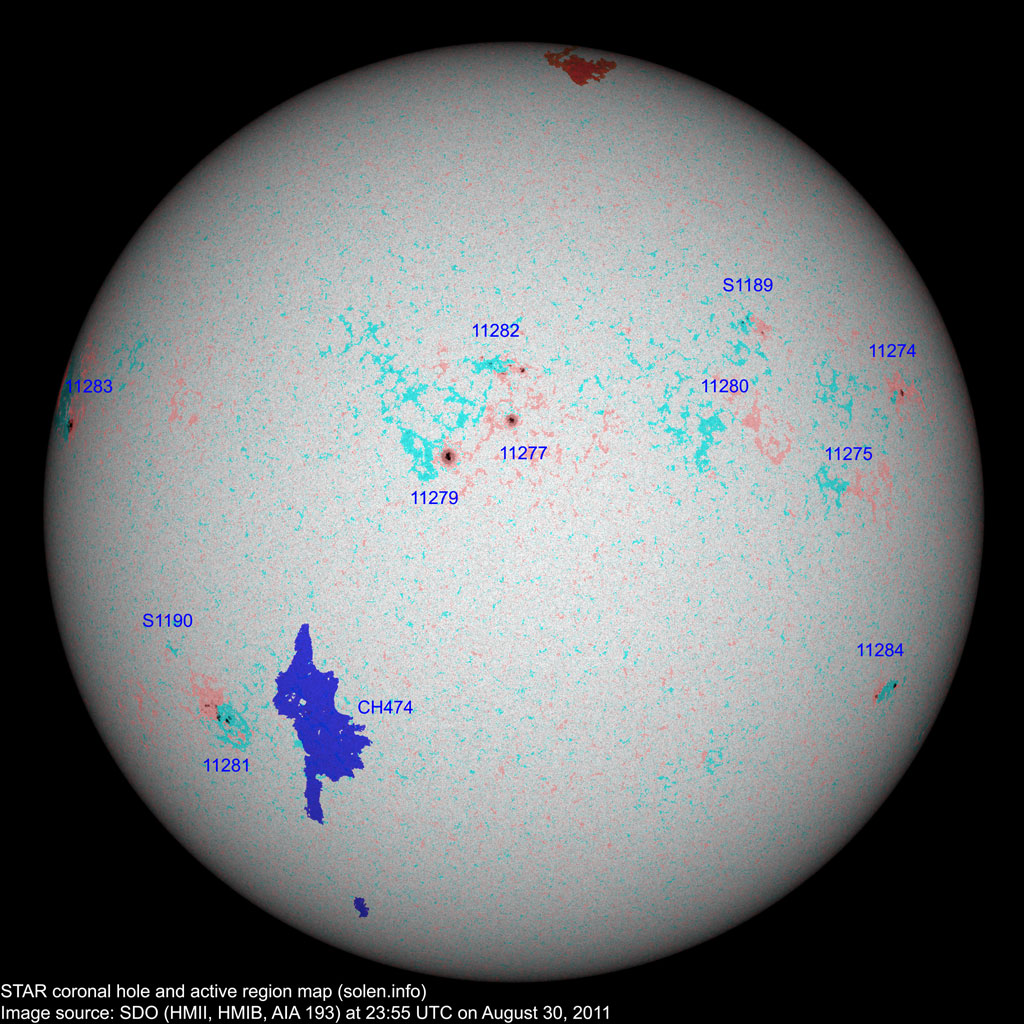
Image credit: TW
Sunspots are emerging at several locations around the solar disk, peppering the Earth-side of the sun with active regions. Of particular interest is fast-growing sunspot 1282, shown here in an August 31st snapshot from NASA’s Solar Dynamics Observatory:

AR1282 has increased in size more than ten-fold during the past 48 hours: movie. Moreover, the sunspot is near the center of the solar disk, so any flares from this active region today would likely be Earth-directed. (SpaceWeather)
Solar wind
speed: 346.5 km/sec
density: 0.3 protons/cm3
X-ray Solar Flares
6-hr max: B4 1617 UT Aug31
24-hr: C2 1124 UT Aug31
The Radio Sun
10.7 cm flux: 105 sfu
Planetary K-index
Now: Kp= 0 quiet
24-hr max: Kp= 1 quiet

Several sunspots have popped up all around the visible solar disk, including a fast growing Sunspot 1282 in the northern hemisphere. A C5.5 Flare took place around Sunspot 1281 located in the southern hemisphere. There will continue to be a chance for C-Class flares around several of these regions which all show some signs of growth. (SolarHam)

NOAA/SWPC Solar Report
Three new regions were numbered: 1282 (N24E01), 1283 (N12E71) and 1284 (S19W57); all of which were small and simply-structured. There were no Earth-directed CMEs observed during the period.
Solar activity is expected to be low through the period (31 August – 02 September).
Geomagnetic field activity was at mostly quiet levels with unsettled periods observed at high latitudes.
Geomagnetic field activity is expected to be at mostly quiet levels through the period (31 August – 02 September).

Published in the last 24 hours
- High Risk of excessive rainfall covers Florida’s Space Coast as St. Johns River near Cocoa reaches 5.67 m
- Asteroid 2026 WJ to pass Earth at 1.7 lunar distances at 04:20 UTC on November 22, with 2026 WD following at 4.4 lunar distances on November 23
- Cyclone Akvan crossed the north Andhra Pradesh and south Odisha coasts close to Gopalpur on November 20 with 70-80 km/h winds gusting to 90, and has weakened into a deep depression
- A broad low over southeastern Florida and the northwestern Bahamas has a 30 percent chance of subtropical or tropical development within 48 hours and a 50 percent chance within 7 days, the National Hurricane Center says
