
Solar Dynamics Observatoy (SDO) – Year 4
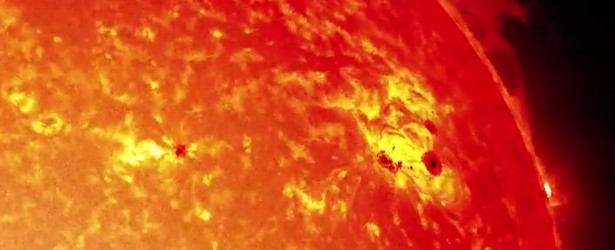
Image credit: TW
NASA's Solar Dynamics Observatory (SDO), launched on February 11, 2010, keeps a 24-hour eye on the entire disk of the Sun, with a prime view of the graceful dance of solar material coursing through the Sun's atmosphere, the corona. The following movie has some of SDO's best sightings of its 4th year, including massive solar explosions and giant sunspot shows.

SDO captures images of the Sun in 10 different wavelengths, each of which helps highlight a different temperature of solar material. Different temperatures can, in turn, show specific structures on the Sun such as solar flares, which are giant explosions of light and x-rays, or coronal loops, which are streams of solar material traveling up and down looping magnetic field lines.
The movie shows examples of both, as well as what's called prominence eruptions, when masses of solar material leap off the sun. The movie also shows a giant sunspot group on the solar surface. This sunspot, a magnetically strong and complex region appearing in mid-January 2014, was one of the largest in nine years.
Scientists study these images to better understand the complex electromagnetic system causing the constant movement on the sun, which can ultimately have an effect closer to Earth, too: Flares and another type of solar explosion called coronal mass ejections can sometimes disrupt technology in space. Moreover, studying our closest star is one way of learning about other stars in the galaxy.
Featured image and video credit: NASA Solar Dynamics Observatory

The Watchers team and our contributors bring the latest on extreme weather, earthquakes, volcanic eruptions, space weather, and all things science. We're all about making sense of the natural world and keeping you informed on what’s happening. Got a tip or a question? Hit us up using the form at newstips!
Published in the last 24 hours
- High Risk of excessive rainfall covers Florida’s Space Coast as St. Johns River near Cocoa reaches 5.67 m
- Asteroid 2026 WJ to pass Earth at 1.7 lunar distances at 04:20 UTC on November 22, with 2026 WD following at 4.4 lunar distances on November 23
- Cyclone Akvan crossed the north Andhra Pradesh and south Odisha coasts close to Gopalpur on November 20 with 70-80 km/h winds gusting to 90, and has weakened into a deep depression
- A broad low over southeastern Florida and the northwestern Bahamas has a 30 percent chance of subtropical or tropical development within 48 hours and a 50 percent chance within 7 days, the National Hurricane Center says
