
M9.3 and M7.7 solar flares erupt from AR 4455, launching Earth-directed CMEs
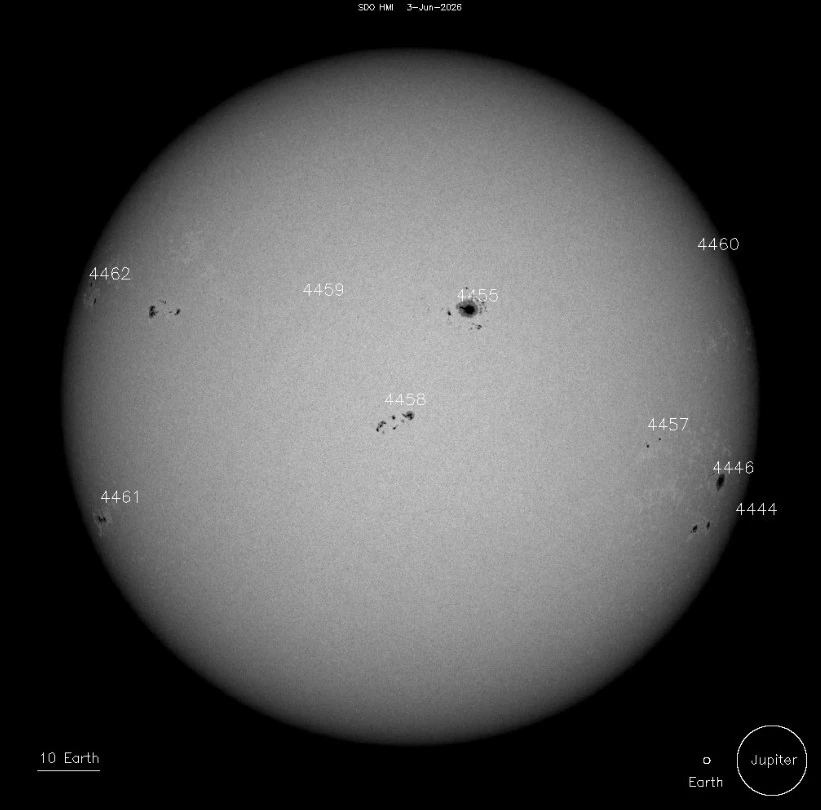
A strong solar flare measuring M9.3 at its peak erupted from Active Region 4455 at 01:36 UTC on June 3, 2026, producing an Earth-directed coronal mass ejection (CME). The event started at 01:22 UTC and ended at 01:43 UTC. At 07:00 UTC, another strong solar flare — M7.7 — erupted from the same region and produced another Earth-directed CME.

Coronal mass ejection produced by M7.7 solar flare on June 3, 2026. Credit: NASA/SDO, The Watchers
The flare originated from Region 4455, near the center disk in the Sun’s northern hemisphere, with a beta magnetic classification and an area of 300 millionths of the solar hemisphere. A coronal mass ejection (CME) was produced, and it’s heading our way.
“Direct Hit! The solar storm launched during the M9.3-flare is indeed Earth-directed,” space weather physicist Dr. Tamitha Skov said. “Since this is the second significant eruption from Region 4455 while in the Earth-strike zone, this means this second storm could get “held up” in “traffic” on its way to Earth.
“The NASA solar storm prediction shows the second storm arrival by late June 4. However, the first storm will precede this, so expect some impact starting around mid-day June 4 with the stronger storm arriving close behind,” Skov said.
Direct Hit! The solar storm launched during the M9.3-flare is indeed Earth-directed! Since this is the second significant eruption from Region 4455 while in the Earth-strike zone, this means this second storm could get "held up" in "traffic" on its way to Earth. The NASA solar… pic.twitter.com/0zFptEpITJ
— Dr. Tamitha Skov (@TamithaSkov) June 3, 2026
Radio frequencies were forecast to be most degraded over the Pacific Ocean at the time of the flare.
SWPC said a particle event from the flare was unlikely because of the source location, but retained a 3% chance late in the UTC day on June 3.


The M9.3 flare was followed by another strong flare, this time measuring M7.7 and peaking at 07:00 UTC. Review of SDO imagery revealed a major CME. With the region in Earth-strike zone — another CME seems to be heading toward us. This flare began at 06:48 UTC and ended at 07:07 UTC.
At the time of the second flare, radio frequencies were forecast to be most degraded over Asia.

Solar activity was at moderate levels in 24 hours to 00:30 UTC on June 3. SWPC reported frequent C-class flares and three separate M-class flares, with the largest earlier event an M3.3 flare from Region 4455 at 16:42 UTC on June 2. That flare produced wideband radio emissions, including a 10 cm radio burst peaking at 150 pfu and a Type II radio burst with an estimated shock velocity of 631 km/s.
SWPC forecasts low to moderate solar activity through June 5, with a 50% chance of R1–R2 Minor to Moderate radio blackout activity each day and a 10% chance of R3 Strong or greater activity each day. Additional flare potential was tied mainly to Regions 4455, 4458, 4461, and 4462.
Solar radiation storm conditions remained below NOAA S-scale thresholds, and SWPC’s 3-Day Forecast shows a 5% chance of S1 – Minor or greater radiation storm levels each day from June 3 through June 5. The greater than 10 MeV proton flux remained at background levels in the latest SWPC discussion.
The geomagnetic field was at quiet levels over the past 24 hours, but this will change in the days ahead. Further updates will follow as analysis of both flares is completed.

Teo Blašković founded The Watchers in 2011 and edited it until 2026, covering seismic and volcanic activity, extreme weather, space weather and near-Earth objects. Articles on this page are his archive.
Published in the last 24 hours
- In 1943, a flight instructor in Texas flew a two-seat training plane into the eye of a hurricane because he was curious, then landed and took the base weatherman up for a second pass Epicenter
- A soy sauce maker used fire to guide villagers through Japan’s 1854 tsunami, then funded a seawall that protected most of Hiro in 1946 Epicenter
- In 2013 a landslide fell onto Svínafellsjökull in southeast Iceland, leaving thicker ice at the foot of the slope; that ice is now moving away and the mountainside has shifted 1 to 3 cm. Epicenter
- Kīlauea's north vent threw lava about 660 feet (200 m) high for six hours on 5 November 2026; the summit is now reinflating, with the next episode forecast for 16 to 21 November. Epicenter
