
Sonic boom rattles South Carolina Midlands, USGS logs M0.0 event near Saint Andrews
Residents across the South Carolina Midlands reported a loud boom and brief shaking late Thursday afternoon, May 28, 2026. The U.S. Geological Survey (USGS) later logged the event as an ‘M0.0 sonic boom’ near Saint Andrews, South Carolina.
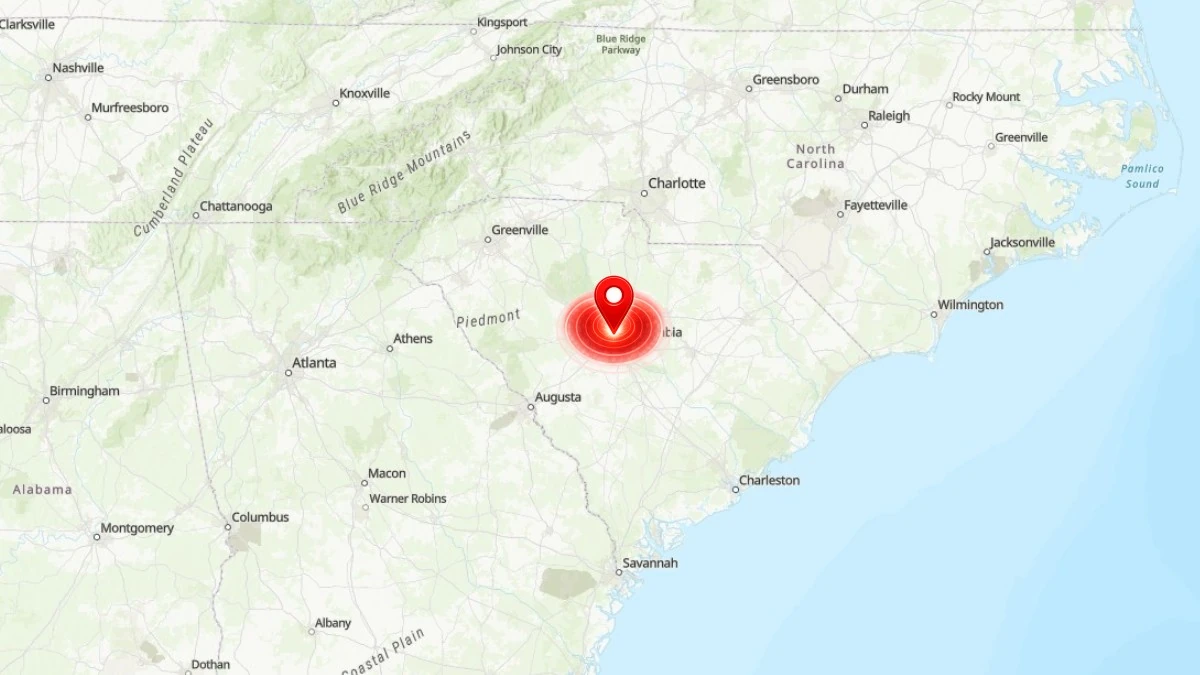
Map showing the location of the M0.0 sonic boom event reported by USGS near Saint Andrews, South Carolina. Credit: TW/SAM, ESRI
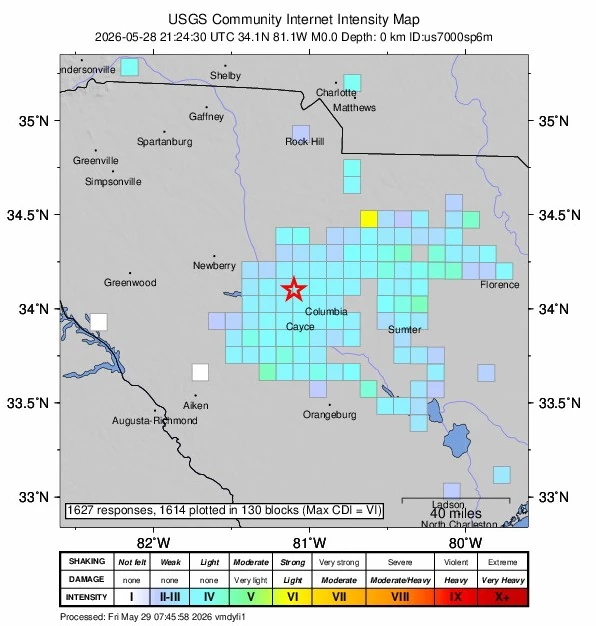
Residents near Columbia and across surrounding Midlands communities reported an explosion-like sound and brief shaking strong enough to rattle homes and windows at about 17:24 EDT (21:24 UTC) on May 28. Local media said the event was heard and widely felt across the Midlands, leading some residents to question whether an earthquake had struck the region.
USGS later attributed the reports to an atmospheric source rather than seismic activity and logged it as “M 0.0 Sonic Boom – 6 km NNE of Saint Andrews, South Carolina.”
“This event is not an earthquake,” USGS seismologists said. “The recorded waves and eyewitness reports are consistent with a sonic boom. Because earthquake magnitude scales are calibrated for seismic waves that travel through the Earth, our standard magnitude calculation methods do not apply to sonic booms.”
“Therefore, we manually assigned a magnitude of 0.0. Given that the source of a sonic boom is moving, the location and origin time are also approximate and are based on the arrival times of the sound waves at seismic stations, as well as the locations of eyewitness reports.”
Some social media users speculated that the boom may have been linked to a Blue Origin incident in Florida. However, timing does not support that explanation. The Blue Origin New Glenn test anomaly at Cape Canaveral Space Force Station took place at about 21:00 EDT (01:00 UTC on May 29), roughly 3.5 to 4 hours after the loud boom reported across the South Carolina Midlands.
The event produced no confirmed injuries, structural damage, emergency declarations, or operational disruptions, and authorities had not publicly identified the source. The American Meteor Society (AMS) had not logged any fireball reports matching the timing and location of the event.
While the source of the sonic boom has not been publicly identified, the event was most consistent with aircraft-related activity, based on its short duration, widespread felt reports, and USGS classification as a sonic boom.
The Columbia metropolitan area lies near several military aviation facilities, including McEntire Joint National Guard Base and Shaw Air Force Base, both of which support F-16 fighter operations capable of supersonic flight. Authorities, however, had not publicly linked the event to aircraft activity as of publication.
Sonic booms from aircraft, meteors, or other atmospheric sources can generate short-lived pressure waves capable of rattling windows and briefly shaking buildings, producing sensations that residents sometimes mistake for seismic activity.
References:
1 M 0.0 Sonic Boom – 6 km NNE of Saint Andrews, South Carolina – USGS – May 28, 2026

I'm a dedicated researcher, journalist, and editor at The Watchers. With over 20 years of experience in the media industry, I specialize in hard science news, focusing on extreme weather, seismic and volcanic activity, space weather, and astronomy, including near-Earth objects and planetary defense strategies. You can reach me at teo /at/ watchers.news.

I felt it in Columbia, SC. Was sitting at a red light on the phone with my wife, she was about 3 miles away and she felt/heard it about 3 seconds before I did. Felt like an explosion, sounded like an explosion, there was a shock wave. Heck of an experience.
I was reminded of your article, “Extensive AMS analysis of Q1 2026 fireball surge raises questions about the near-Earth meteoroid environment” back in March. I would love an update to this in the future.