
Rare tornado touches down near Devipur in Akhnoor, Jammu and Kashmir
A rare tornado was reported near Devipur in the Akhnoor area of Jammu district, Jammu and Kashmir, India, on April 11, 2026, during scattered afternoon thundershowers. Eyewitness videos showed a narrow funnel extending from the cloud base to a rotating dust plume at the surface, while preliminary reports indicated no damage, injuries, or casualties. Faizan Arif, a Kashmir-based weather analyst, described the Akhnoor tornado as a “never-before-witnessed” event in Jammu’s Akhnoor area.
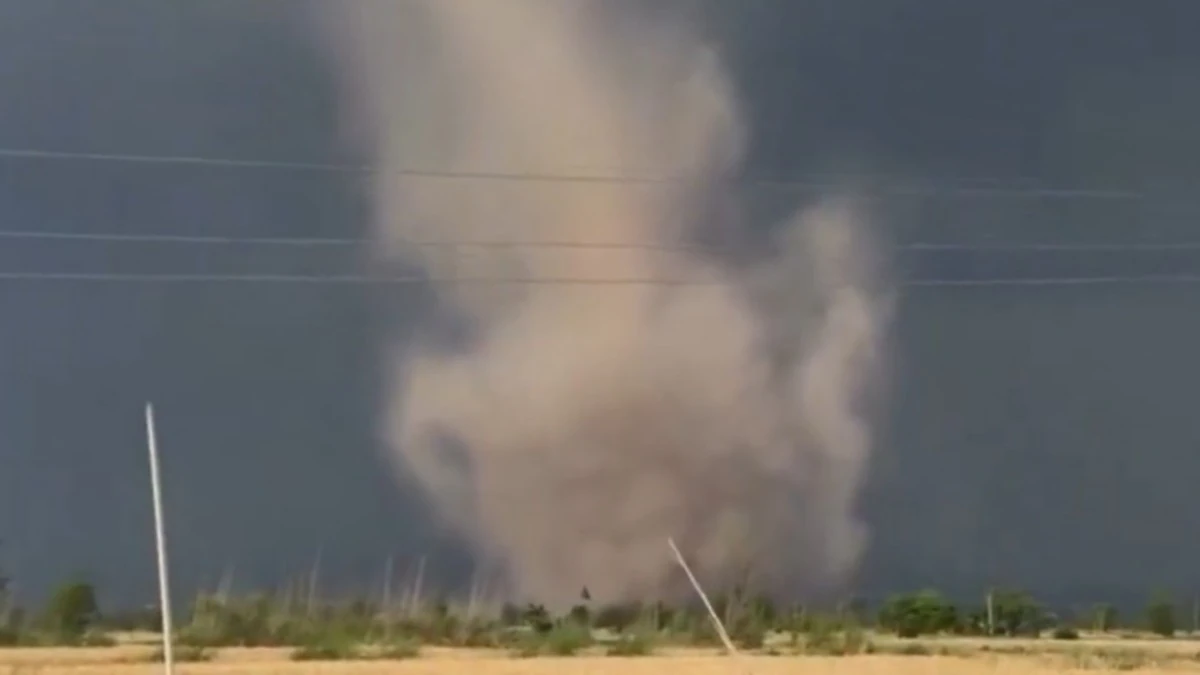
Tornado in Devipur, Akhnoor, Jammu and Kashmir, India on April 11, 2026. Credit: Arab Storms
Eyewitness videos from the area showed a narrow condensation funnel extending from a dark convective cloud base to a rotating dust plume at the surface over open agricultural fields.
The tornado remained visible for about 10 minutes, according to local reports. Despite the clearly defined vortex, no damage to homes, power infrastructure, or crops had been reported as of 16:17 UTC, and no injuries or casualties were recorded.
Multiple videos circulating online showed the vortex moving across rural land near utility poles and wheat fields. The footage showed a vertically continuous funnel and a concentrated surface circulation lofting dust and debris, consistent with a brief tornado or landspout-type vortex.
Faizan Arif, a Kashmir-based weather analyst with degrees in applied physics and journalism who runs Kashmir Weather, described the event as highly unusual. “In a never-before-witnessed event, a tornado was reported in Jammu’s Akhnoor area,” Arif said.
In a post-event analysis issued about three hours after the tornado, Arif said Doppler weather radar data did not show signs of ongoing organized rotation within a 100 km (62 miles) radius of Akhnoor.
According to the analysis, radial velocity scans did not show a tight inbound–outbound couplet typically associated with mesocyclonic circulation, while vertical wind profiles showed weak and inconsistent wind shear.
His assessment suggests the tornado was likely brief and localized, with limited potential for redevelopment later in the day. Arif also said surface cooling after the event reduced atmospheric instability, lowering the risk of additional tornadic development.
The India Meteorological Department forecast scattered rain and thundershowers for parts of Jammu and Kashmir on April 11. While convective instability was present, no official storm survey or formal classification had been issued at the time of press.

Teo Blašković founded The Watchers in 2011 and edited it until 2026, covering seismic and volcanic activity, extreme weather, space weather and near-Earth objects. Articles on this page are his archive.
Published in the last 24 hours
- Scientists directly observe how submarine landslides unfold in western Canada Epicenter
- Odisha evacuated 983,642 people before Phailin crossed near Gopalpur on 12 October 2013 with winds of 200-210 km/h gusting to 220, and 44 died, against 9,885 in the 1999 super cyclone. Cyclone Akvan crossed the same coast on 20 November 2026. Epicenter
- Lava fountains reached 1,900 feet (580 m) at Kīlauea Iki in 1959, the highest ever recorded at Kīlauea, as USGS forecasts episode 57 fountaining at Halemaʻumaʻu for November 22-26. Epicenter
- Novarupta in Alaska erupted about 3 cubic miles of magma in roughly 60 hours from 6 June 1912, 30 times Mount St. Helens in 1980, and strong northwesterly winds lifted that same loose ash on 16 November 2026, prompting an NWS SIGMET. Epicenter
