
Small meteotsunami observed across North Island coasts, New Zealand
A small meteotsunami was observed along New Zealand’s East Coast and Lake Taupō last week as a strong weather system swept across the upper North Island, GeoNet reported on December 8, 2025.

Image credit: Ted Buddy
Unusual sea-level disturbances recorded by tsunami gauges along New Zealand’s East Coast and in Lake Taupō last week have been confirmed as a small meteotsunami, according to GeoNet’s National Geohazards Monitoring Centre (NGMC).
GeoNet instruments at Napier, Castlepoint, Gisborne, and Lake Taupō detected the largest wave oscillation at 25 cm (10 inches) in Napier.
Analysis of de-tided sea-level data, where tidal effects are mathematically removed, showed a clear disturbance around 18:00 UTC on December 2 (07:00 NZDT on December 3) at Napier and an earlier disruption around 15:00 UTC on December 2 (04:00 NZDT, December 3) at Lake Taupō, suggesting the disturbance moved southeastward through the region.
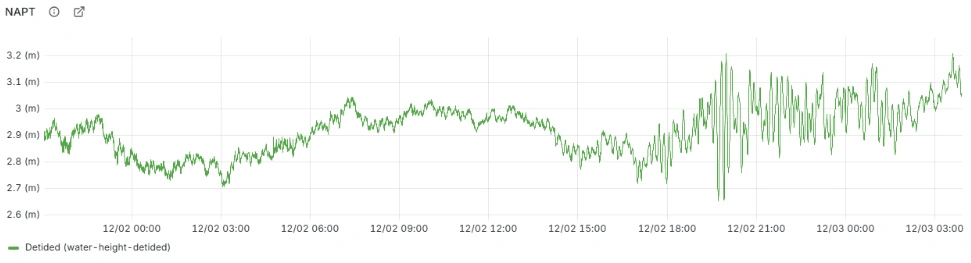
The event occurred as a powerful weather front crossed the upper North Island, producing atmospheric pressure changes strong enough to generate long ocean waves.
“From Tuesday afternoon and right through Wednesday we have seen waves of active thunderstorms moving across the upper North Island. This included offshore from Coromandel early Wednesday morning and it’s almost certain that the minor tsunami activity detected nearby is related,” said Meteorologist Chris Brandolino from Earth Sciences NZ.
Unlike tsunami’s caused by earthquakes, a meteotsunami–short for meteorological tsunami–is triggered by rapid changes in air pressure from fast-moving weather systems such as thunderstorms or squall lines.
When the speed of the pressure disturbance matches the natural wave speed of the water below, the resulting resonance amplifies wave heights, particularly in coastal areas with bays, shelves, or inlets. This produces waves that are much larger than normal, which we call a meteotsunami.
Meteotsunamis are much smaller than quake-triggered tsunamis, but act similarly to them. These small tsunamis may not carry large volumes of water along with debris and can generate strong localized currents. While not powerful enough to sweep people or structures on shore like quake-tsunamis, they do pose a significant threat to people and boats in water.
GeoNet described the event as a reminder of the diverse mechanisms capable of producing tsunami in New Zealand, including earthquakes, submarine landslides, volcanic activity, and meteorological disturbances, and underscored the importance of continuous monitoring and expert analysis in identifying and understanding such events quickly.

I am an Assistant Editor and Severe Weather & Science Journalist at The Watchers, specializing in real-time severe weather coverage, geophysical event reporting, and research-driven scientific analysis. You can reach me at rishav(at)watchers(.)news.

Commenting rules and guidelines
We value the thoughts and opinions of our readers and welcome healthy discussions on our website. In order to maintain a respectful and positive community, we ask that all commenters follow these rules.