
Lava overflow observed at Stromboli’s northern crater area, Italy
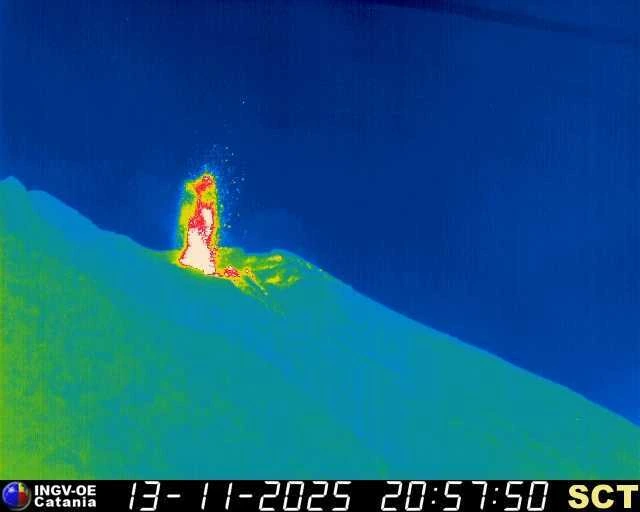
A lava overflow began from Stromboli’s northern crater area on November 13, 2025, sending a confined lava flow down the upper Sciara del Fuoco.

Image credit: INGV
A lava overflow began on Stromboli’s northern crater area at approximately 19:30 UTC on November 13, according to the National Institute of Geophysics and Volcanology (INGV), Etna Observatory. Camera surveillance shows the overflow feeding a lava flow confined to the upper sector of the Sciara del Fuoco.
The northern crater area is currently producing modest but continuous spattering from at least two active vents. Explosive activity persists at the southern crater area with no notable changes reported.
Seismic monitoring indicates that the average amplitude of volcanic tremor remains at medium levels. INGV reports no significant variations in the rate or amplitude of explosion quakes.
Ground deformation networks similarly show no meaningful changes, suggesting the activity is consistent with the ongoing eruptive dynamics.
Stromboli is known for persistent incandescent explosive activity that is frequently visible at night, earning it the informal name “Lighthouse of the Mediterranean.” The volcano forms the northeastern sector of the Aeolian Islands and represents the emergent summit of a stratovolcano constructed in two main eruptive cycles. The younger cycle produced the western part of the island.
The Neostromboli eruptive phase occurred between approximately 13 000 and 5 000 years ago. The active summit vents are situated at the head of the Sciara del Fuoco, a prominent collapse scarp formed about 5 000 years ago by a series of slope failures that extend below sea level.
The modern edifice has developed within this scarp, which channels pyroclastic material and lava flows toward the NW sector of the island.
Mild Strombolian explosions, occasionally accompanied by lava effusion, have been essentially continuous for more than 1 000 years.

I am an Assistant Editor and Severe Weather & Science Journalist at The Watchers, specializing in real-time severe weather coverage, geophysical event reporting, and research-driven scientific analysis. You can reach me at rishav(at)watchers(.)news.

Commenting rules and guidelines
We value the thoughts and opinions of our readers and welcome healthy discussions on our website. In order to maintain a respectful and positive community, we ask that all commenters follow these rules.